




















































International Tea Day: Tea production rises, but exports continue to lose ground
International Tea Day: Tea production rises, but exports continue to lose ground

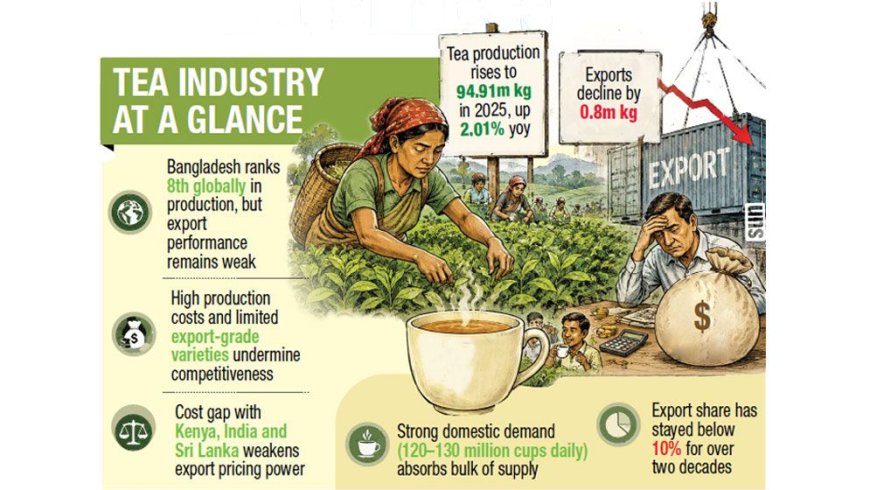
The country’s gradual rise in tea production has failed to make a meaningful impact on exports, largely because producers remain heavily dependent on the domestic market and are reluctant to cultivate improved tea varieties.
According to the state-run Bangladesh Tea Board (BTB), the country produced 9.49 crore kilograms (kg) of tea in 2025, an increase of 18.7 lakh kg, or 2.01%, compared to 2024.
Despite higher production, Bangladesh saw a sharp decline in tea exports during the same period, with exports dropping by around 8.1 lakh kg.
Industry insiders say the continued fall in exports reflects the lack of a strong export-oriented strategy among tea producers, despite rising output.
“We are falling behind in tea exports mainly for two reasons. First, tea production costs in Bangladesh are much higher than in many other tea-producing countries. Second, the type of tea we produce does not meet international market demand,” said Tahsin Ahmed Chowdhury.
He noted that Bangladesh mainly exports black tea, while many competing countries focus on orthodox tea. “Our tea producers need to be more courageous,” he said.
Tahsin also pointed out that Bangladesh would need to lower tea prices significantly to compete globally, which is difficult because costs for electricity, fuel, fertiliser, pesticides and workers’ wages have risen sharply.
Bangladesh currently ranks eighth among tea-producing nations. China leads global tea production, followed by India, Kenya, Sri Lanka, Turkey, Vietnam, Indonesia, while Uganda and Argentina rank ninth and tenth respectively.
Tahsin said Kenya produces around 4,000 kg of tea per hectare on average, compared to only about 1,500 kg in Bangladesh, allowing competitors to offer tea at much lower prices.
BTB data shows Bangladesh produced 3.14 crore kg of tea in 1970. Production rose to 5.31 crore kg by 2001, when exports reached 1.29 crore kg and earned Tk894 crore.
Although tea exports declined in 2008, foreign exchange earnings increased due to higher-quality tea exports. That year, Bangladesh produced 5.86 crore kg of tea and exported 83.9 lakh kg, earning Tk97.69 crore in foreign exchange.
In 2023, Bangladesh achieved record tea production of 10.29 crore kg. However, despite the milestone, exports stood at only 10.4 lakh kg, generating Tk27.25 crore.
Over the past two decades, tea exports have dropped to below 10% of total production as domestic demand has surged. Bangladeshis now consume around 12 crore to 13 crore cups of tea daily.
Shah Moinuddin Hasan said economic growth and urbanisation have increased the number of tea consumers in the country.
“Domestic demand is growing almost as fast as production. As tea fetches better prices locally than internationally, producers are becoming less interested in exports,” he said.
The introduction of a minimum floor price in tea auctions has further encouraged producers to focus on the domestic market. Since the system was introduced in 2024, BTB has regularly increased the minimum price. As a result, tea prices in the ongoing 2025–26 auction season are Tk25 to Tk40 higher per kg than the previous season.
Kamran Tanvirur Rahman said Bangladesh once exported tea in large quantities, but the industry is now almost entirely dependent on the local market.
“We are now producing nearly one crore kg of surplus tea. Very little tea is left for export,” he said.
He explained that Bangladesh used to produce orthodox tea until the 1980s, but shifted towards CTC (Crush, Tear, Curl) or black tea to meet growing domestic demand.
“If we want to return to orthodox tea production, factories will need major changes. Given the high production costs, I do not think many producers are willing to invest for exports,” he added.
However, demand for premium-quality tea is also growing in the domestic market, with many companies importing orthodox tea to meet consumer demand.
BTB Chairman Maj Gen Md Mesbah Uddin Ahmed acknowledged the challenges and said both the government and tea producers are working to address them.
“We are trying to reduce production costs and bring them closer to those in countries like Kenya, India and Sri Lanka,” he said.
He added that the government also aims to further increase production, as around 95% of total tea output is consumed locally. Efforts are underway to improve black tea quality while also exploring orthodox and green tea production for international markets.
The chairman said these initiatives would also help meet growing domestic demand for premium tea.
Annual tea demand in Bangladesh now exceeds nine crore kg. In the latest season, the country’s 172 tea gardens produced 9.49 crore kg of tea, while BTB has set a target of 10.4 crore kg for the current season.
Bangladesh has 169 tea gardens covering more than 2.80 lakh acres of land. Of them, 90 gardens are located in Moulvibazar, accounting for around 55% of total tea production. Another district in the Sylhet region, Habiganj, contributes nearly 22% of the country’s output.
What's Your Reaction?