






















































“Anti-business culture” emerges as a major obstacle to industrial expansion and investor confidence
Economists say the challenges are structural in nature and cannot be attributed to any single policy failure.

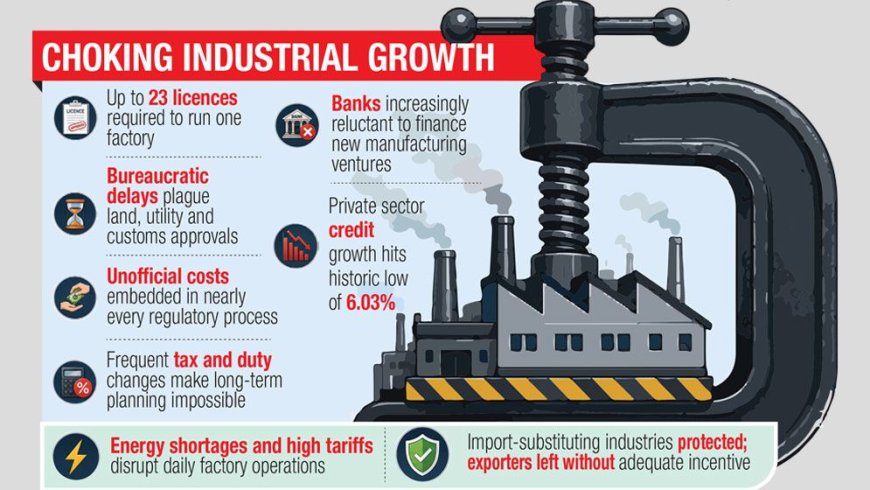
Local industries are reeling under what business leaders and economists describe as an “anti-business culture” — a toxic mix of bureaucratic overreach, regulatory disorder and soaring costs that is steadily choking investment and industrial growth.
The warning signs are becoming increasingly difficult to ignore.
Nearly 400 garment factories have shut down over the past three years, while around 65 accessories and packaging units have closed since June 2025 alone.
At the same time, private sector credit growth has fallen to a record low of 6.03%, with entrepreneurs — particularly small and medium-sized business owners — saying the system is becoming increasingly hostile to enterprise.
“To expand industries and grow the economy, we must create more entrepreneurs. But the current trade licence system remains a major barrier for new entrepreneurs,” said Abul Kasem Khan, former president of the Dhaka Chamber of Commerce and Industry and vice chairman of AK Khan & Company.
He proposed introducing a single unified licence alongside a five-year tax exemption for young entrepreneurs, arguing that renewing a trade licence should be as simple as paying a utility bill.
Kasem, who also chairs Business Initiative Leading Development, noted that manufacturers currently need as many as 23 separate licences to operate — a burden he described as indefensible.
“Deregulation is the most effective way to shrink the grey economy and bring businesses into the formal sector,” he said, pointing out that nearly half of the country’s economy remains informal.
BUILD plans to organise a policy summit later this year to outline private sector priorities for achieving a trillion-dollar economy.
Industry stakeholders say the problems extend across nearly every stage of doing business, from land approvals and utility connections to environmental clearances, customs processing and tax compliance — all of which are often delayed and riddled with unofficial costs.
Meanwhile, high interest rates, rising non-performing loans and banks’ growing reluctance to finance new manufacturing projects are intensifying the pressure.
In the garments accessories and packaging sector, Bangladesh Garment Accessories and Packaging Manufacturers and Exporters Association president Md Shahriar said the closure of 65 factories reflects a severe liquidity crisis, worsened by delays in back-to-back letter-of-credit payments and the restructuring of several Islamic banks.
“Expansion has completely stalled,” he said.
The country’s flagship garment industry is also under mounting strain.
Bangladesh Garment Manufacturers and Exporters Association president Mahmud Hasan Khan pointed to an acute energy crisis, rising input costs — partly driven by geopolitical tensions in the Middle East — and inconsistent policymaking as major structural risks. Infrastructure bottlenecks and rising logistics expenses are adding to the pressure.
Bangladesh Chamber of Industries President Anwar-ul Alam Chowdhury Parvez said the roots of the crisis run deep.
Working capital shortages that began during the COVID-19 pandemic were later compounded by gas supply disruptions, currency depreciation and weak demand, pushing many firms towards loan default classification.
He urged Bangladesh Bank to restructure working capital facilities, convert overdue LC liabilities into long-term subsidised loans, and reduce lending rates to a more sustainable 11%–12%.
Economists say the challenges are structural and extend far beyond any single policy failure.
Dr Zaidi Sattar, chairman of the Policy Research Institute of Bangladesh, identified what he called an “anti-export bias” embedded within industrial policy. He argued that import-substituting industries receive far greater protection than exporters receive in incentives, contributing to stagnation in non-garment export sectors.
Currency depreciation and existing tariff structures, he added, have further increased import costs and weakened competitiveness.
Dr M Masrur Reaz, chairman of Policy Exchange Bangladesh, called for a coordinated export-led growth strategy integrating trade, investment, tax and industrial policies.
“Relying on high tariff protection is not a strategy,” he said, stressing the need for stronger institutional coordination with investment growth, consumer welfare and export diversification placed at the centre of policymaking.
Experts across the board are now calling for sweeping institutional reforms, including an independent commercial judiciary, full digitisation of licensing, taxation, customs and land management systems, strict deadlines for regulatory approvals, reduced discretionary powers for officials, and stronger accountability mechanisms.
What's Your Reaction?