


















































Bangladesh plans record deficit budget amid mounting debt and soaring interest costs
Bangladesh plans record deficit budget amid mounting debt and soaring interest costs.

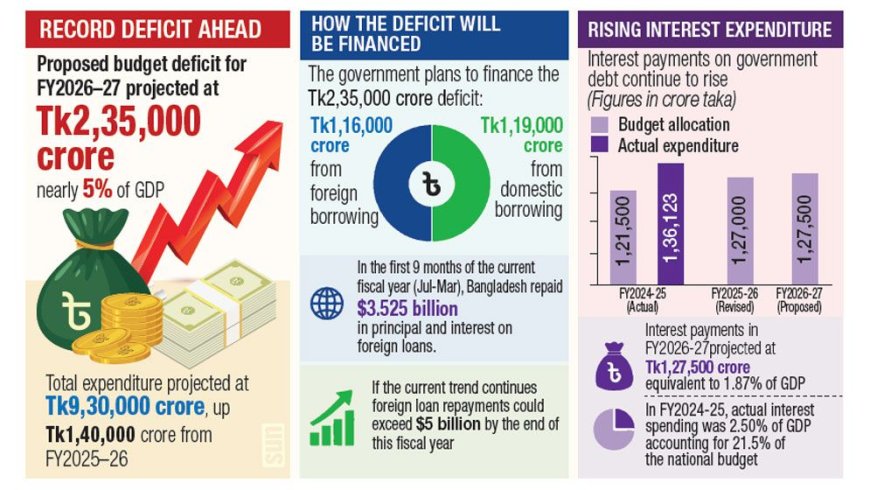
Bangladesh is heading towards an ambitious yet heavily deficit-driven budget for fiscal year 2026–27, with the proposed budget deficit expected to hit a record Tk2,35,000 crore, nearly 5 percent of the country’s Gross Domestic Product (GDP).
To bridge the huge fiscal gap, the government is likely to depend on both foreign borrowing and domestic bank financing.
Under the proposed budget framework, Tk1,16,000 crore of the deficit is expected to be financed through foreign loans, while the remaining Tk1,19,000 crore will come from domestic sources.
Finance Division data show the government’s reliance on domestic borrowing has been increasing steadily in recent years. In the current fiscal year, the original domestic borrowing target was Tk1,25,000 crore, which was later revised upward to Tk1,37,000 crore in the amended budget.
One of the most alarming features of the proposed budget is the rising cost of debt servicing. The government is expected to spend Tk1,27,500 crore on interest payments alone under the new proposal — Tk500 crore higher than the revised allocation for the current fiscal year.
Economists warn that an increasing share of public expenditure that could otherwise fund development projects or social safety net programmes is being absorbed by debt repayment obligations.
The proposed budget for FY2026–27 has been estimated at Tk9,30,000 crore, marking an increase of Tk1,40,000 crore from the current fiscal year’s budget.
Debt servicing has now become the single largest expenditure item in the national budget.
According to the finance ministry, the government initially allocated Tk1,21,500 crore for interest payments in FY2024–25, equivalent to 2.03 percent of GDP. However, actual interest expenditure rose to Tk1,36,123 crore, or 2.50 percent of GDP, accounting for 21.5 percent of the national budget.
In the revised budget for FY2025–26, Tk1,27,000 crore was allocated for interest payments. For FY2026–27, interest expenditure is projected to climb further to Tk1,27,500 crore, equivalent to 1.87 percent of GDP.
Economists have cautioned that the growing debt servicing burden, especially interest payments, could significantly limit development spending and social welfare allocations.
Dr. Zahid Hussain, former lead economist at the World Bank, said managing such a large budget deficit under current global and domestic economic conditions would be extremely difficult.
He noted that mobilising such a huge volume of financing may not be feasible in the prevailing global environment, and even if the funds are secured, Bangladesh may lack the capacity to utilise them effectively. He stressed the need for a realistic budget aimed at restoring fiscal discipline and macroeconomic stability.
Dr. Zahid also warned that excessive dependence on borrowing could push the country towards a “debt trap”. He said heavy government borrowing from the banking sector would intensify pressure on money supply and inflation.
“If the government borrows Tk1,19,000 crore from domestic sources next fiscal year, private entrepreneurs may face serious difficulties in accessing bank credit, creating a crowding-out effect on private sector investment,” he said.
He further warned that unless inflation declines, interest-related expenditures are likely to continue rising in the coming fiscal year. However, economists see little sign of inflationary pressure easing anytime soon.
Rising foreign debt repayment pressure
Meanwhile, Bangladesh’s external debt servicing obligations continue to rise steadily.
During the first nine months of the current fiscal year (July–March), the country repaid more than $3.5 billion in principal and interest on foreign loans to development partners.
According to data from the Economic Relations Division (ERD), Bangladesh repaid $3.525 billion during the period, while receiving $3.89 billion in foreign loans and grants. Of the total repayment amount, $2.276 billion was paid as principal and $1.25 billion as interest.
Officials said the country’s foreign debt repayment burden has been increasing continuously over the past several years. In the previous fiscal year, Bangladesh crossed the $4 billion mark in foreign debt repayments for the first time, repaying $4.09 billion compared to $3.37 billion in the preceding year.
If the current trend continues, total foreign loan repayments could exceed $5 billion by the end of the ongoing fiscal year.
Dr. Mustafizur Rahman, distinguished fellow at the Centre for Policy Dialogue, said persistent shortfalls in revenue collection continue to weaken budget management every year.
“A budget deficit approaching 5 percent of GDP poses serious challenges to macroeconomic stability,” he said.
He emphasised that without fundamental reforms in the National Board of Revenue (NBR) and the financial sector, implementing such a large budget would be extremely challenging.
However, he added that as the Bangladesh Nationalist Party prepares politically for future elections, pressure to expand public spending and budgetary commitments has also intensified.
What's Your Reaction?