











































Middle class likely to bear the brunt of tax overhaul in FY27 budget
Middle class likely to bear the brunt of tax overhaul in FY27 budget

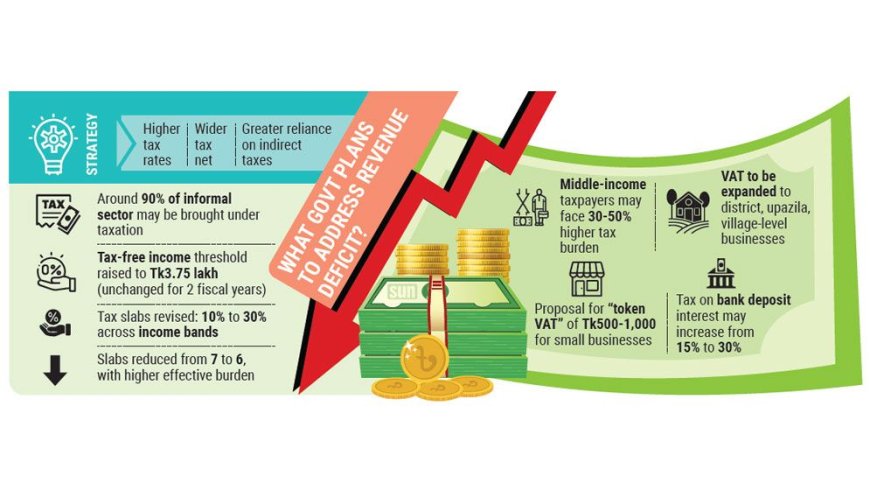
Ahead of the 2026–27 national budget, major changes to the country’s tax structure are becoming increasingly evident as the government moves to address a widening revenue deficit. To tackle an estimated record shortfall of nearly Tk1 lakh crore in the current fiscal year, authorities are pursuing a strategy focused on higher tax rates, broadening the tax net, and increasing reliance on indirect taxes. Plans to introduce a wealth tax by replacing the existing surcharge system also remain under consideration. At the same time, efforts are underway to bring nearly 90% of the informal sector under taxation.
According to Finance Division budget documents, the government is preparing a Tk9.30 lakh crore budget for FY27, with the National Board of Revenue (NBR) assigned a revenue target of Tk6.95 lakh crore. To meet this ambitious target, the NBR is initiating major structural reforms aimed at expanding direct taxation and improving tax administration.
However, analysts say the upcoming budget appears heavily focused on revenue generation, while public relief and affordability concerns are receiving comparatively less attention.
Former NBR chairman Badiur Rahman said implementation strategies are just as important as budget announcements.
Speaking to the Daily Sun, he said, “Banks are facing a liquidity shortage, while businesses are struggling to operate. If the flow of financial resources slows, reviving economic momentum becomes difficult.”
While describing the move to bring small businesses into the tax net as positive, he cautioned that expected outcomes would not materialise unless policymakers take into account income levels and inflationary pressures. He also stressed the importance of ensuring good governance in the banking sector.
Former Bangladesh Bank chief economist Mustafa K Mujeri warned that increasing the tax burden in the current economic climate could create serious challenges.
“High inflation, stagnant incomes, and rising business costs mean additional taxes would hurt both consumption and investment, potentially slowing overall economic growth,” he said, adding that fairness, efficiency in the tax structure, and stronger action against tax evasion are equally important.
Centre for Policy Dialogue Additional Research Director Towfiqul Islam Khan said global inflationary pressures, geopolitical tensions, and slower economic growth must be reflected in the budget framework.
He also noted that tax collection remains a major challenge, especially amid pressure from the International Monetary Fund, and stressed that curbing tax evasion should take priority over imposing additional burdens on compliant taxpayers.
Tax burden set to rise
Tax rates for individual taxpayers for the upcoming fiscal year have already been finalised by the interim government and will remain effective for the following two fiscal years. The tax-free income threshold has been raised from Tk3.5 lakh to Tk3.75 lakh for FY27 and FY28.
Despite this adjustment, significant changes in tax slabs and rates have altered the overall tax structure.
Economists have criticised the decision to keep the tax-free threshold unchanged at Tk3.75 lakh despite persistent inflation, arguing that revised tax slabs and rates effectively increase the tax burden even if incomes remain stagnant.
According to Finance Ministry and NBR sources, income up to Tk3.75 lakh will remain tax-free in FY27 and FY28.
Income above that threshold will be taxed at 10% on the next Tk3 lakh, 15% on the following Tk4 lakh, 20% on the next Tk5 lakh, 25% on the subsequent Tk20 lakh, and 30% on any remaining income.
Under the revised structure, the number of tax slabs has been reduced from seven to six, while effective tax rates in several brackets have increased by five percentage points. As a result, lower-middle, middle, and higher-income earners are all expected to face higher tax liabilities. For instance, an individual earning Tk1 lakh per month previously paid Tk47,500 in taxes without exemptions, but under the new structure the amount would rise to Tk58,750.
Analysts estimate that taxpayers may end up paying 30% to 50% more tax compared with previous years, adding further pressure on the middle class.
VAT expansion to grassroots level sparks debate
In another major policy shift, the NBR plans to expand VAT coverage to the grassroots level in an effort to improve the tax-to-GDP ratio. Under the proposal, small businesses in districts, upazilas, and rural areas would also be brought under VAT coverage, with a “token VAT” ranging from Tk500 to Tk1,000 under consideration.
Authorities are also considering making the Business Identification Number (BIN) mandatory for opening bank accounts and obtaining trade licences.
According to the 2024 Economic Census by the Bangladesh Bureau of Statistics, the country has around 1.17 crore economic units, more than 99% of which are cottage, micro, and small enterprises, while nearly 74% operate in rural areas.
Despite this large economic base, only around eight lakh businesses currently hold BINs, and just over five lakh regularly submit VAT returns, according to NBR data.
Officials say the absence of consolidated business data remains a major challenge. Although trade licences are issued by city corporations, municipalities, and union councils, there is no unified database of active businesses. Similarly, despite more than 17 crore bank accounts nationwide, there is limited information on how many are business-related. This gap has prompted the NBR to explore new initiatives to increase revenue collection at the grassroots level.
Md Robiul Islam Rasel, founder of Sabuj Chhaya Manipuri Tant Handicraft Enterprise, said small entrepreneurs still lack the capacity to maintain accounts, submit VAT returns, or manage BIN-related procedures.
“A Tk500–1,000 token VAT may appear small, but the administrative complexity and compliance burden could create additional pressure,” he said.
“If the government truly wants to include us, procedures must first be simplified and proper training and support provided. Otherwise, many small businesses may struggle to survive.”
Former NBR chairman Badiur Rahman said bringing small businesses into the tax system could help broaden the revenue base, but warned that policymakers must carefully consider income levels, inflation, and market realities to avoid negative consequences.
Concerns grow over taxes on savings and investment
To boost revenue collection, the government is considering increasing taxes in several areas while also proposing limited relief measures for ordinary depositors.
Under the proposed budget, taxes on interest income from bank deposits may rise sharply. Currently, a 15% tax is imposed on interest earnings from bank deposits, but the government is considering increasing the rate to 30%. If implemented, a substantial portion of earnings from fixed deposits (FDRs) and savings certificates would be deducted as tax, which analysts fear could discourage savings among ordinary citizens.
At the same time, the NBR is considering expanding excise duty exemptions to ease pressure on small depositors. Under the proposal, bank deposits of up to Tk5 lakh annually would be fully exempt from excise duty, compared with the current threshold of Tk3 lakh.
What's Your Reaction?