































World Kidney Day: Dialysis and the Burden of Survival
92% of families with kidney patients face financial hardship as cases rise annually


Shahabuddin once drove an autorickshaw to support his three-member family in Boalmari upazila of Faridpur.
The 45-year-old suffered a stroke four years ago and contracted dengue two years later. In February last year, he began experiencing problems with his eyes.
After undergoing treatment at a hospital in Gopalganj for six months, he returned to driving. But within a week, his body suddenly started swelling. He was admitted to Faridpur General Hospital the same day, where medical tests revealed complications with his kidneys.
Over the past six months, Shahabuddin has spent most of his time in hospitals, undergoing dialysis at both government and private facilities in Faridpur and Dhaka. To bear the treatment costs, his family sold his autorickshaw, trees from their homestead, and his wife’s jewellery, while also seeking financial help from relatives and villagers.
“We’ve already exhausted everything we had. We don’t even have land left to sell… I don’t know how we will continue his treatment,” said Shahabuddin’s wife, Khadiza Begum, her voice heavy with worry and despair.
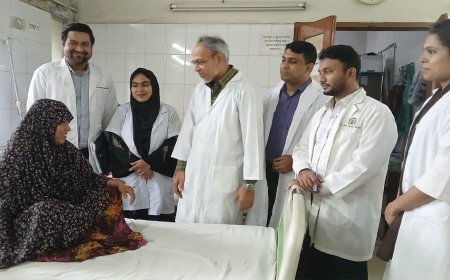
She spoke to this correspondent in the waiting room of the National Institute of Kidney Diseases and Urology (NIKDU) while her husband was undergoing dialysis.
Like Shahabuddin’s family, many households are being forced to sell their belongings to cover the high cost of kidney disease treatment, pushing them deeper into poverty. A 2024 study by the Bangladesh Institute of Development Studies found that 92 percent of families with kidney patients experience financial distress while trying to pay for dialysis treatment in Bangladesh.
According to the study, published in December 2024, patients incur an average monthly cost of Tk 46,426, with expenses ranging from Tk 6,690 to Tk 2,10,000. It also found that around 90 percent of households face catastrophic health expenditure (CHE)—healthcare spending so high that it threatens a family’s financial stability—while financing dialysis. About 19.5 percent of patients receive fewer dialysis sessions than medically recommended.
The cross-sectional hospital-based study surveyed 477 hospitalised patients receiving treatment at public, private, and NGO healthcare facilities.
Currently, around 35 government hospitals offer dialysis services at comparatively lower costs than private healthcare facilities. However, most private facilities are concentrated in towns and cities, leaving many rural patients with limited access to treatment.
Meanwhile, the government lacks comprehensive nationwide data on kidney patients. However, records from the country’s largest public kidney hospital indicate that cases of kidney complications are rising.
According to the Health Bulletin 2024, published earlier this month, a total of 2.06 lakh patients received treatment at NIKDU in 2024, marking an 8.42 percent increase from 1.90 lakh patients in 2023 at the 500-bed facility. In 2022, the number of patients treated there was 1.78 lakh.
Against this backdrop, Bangladesh, along with the rest of the world, will observe World Kidney Day tomorrow under the theme “Kidney Health for All — Caring for People, Protecting the Planet.”
Contacted by The Daily Star yesterday evening, Farhad Hasan Chowdhury, member secretary of the Bangladesh Renal Association, said that because kidney disease treatment—particularly dialysis—is expensive, greater focus should be placed on prevention.
“We are emphasising how people can keep their kidneys healthy and raising public awareness about its importance,” he said.
“Although the government is expanding dialysis services, that may not be the most sustainable long-term solution. Cadaveric kidney transplantation could be a better alternative.”
‘SOLD MY EARRINGS AS LAST RESORT’
Khadiza Begum said when her husband was first admitted to Faridpur General Hospital around October last year, he stayed for 12 days and the family spent around Tk 20,000 on treatment—an amount partly raised with help from villagers.
“Doctors later advised three injections costing Tk 11,000 each, but we couldn’t afford them. After staying home for four days, his condition worsened and he had to be readmitted for another 12 days. Relatives helped with money, and we had to sell trees worth Tk 40,000 to cover the expenses,” she said.
The family later consulted other doctors and continued medication at home, but Shahabuddin’s condition did not improve. On February 10 this year, he was admitted to the same hospital again as his health deteriorated.
“On February 12, the day of the national election, doctors recommended dialysis, but the service was unavailable that day. He later received dialysis at a private clinic in Faridpur town, which cost Tk 17,000,” Khadiza said.
They later returned to the government hospital, where dialysis cost Tk 420 per session.
“After some improvement, doctors advised dialysis twice a week before discharging him. Outside the hospital, each session costs around Tk 3,500, and transportation costs another Tk 1,500,” she added.
Shahabuddin was later admitted again for four more dialysis sessions. “During this time, we had to sell his autorickshaw for Tk 26,000.”
Doctors later recommended inserting a permanent dialysis access (fistula) in his hand, a procedure unavailable at Faridpur hospital. The family then travelled to Dhaka last Thursday (March 5).
“However, the procedure could not be done because his hand was swollen, and the hospital also refused to admit him. Even after pleading and crying, he could not get admitted to the hospital,” she said.
Meanwhile, Shahabuddin has been receiving dialysis as an outpatient at a cost of Tk 3,400 per session, while inpatients pay Tk 600.
Dialysis services at NIKDU are provided by an Indian company under a public-private partnership with the Directorate General of Health Services.
“To continue his treatment, I sold my earrings for Tk 26,000 as a last resort,” Khadiza said, adding that Shahabuddin needs three more dialysis sessions to reduce the swelling in his hand so that doctors can perform the fistula procedure.
“After that, we will return to Faridpur hospital.”
She added, “One of my sisters-in-law previously died from kidney disease. Because of that, many people think he will not survive either and hesitate to help. But as a wife, I cannot bear to see my husband suffer like this. So I am trying everything I can.”
The director of NIKDU, Syed Alfa Sani, could not be reached for comment.
What's Your Reaction?