
















































Tk 2,028 crore initiative to strengthen fragile western rail network
ECNEC approval expected today

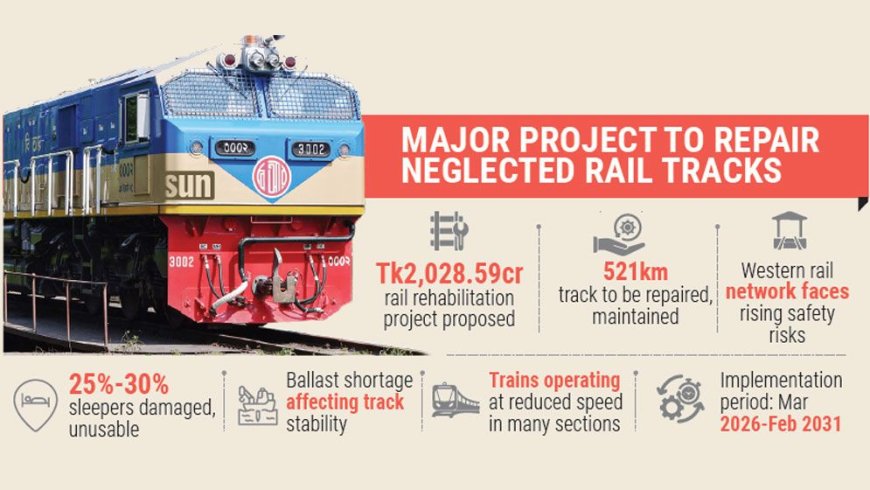
The government has launched a Tk2,028.59 crore initiative to rehabilitate and maintain Bangladesh’s deteriorating western railway network, amid rising safety concerns over ageing tracks, damaged sleepers and operational risks.
The Railway Ministry has submitted a development project proposal (DPP), titled “Bangladesh Railway West Zone Rail Track Maintenance and Rehabilitation (Phase 1),” to the Planning Commission for approval.
A senior Planning Commission official said the review process has been completed and the proposal is set to be placed before the Executive Committee of the National Economic Council (ECNEC) today. If cleared, the project will be implemented from March 2026 to February 2031 at an estimated cost of Tk2,028.59 crore.
As part of the first phase, priority will be given to repairing and preserving existing tracks across key sections, including Joydebpur–Ibrahimabad, Sayedabad–Ishwardi Bypass, Ishwardi–Baishyash–Masakti, Bheramara–Ishwardi Bypass, Malanchi–Sahagola, Sahagola–Santahar, Santahar–Jaipurhat, Joypurhat–Birampur, Birampur–Parvatipur, Abdulpur–Rajshahi Court and Bhavanipur–Madhyapara. In total, around 521 kilometres of railway track will be rehabilitated and maintained to improve operational capacity and service quality.
Officials said years of underfunding have left large parts of the western network in a fragile state. Although 948 kilometres of new railway lines were built over the past 15 years, maintenance of ageing infrastructure has lagged behind.
Railway data indicate that 25–30% of sleepers in several sections are damaged or unusable, while widespread ballast shortages are affecting track stability, gauge and alignment. Cracks, broken rails and recurring technical faults have significantly increased safety risks.
Chief Engineer (West Zone) Ahmed Hossain Masum recently said the proposal has been reviewed and cleared for submission to ECNEC for final approval.
A feasibility study has labelled the project urgent, noting that many railway lines in the western region are nearly a century old and have already undergone 12–15% wear, which continues to worsen. Frequent rail fractures, weakened joints and structural degradation have raised serious concerns about safe train operations.
Officials also pointed out that excessive train movement beyond sectional capacity has accelerated the deterioration of rails, sleepers and fittings, forcing trains to operate at reduced speeds in several areas and disrupting both passenger and freight services.
Between 2009 and 2024, eight new railway lines were constructed at a cost exceeding Tk71,525 crore. However, maintenance funding for western routes has remained inadequate, with annual requirements estimated at Tk150–300 crore, compared to much lower allocations. In the current fiscal year, only Tk65 crore has been earmarked for maintenance.
Officials warned that without immediate intervention, further deterioration could severely hamper train operations across multiple sections.
Meanwhile, the government is also looking to expand regional rail connectivity through initiatives such as the Trans-Asian Railway Network, BIMSTEC and the BBIN Initiative, all of which will depend heavily on the western railway network for both passenger and freight movement.
What's Your Reaction?