












































Education is mired in corruption
Education is mired in corruption.

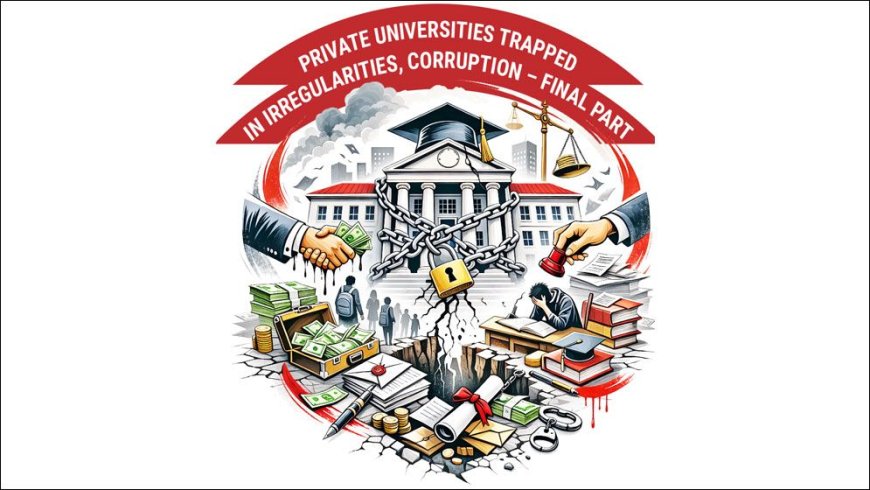
The fundamental purpose of education is to nurture honest, capable, and enlightened individuals. It dispels ignorance and shapes character, which is why educational institutions are often described as the factories where a nation’s future citizens are formed. But when those entrusted with this responsibility become entangled in corruption, the very foundation of an educated generation is put at risk.
Private universities now form a major pillar of Bangladesh’s higher education system. Yet many of these institutions face persistent allegations of corruption. Financial, administrative, and academic irregularities are said to be widespread. Although legally designated as non-profit entities, some have allegedly evolved into profit-driven enterprises, with accusations of large-scale fund misappropriation. Instead of being governed through syndicates and academic councils as mandated by law, several are reportedly run like personal businesses by their trustees.
Five years ago, the University Grants Commission (UGC) initiated investigations into 25 private universities following numerous complaints. However, only three cases were forwarded to the relevant ministry, and little is known about the progress of the remaining inquiries.
Allegations of certificate trading and financial misconduct
Following repeated accusations of corruption and irregularities at Southern University in Chattogram, the Ministry of Education appointed an administrator in May last year. The university was accused of engaging in certificate trading. On 20 April 2024, Vice-Chancellor Prof Engineer Md Mozammel Haque was reportedly removed from his post after raising concerns about irregularities—allegedly in violation of regulations.
Subsequently, then treasurer Sharif Ashrafuzzaman was appointed Acting Vice-Chancellor, despite facing allegations himself. According to the law, only the chancellor—the president—has the authority to appoint or remove a vice-chancellor. On 10 September, the ministry’s Private University Wing-1 stated that Prof Mozammel Haque would continue in his role, as he had not been lawfully relieved. However, the university’s Board of Trustees (BOT) reportedly disregarded this directive.
On 24 October, BOT Member Secretary Sarwar Jahan filed a writ petition in the High Court challenging the ministry’s order. The High Court subsequently suspended the directive. Prof Mozammel Haque then appealed to the Appellate Division, and on 4 December the court suspended the temporary relief order for three months, citing insufficient legal grounds.
Recently, Prof Mozammel Haque lodged complaints with the Anti-Corruption Commission (ACC) and the Ministry of Education against several BOT members, including Sarwar Jahan and Israt Jahan, alleging corruption and irregularities. The ministry directed the UGC to investigate, resulting in the formation of a four-member inquiry committee. Preliminary findings reportedly found substance in some of the allegations, prompting the appointment of an administrator to stabilize the institution.
Southern University is not an isolated case. The ACC has decided to investigate allegations of financial irregularities amounting to approximately Tk4.5 billion against the Board of Trustees of Shanto-Mariam University. It is alleged that Tk3.436 billion was transferred from university funds to the Shanto-Mariam Foundation in violation of regulations and that Tk1.02 billion in government revenue was evaded since its inception.
The ACC has also launched an inquiry into Northern University Bangladesh. The agency is investigating allegations that its BOT Chairman Abu Yusuf Md Abdullah and family members accumulated wealth beyond known income and laundered money abroad.
Outside Dhaka, similar concerns persist. In Barishal, several private universities continue to operate entirely from rented buildings without permanent campuses. The UGC has already instructed one such institution to suspend new admissions for the January semester. Civil society representatives have called for stricter oversight, while the UGC has reiterated that permanent campuses are mandatory for permanent certification.
In the Barishal division, three private universities were established—Global University Bangladesh in 2015, Global Village University in 2017, and Trust University in 2018. Yet all three still function from rented premises. Students allege that promises of permanent campuses remain unfulfilled and that academic sessions are frequently prolonged beyond scheduled durations. Even after more than seven years, none has shifted to a permanent campus.
UGC preparing action
According to the UGC, between 20 and 30 private universities face serious allegations, including money laundering and fund embezzlement. Investigations are ongoing, and if allegations are proven, BOTs may be dissolved and administrators appointed.
The scope of accusations is broad. As student enrollment rises each year, so do institutional revenues—and, allegedly, instances of corruption. Transparency in income and expenditure remains limited. Disregarding legal provisions, some BOT members are accused of exploiting loopholes to misappropriate substantial sums.
The UGC is reportedly preparing measures against 16 private universities for failing to shift to permanent campuses, admitting excessive numbers of students, and committing other violations. A UGC source indicated that action would be taken against institutions breaching admission policies, making irregular academic appointments—such as appointing a business studies dean to oversee the arts faculty—or allowing individuals to serve simultaneously as dean and department chair.
Under the banner of expanding higher education, education itself has become increasingly commercialized. Across the country, private universities have allegedly been approved on political grounds rather than through rigorous evaluation of qualifications and capacity. Many license holders have treated their institutions as business ventures. But education cannot function as a commodity. Indiscriminate approvals have not only eroded academic standards but also allowed corruption to take deep root within the system.
As a consequence, the education sector itself appears to be sinking under the weight of corruption.
What's Your Reaction?