




























































Can Bangladesh halt and reverse its five-year decline in new foreign direct investment (FDI)?
Can Bangladesh halt and reverse its five-year decline in new foreign direct investment (FDI)?

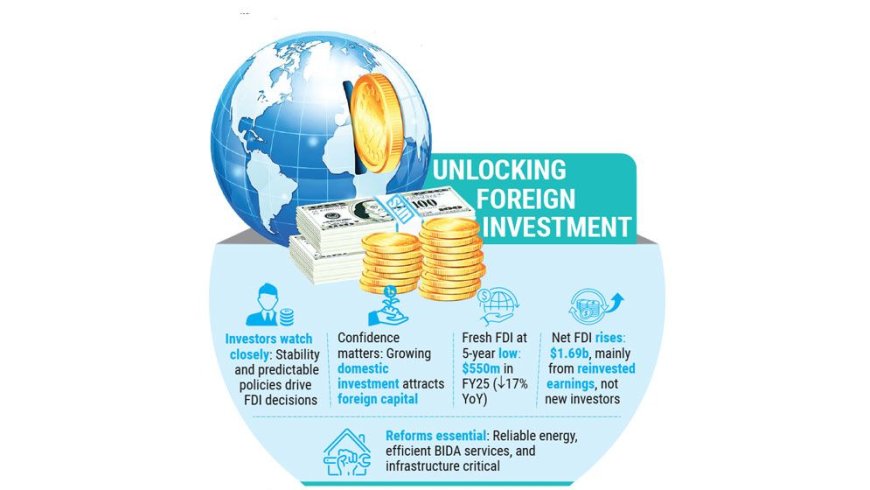
Foreign direct investment figures initially suggest an encouraging trend. Net FDI increased by 19% in the outgoing fiscal year to $1.69 billion, according to data from Bangladesh Bank.
However, a closer look reveals a more sobering picture: fresh equity inflows — the most reliable measure of new investor confidence — have fallen to their lowest level in five years.
New foreign investment declined to just $550 million in FY2024–25, nearly 17% lower than the previous year. Even during the Covid-19 pandemic, fresh equity inflows were higher, at $720 million. After reaching a peak of $1.14 billion in FY22, new inflows have steadily tapered off.
For economists, the signal is unmistakable: Bangladesh is still struggling to attract sufficient new long-term capital.
Headline growth, limited new capital
The recent uptick in overall FDI has largely been driven by reinvested earnings and intra-company loans rather than fresh equity from new investors.
While reinvestment indicates that existing investors remain committed, analysts warn that it does not necessarily reflect growing international confidence in Bangladesh as a new investment destination.
“Investors look at profitability and predictability,” said Dr Mustafa K Mujeri, executive director of the Institute for Inclusive Finance and Development and former chief economist of Bangladesh Bank.
He noted that foreign investors closely track domestic investment trends before making decisions.
“When domestic investment rises, it sends a strong signal,” he said. “Foreign investors prefer markets where local entrepreneurs show confidence in the future.”
Bangladesh is not alone in seeking foreign capital. Across Asia and beyond, emerging economies are competing intensely for a limited pool of global investment.
“Every country is competing,” Dr Mujeri observed. “Investors will go where returns are promising and risks are manageable.”
In today’s volatile global environment, foreign investment decisions are rarely short-term. Most investors plan with a five- to ten-year horizon. As a result, they assess deeper structural factors — policy continuity, regulatory stability, infrastructure readiness, political climate and institutional reliability.
Without these fundamentals, temporary macroeconomic improvements may not be enough to draw new investors.
Stability alone will not suffice
Prof Mustafizur Rahman, Distinguished Fellow at the Centre for Policy Dialogue, believes Bangladesh is at a pivotal moment.
“Stability creates opportunity,” he said. “But reforms and effective implementation will determine whether Bangladesh can seize that opportunity.”
He pointed to persistent structural bottlenecks — especially energy shortages and bureaucratic delays — that continue to worry investors.
Reliable gas and electricity supplies remain essential for industrial growth.
Prof Rahman also emphasised the need to improve the efficiency and accessibility of the one-stop service provided by the Bangladesh Investment Development Authority. Bureaucratic complexities and procedural delays, he noted, still discourage both foreign and domestic investors.
“Policy consistency, infrastructure preparedness and institutional efficiency are critical,” he said. “Without these, investor confidence will remain guarded.”
From promotion to implementation
Efforts have been made to reconnect with global investors. In April last year, the Bangladesh Investment Development Authority hosted a four-day international investment conference aimed at restoring confidence and highlighting opportunities.
Yet the continued decline in fresh equity inflows suggests that promotional events alone cannot replace substantive reforms.
Analysts say investors are now watching closely to see whether policy commitments translate into real improvements in regulatory procedures, dispute resolution mechanisms, energy access and contract enforcement.
A decisive moment
Bangladesh’s economy continues to expand, supported by strong domestic demand and export performance.
But sustaining long-term growth will require higher levels of productive investment, particularly in manufacturing, infrastructure and higher-value industries.
The drop in fresh FDI indicates that while existing investors remain engaged, new global players are still cautious.
Converting that caution into confidence will depend not only on macroeconomic stability but also on ensuring predictable policies, reducing administrative hurdles and strengthening institutional credibility.
For Bangladesh, the task is no longer simply to attract capital — it is to convince the world that long-term investment here is both profitable and secure.
What's Your Reaction?