
































































From AI to Starlink: How Drone Technology Is Transforming the War in Ukraine
From AI to Starlink: How Drone Technology Is Transforming the War in Ukraine

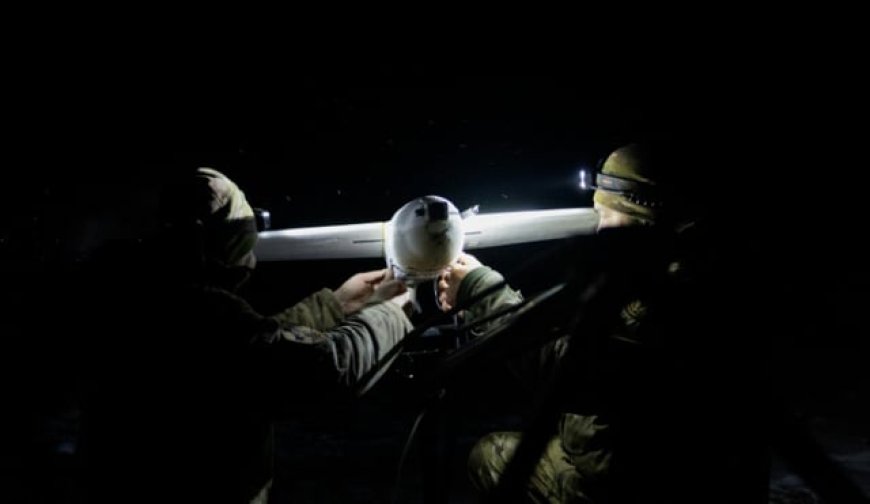
As the war in Ukraine enters its fifth year, drones have come to dominate the battlefield — a dramatic shift in modern warfare that is drawing global attention.
Here’s an overview of the technologies reshaping the conflict, four years after Russia launched its full-scale invasion by sending troops and tanks across the border into Ukraine:
- Kill zone -
From inexpensive commercial gadgets originally built for civilian purposes to small aircraft packed with explosives, drones now account for up to 80 percent of battlefield damage, according to Ukraine’s Defence Minister Mykhailo Fedorov.
“Modern warfare is now impossible without drones,” a Ukrainian infantry soldier known as Koleso told AFP in eastern Ukraine.
The front line has effectively become a “kill zone” extending up to 20 kilometres (12 miles) deep — an area between opposing forces where constant drone surveillance makes survival extremely difficult, military analyst Kateryna Bondar said.
Troops operate in small, fast-moving units, constantly scanning the sky to avoid detection.
Large artillery systems, along with slow-moving tanks and armoured vehicles, have become easy targets due to their size and limited mobility.
To reduce troop exposure, Ukrainian forces increasingly deploy ground drones to transport supplies into high-risk areas and evacuate wounded soldiers.
- Fibre optics -
A stable link between drone and operator is critical for remote control.
“The real race is in communications,” Bondar noted.
Most early drones relied on radio signals, but these proved vulnerable to electronic warfare tactics such as jamming and interception, which can sever connections or bring drones down.
In response, Russia has adopted drones guided by ultra-thin fibre-optic cables, which are largely resistant to electronic interference.
Their growing use has left parts of frontline cities and countryside draped in strands of cable, evoking scenes from dystopian science fiction.
- Starlink -
As another alternative to radio control, Ukrainian forces have begun equipping drones with terminals from Starlink.
This enables operation through satellite internet connections.
“We need to operate at long distances with stable video and control,” said Phoenix, commander of Ukraine’s Lasar Group, an early adopter of Starlink-enabled drones.
Russian forces soon followed suit, prompting Ukraine to urge Elon Musk to disable unauthorised Russian terminals last month.
Military observers said the shutdown affected both Russian and Ukrainian systems.
The US-based Institute for the Study of War suggested the move may have contributed to a swift, localised Ukrainian advance in the southern Zaporizhzhia region in early February.
- Air defences -
The proliferation of drones has forced both sides to rethink air defence strategies.
Using advanced missiles — often costing millions — to shoot down relatively cheap drones is not sustainable.
Alongside electronic jamming, Ukraine has developed low-cost interceptor drones designed specifically to destroy enemy UAVs mid-air.
“We’ve opened a new chapter — drones fighting drones,” said Marko Kushnir of General Cherry, a leading interceptor drone manufacturer.
Near the front lines, roads are now shielded with protective netting to block incoming drones, while trucks fitted with anti-drone cages and jamming systems move quickly through exposed areas.
Machine guns remain a last line of defence against aerial threats.
Ukraine’s Western partners have closely studied Kyiv’s experience, particularly after Russian drones repeatedly entered European airspace in recent months.
- AI -
Engineers are now racing to integrate artificial intelligence into drone systems to boost effectiveness.
Ukrainian firms such as The Fourth Law say they have developed “terminal guidance” systems, allowing AI to assume control in the final seconds before impact.
The goal is to enhance strike accuracy, especially when signal loss occurs just before a hit.
“Russia and China are developing similar technologies — if we don’t keep up, we’ll fall behind,” said TFL’s Maksym Savanevskyi.
Fully autonomous systems, however, remain distant.
“AI supports rather than replaces humans,” Bondar said.
“I once thought humans could be completely removed from combat systems — that everything could be automated. That was naïve,” said former Google CEO Eric Schmidt, now head of SwiftBeat, which supplies AI-powered drones to Ukraine’s military.
“For the foreseeable future, it will be drones first, people second,” he told a conference in Kyiv.
On the eastern front, however, infantry soldier Koleso insisted that human troops will always remain essential.
“Until you raise the flag yourself, with your own hands, and secure the position, it isn’t truly yours,” he said.
What's Your Reaction?