










































Pilgrims offer prayers on Mount Arafat as Hajj reaches its peak
Pilgrims offer prayers on Mount Arafat as Hajj reaches its peak.

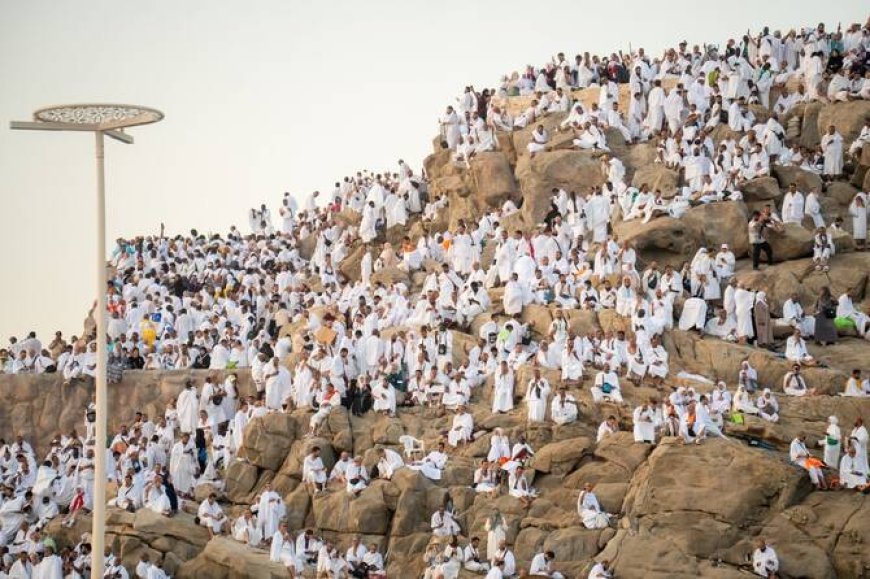
Huge numbers of Muslims gathered on Mount Arafat on Tuesday for the most significant ritual of the Hajj pilgrimage, as intense desert heat pushed temperatures close to 40 degrees Celsius.
From early morning, thousands of worshippers dressed in white robes recited verses from the Quran on the 70-metre rocky hill near Makkah, where Prophet Hazrat Mohammed (PBUH) is believed to have delivered his final sermon.
More than 1.5 million pilgrims have taken part in this year’s Hajj despite tensions and conflict across the Middle East stemming from the US-Israeli war with Iran.
During the conflict, Tehran responded with waves of drone and ballistic missile attacks that struck major infrastructure and energy facilities across the Gulf region, including in Saudi Arabia.
Over 30,000 Iranians travelled for Hajj this year, far below the 86,000 initially expected. Iran’s state news agency IRNA attributed the decline to the “wartime situation.”
Despite the regional unrest, Saudi officials said over the weekend that the number of international pilgrims this year had surpassed that of 2025.
Hajj, one of the five pillars of Islam, is obligatory at least once in a lifetime for Muslims who are physically and financially able to perform it.
With temperatures in Makkah reaching as high as 44 degrees Celsius in recent days, Saudi authorities advised pilgrims to stay hydrated and protect themselves from the sun during the largely outdoor rituals, which can last five days or longer.
As male pilgrims are not allowed to wear hats, many carried umbrellas to shield themselves from the scorching heat.
After completing prayers at Mount Arafat, pilgrims are set to spend the night in Muzdalifah, where they will gather pebbles for the symbolic “stoning of the devil” ritual in Mina beginning Wednesday.
The Hajj follows the route of Prophet Hazrat Mohammed’s (PBUH) farewell pilgrimage around 1,400 years ago.
The pilgrimage has also long been a key source of legitimacy for the Al Saud monarchy, whose ruler holds the title “Custodian of the Two Holy Mosques” in Makkah and Medina.
What's Your Reaction?