

























































Justice for Six Children’s Deaths, But Killers of Six Hundred Children Remain Free
Justice for Six Children’s Deaths, But Killers of Six Hundred Children Remain Free

Article 27 of the Constitution of Bangladesh declares that “all citizens are equal before the law and are entitled to equal protection of the law.” Yet a fundamental question remains: are we truly upholding this constitutional principle? In reality, there are individuals in this country who appear to stand above the law. They remain beyond the reach of accountability, moving freely despite serious allegations against them. Cases are often not accepted against them, investigations are not launched despite available evidence, and under the guise of social influence or civil society status, they continue to operate without consequence. Recent incidents involving child deaths have once again brought this disparity in justice into sharp focus.
On the eve of Eid, six newborn babies died at Ad-din Hospital in Dhaka, shocking the nation. In response, the government launched an investigation, and the Health Minister pledged strict action against those responsible. The promise was followed by action. The Directorate General of Health Services (DGHS) subsequently revoked the licence of Ad-din Hospital in Moghbazar.
The decision was communicated through a letter sent to the hospital’s Executive Director and proprietor, Sheikh Mohiuddin. Signed by the Director (Hospitals and Clinics) on behalf of the DGHS Director General, the letter stated that the hospital could seek a review or appeal the decision within 30 days.
According to the letter, the action was taken after reviewing the hospital’s response to a show-cause notice issued following the deaths of six newborns on 27 May. The notice had been served under Section 11(1) of the Medical Practice and Private Clinics and Laboratories (Regulation) Ordinance, 1982, asking why the hospital’s licence should not be cancelled. Although the hospital was granted an extension to submit its explanation, the authorities ultimately found its response unsatisfactory. As a result, the licence was revoked under Section 11(2)(b) of the ordinance.
Alongside the administrative action, police have filed a case over the deaths and an investigation is underway. While patient deaths resulting from negligence are not unprecedented in Bangladesh, regulatory authorities have rarely acted with such firmness in the past. Investigations would often be announced, public outrage would flare briefly, and then the matter would quietly fade away. Influential owners of private healthcare institutions frequently managed to avoid accountability, allowing profit motives to overshadow patient welfare.
Against that backdrop, the government’s decision to act against a powerful institution such as Ad-din Hospital is significant. It serves not only as a measure against one hospital but also as a warning to other private healthcare providers accused of exploiting patients in the name of medical care. The Health Minister deserves recognition for maintaining a strong and consistent position on the issue from the outset. The action establishes an important precedent in strengthening accountability within the healthcare sector.
The current administration has also demonstrated its commitment to swift justice in other cases. A Dhaka court recently sentenced Sohail Rana and his wife, Swapna Khatun, to death for the rape and murder of seven-year-old Ramisa Akhtar in Pallabi. The verdict, delivered within six days of the case, has been widely viewed as a milestone in ensuring prompt justice. Ramisa’s mutilated body was recovered on 19 May from a flat in Mirpur-11. Legal observers believe the swift conclusion of the case may contribute to deterring future incidents of child abuse and murder.
Yet an important question remains: is the rule of law being applied equally in every case?
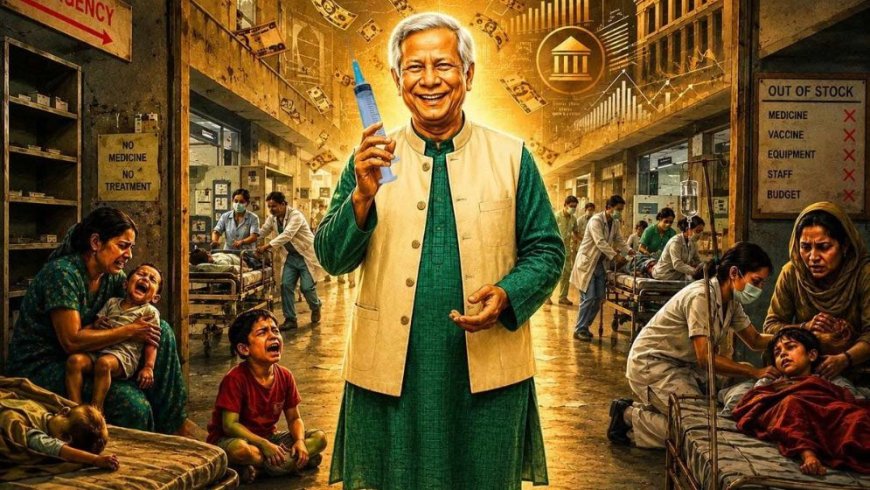
That question arises because, while the government has acted decisively in some incidents involving child deaths, it has remained reluctant to pursue accountability in another tragedy—the deaths of more than 600 children from measles. Such a scale of child mortality is unprecedented in Bangladesh, and reports examining the causes have appeared across the media. Many observers argue that the issue extends beyond a public health crisis and reflects severe administrative failures during the tenure of the previous interim government.
At a UNICEF press conference, UNICEF Representative Rana Flowers stated that UNICEF had repeatedly warned the Ministry of Health about a looming vaccine shortage. According to her, at least five formal letters and ten meetings with government officials highlighted the risk. UNICEF maintains that changes in vaccine procurement procedures delayed the arrival of essential vaccines, contributing to the crisis.
Government leaders, including Prime Minister Tarique Rahman, the Health Minister and the Information Adviser, have publicly attributed the disaster to negligence by the previous administration. However, despite these statements, no independent investigation committee has yet been formed to determine responsibility.
Several parents and concerned citizens have attempted to pursue legal action over the matter, but their efforts have largely failed. Most recently, independent Member of Parliament Sheikh Mujibur Rahman Iqbal of Kishoreganj-5 filed a petition in the Chief Metropolitan Magistrate’s Court seeking legal proceedings against five individuals, including former Chief Adviser Dr Muhammad Yunus and former Health Adviser Nurjahan Begum. The petition alleged negligence in addressing the measles outbreak and the resulting child deaths. The court declined to accept the case.
The judiciary has nevertheless shown interest in the matter. Following a public-interest writ petition, the High Court issued a rule asking why an inquiry commission should not be formed to investigate the failure of responsible authorities during the measles outbreak. The bench of Justice Razik-Al-Jalil and Justice Debasish Roy Chowdhury directed the Cabinet Secretary, Health Secretary, Home Secretary, Public Administration Secretary, DGHS Director General and others to explain why such a commission should not be established.
Advocate Syed Mamun Mahbub, who represented the petitioner, said the court sought clarification on who bears responsibility for the ongoing child deaths and why the state failed to fulfil its obligations. The writ, filed by Supreme Court lawyer M. Ashraful Islam, also alleged that measles vaccines had been diverted outside the public system and requested an investigation committee as well as restrictions on overseas travel for certain former officials until inquiries were completed. A legal notice on the matter had been served earlier, but no substantive resolution has yet emerged.
Meanwhile, the government has offered no detailed response to the allegations. Critics argue that there appears to be an unwillingness to pursue a full investigation. This raises a critical question: why?
The current administration has undertaken extensive efforts to contain the measles outbreak, and responsibility for the original failures does not rest with it. If that is the case, there should be no obstacle to conducting an impartial inquiry and ensuring accountability for those found responsible. If the deaths of more than 600 children are not thoroughly investigated and those responsible are not brought before the law, Bangladesh’s progress toward establishing genuine rule of law and equal justice will remain incomplete.
Justice cannot be selective. If six child deaths warrant investigations, sanctions and legal proceedings, then the deaths of hundreds of children deserve no less. Equal protection under the law, as guaranteed by the Constitution, demands nothing less than equal accountability.
What's Your Reaction?