











































G7 leaders commit to strengthening efforts to tackle global debt vulnerabilities
G7 leaders commit to strengthening efforts to tackle global debt vulnerabilities.

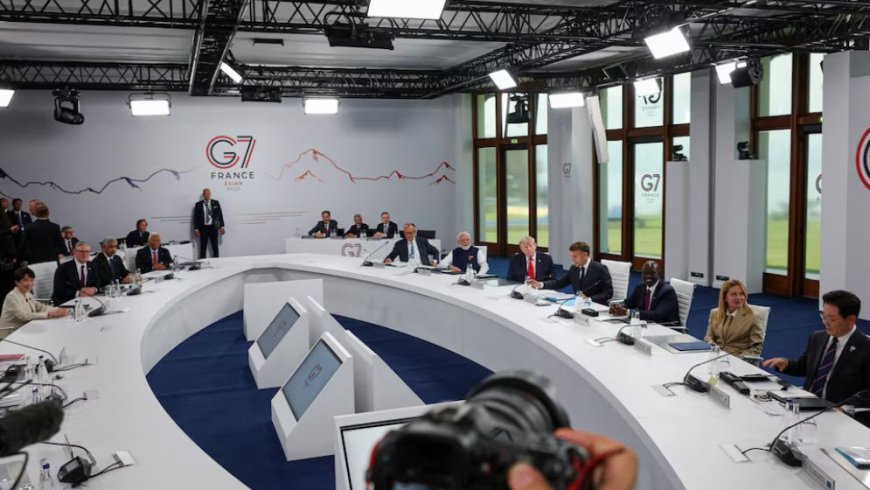
G7 leaders on Tuesday pledged to intensify efforts to address mounting debt burdens in developing nations, including middle-income countries that are not covered by the debt relief framework introduced by the Group of 20 (G20) during the COVID-19 pandemic.
In a joint declaration issued after a session attended by guest nations Kenya, Egypt, India, Brazil and South Korea, the G7 reaffirmed its commitment to international development cooperation while calling for reforms and greater mobilisation of private-sector investment.
The leaders acknowledged that traditional development policies had yielded progress but had achieved only “limited impact in reducing financial dependency on external assistance.” They noted that public funding—significantly reduced in recent years by the United States and other advanced economies—would remain essential but would not be sufficient to meet growing global development needs.
“We will enhance efforts to address escalating global debt vulnerabilities that threaten economic stability and constrain fiscal space for essential public service interventions,” the statement said. The declaration was also backed by South Korea and Kenya.
The G7 further stressed the need to advance a common approach to debt restructuring for vulnerable middle-income countries that are not eligible for the G20 Common Framework, which was established during the pandemic to support the world’s poorest nations.
Eric LeCompte, executive director of development advocacy group Jubilee USA Network, welcomed the move, describing it as a call for proactive debt restructuring before crises emerge. He also highlighted the importance of the leaders’ emphasis on private investment amid declining public development financing.
According to OECD data, official development assistance fell by 23.1 percent in real terms in 2025 to $174.3 billion, driven largely by a nearly 57 percent reduction in US aid, alongside smaller cuts by Germany, France, the United Kingdom and Japan.
Kevin Gallagher, director of Boston University’s Global Development Policy Center, said the declaration marked the first formal recognition by the G7 of debt challenges facing poorer countries outside the Common Framework. However, he expressed disappointment that the statement did not address the immediate financial pressures on developing countries resulting from the conflict in the Middle East.
“Countries outside the G7, particularly in Asia and Africa that rely heavily on imported energy, require urgent liquidity support, fiscal assistance for essential imports and fuel subsidies, as well as long-term affordable development financing to reduce their vulnerability,” Gallagher said.
Development organisation Oxfam International criticised the declaration and urged G7 nations to honour their longstanding commitment to allocate 0.7 percent of gross national income to foreign aid.
“The G7 has implemented the largest collective reduction in life-saving aid in its history, a decision that is already having devastating consequences for millions of people,” said Joern Kalinski, Oxfam’s senior adviser on the G7. He argued that redirecting aid to incentivise private investment instead of funding public services such as schools and hospitals would worsen an already critical situation.
What's Your Reaction?