



































































Flood misery deepens as death toll reaches 51, over a million stranded
Flood misery deepens as death toll reaches 51, over a million stranded

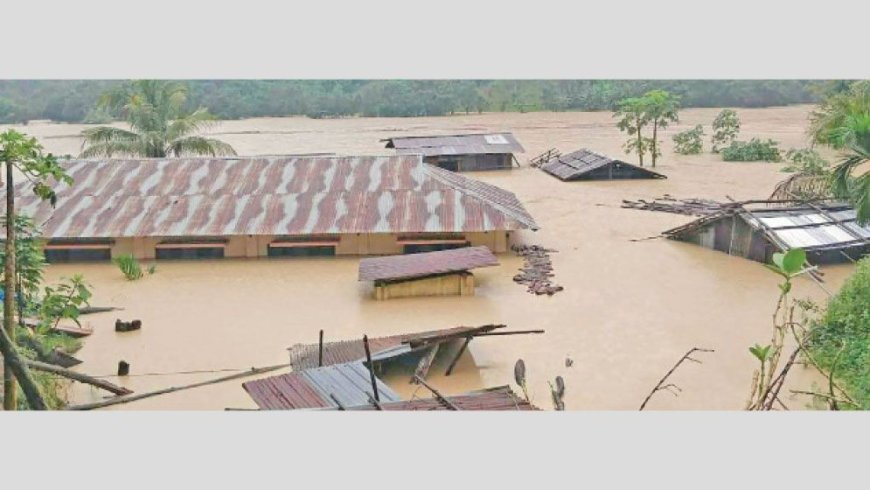
Bangladesh's flood crisis deepens as death toll reaches 51, over 1 million affected
Bangladesh's flood emergency has intensified, with the death toll rising to 51 and more than one million people affected as relentless monsoon rains, upstream hill runoff and landslides continue to wreak havoc across large parts of the country.
Although floodwaters have begun receding in parts of the southeast, authorities have warned that heavy rainfall forecast over the next two days could trigger fresh flooding in the northeast and northern districts.
According to the Ministry of Disaster Management and Relief's latest situation report issued on Sunday, a total of 1,022,963 people from 267,918 families have been affected across seven of the worst-hit districts—Khagrachhari, Rangamati, Bandarban, Cox's Bazar, Chattogram, Moulvibazar and Habiganj.
Official figures show that 51 people have died so far—28 in Cox's Bazar, 13 in Chattogram, six in Bandarban, three in Rangamati and one in Habiganj.
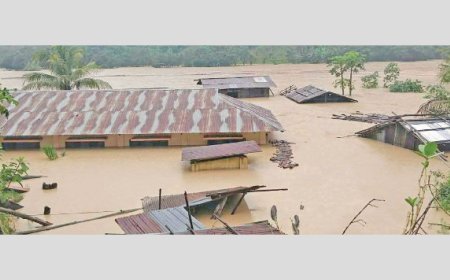
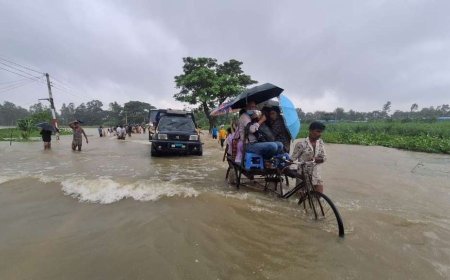
Floodwaters have inundated 58 upazilas, affecting 386 unions and 11 municipalities, leaving vast areas underwater and disrupting normal life.
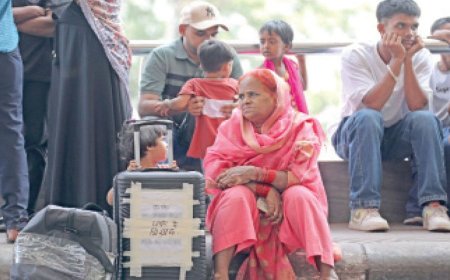
Authorities have opened 1,131 shelters, where 44,457 displaced people are taking refuge. Relief efforts are continuing, with food, drinking water and emergency supplies being distributed across the affected districts.
The disaster has also severely affected agriculture, inundating 534,570 hectares of cropland across 12 districts and threatening food production and the livelihoods of thousands of farming families.
Govt promises rehabilitation
State Minister for Disaster Management and Relief M Iqbal Hossain said the government would launch a comprehensive rehabilitation programme once the immediate emergency eases.
While distributing relief materials in flood-hit Khagrachhari on Sunday, he said the government's immediate priority was providing food assistance before moving on to rebuilding homes, restoring agricultural land and repairing damaged infrastructure.
"The government is always with the flood victims. Food assistance is being provided now, and special measures will be taken later to rehabilitate damaged houses, agricultural land and infrastructure," he said.
Southeast improves, but new flood threat looms
The Flood Forecasting and Warning Centre (FFWC) said conditions in the southeastern region were gradually improving as river levels continued to fall. However, it warned that heavy to very heavy rainfall over the next 24 to 48 hours could trigger fresh flooding in parts of the northeast and north.
Three rivers at five monitoring stations remained above the danger level—the Sangu at Bandarban and Dohazari, the Kushiyara at Markuli and Fenchuganj, and the Someswari at Khalmakanda in Netrokona.
Assistant Engineer and Duty Forecasting Officer Mostafa Kamal Jihan said heavy rainfall was expected across Sylhet, Rangpur and Mymensingh divisions, as well as the adjoining Indian states of Meghalaya, Assam and West Bengal, increasing the risk of renewed flooding.
Although water levels in the Halda, Sangu, Matamuhuri, Gomti, Feni and Selonia rivers have receded, the FFWC warned that the Muhuri, Feni, Selonia and Halda rivers could again rise above the danger level, causing short-term flooding in low-lying areas of Feni, Chattogram and Khagrachhari. Temporary inundation is also possible in parts of Lakshmipur and Noakhali.
In the northeast, while the Manu, Dhalai and Khowai rivers have receded, the Sari-Goyain, Jadukata, Someswari and Bhugai-Kangsha rivers may overflow within the next two days, posing fresh risks to Sylhet, Sunamganj, Netrokona, Sherpur and Mymensingh.
The agency also said the Surma River continued to rise while the Kushiyara remained stable. Water levels in both rivers are expected to increase over the next 24 to 72 hours, potentially worsening flooding along the Kushiyara in Sylhet and Sunamganj, while low-lying areas along the Surma may also face temporary inundation.
Further north, rising water levels in the Teesta, Dharla and Dudhkumar rivers could trigger short-duration flooding in Nilphamari, Lalmonirhat, Rangpur, Kurigram and Gaibandha.
Despite the fresh warnings, the FFWC said conditions were steadily improving in Bandarban, Chattogram, Cox's Bazar, Moulvibazar and Habiganj as water levels continued to decline.
Crops sustain heavy losses
The Ministry of Agriculture said 534,570 hectares of cropland have been inundated, with 28,610 hectares suffering significant damage in 12 districts.
The affected areas include Chattogram, Cox's Bazar, Rangamati, Khagrachhari, Bandarban, Sunamganj, Sirajganj, Habiganj, Naogaon, Jashore, Chuadanga and Meherpur.
Damaged crops include Aus paddy, Aman seedbeds, jute, summer vegetables, chilli, ginger, turmeric and various fruits.
Army, BGB step up rescue efforts
The Bangladesh Army has continued round-the-clock humanitarian operations, particularly in the Chattogram Area, distributing food, safe drinking water and other emergency supplies to stranded residents.
The Inter Services Public Relations (ISPR) said troops would continue relief operations until the situation improves and normal life resumes.
Meanwhile, Border Guard Bangladesh (BGB) has been deployed in 11 flood-hit districts to conduct rescue operations, provide shelter and medical assistance, distribute relief materials and help restore damaged communication networks.
According to the BGB, personnel have rescued more than 600 people from 122 families, including 116 tourists stranded in Bandarban. The force has also established 90 observation posts to monitor the situation around the clock.
Encroached canals worsen flooding
Officials and residents say this year's prolonged flooding has been aggravated not only by record rainfall and unusually high tides but also by years of canal encroachment, blocked embankments and dysfunctional sluice gates that have severely hampered drainage into the Bay of Bengal.
In many areas, canals and sluice gates had been obstructed by fish enclosures, salt cultivation and illegal structures. Some obstructions were removed during the flood to speed up drainage, but extensive flooding persisted in coastal parts of Chattogram and Cox's Bazar despite reduced rainfall.
Water Development Board officials said years of encroachment and poor maintenance had significantly reduced the drainage capacity of key waterways, while local users often kept sluice gates closed to protect fish farms and salt fields.
Banshkhali among worst affected
Banshkhali in Chattogram remains one of the hardest-hit areas, with around 60,000 people still marooned.
The Water Development Board said the upazila's main drainage channel, the 32-kilometre Jalkadar Canal, has narrowed dramatically due to widespread encroachment, restricting the natural flow of floodwater.
Of the area's 89 sluice gates, 15 are completely inoperative, while many others are in poor condition.
"I have never seen such a terrible flood or water remaining for so long," said local resident Neyamat Ali. "Our homes and belongings have been washed away."
Similar conditions were reported in Chakaria, Pekua and Matamuhuri in Cox's Bazar, where thousands remained stranded despite receding water levels.
Widespread destruction across Chattogram Division
Divisional authorities said the floods have damaged 79,187 houses, 344 educational institutions, nearly 3,840 kilometres of roads, and 339 bridges and culverts across 11 districts.
A total of 34,723 people were staying in 3,941 shelters on Sunday, with Satkania and Banshkhali among the worst-affected upazilas.
A burial through floodwaters
The human cost of the disaster was highlighted in Satkania's Keochia Union, where the family of a man who died after falling ill while fishing had to transport his coffin on a makeshift raft through floodwaters because their family graveyard was submerged.
Relatives carried the coffin about 300 metres across floodwater before transporting it another two kilometres by auto-rickshaw to higher ground for burial.
Rail link restored
In a sign of gradual recovery, train services on the Chattogram-Cox's Bazar route resumed on Sunday after a five-day suspension caused by flood damage.
Bangladesh Railway said repair work had been completed on submerged sections of the track, allowing the Parjatak Express to resume operations.
Govt vows sustained support
During visits to flood-hit areas in Rangamati, Khagrachhari and Chattogram, ministers said Prime Minister Tarique Rahman was closely monitoring the disaster response and had directed authorities to continue relief operations for as long as necessary.
They assured affected families that rehabilitation programmes would begin once floodwaters recede and pledged that no flood victim would be left without government assistance.
Technical institutions on alert
The Directorate of Technical Education has instructed 161 government technical schools and colleges to move laboratory equipment and important documents to higher floors, establish emergency response cells and remain ready to serve as temporary shelters if required.
What's Your Reaction?