


































Record Budget Faces Test Amid Fragile Economy
Record Budget Faces Test Amid Fragile Economy

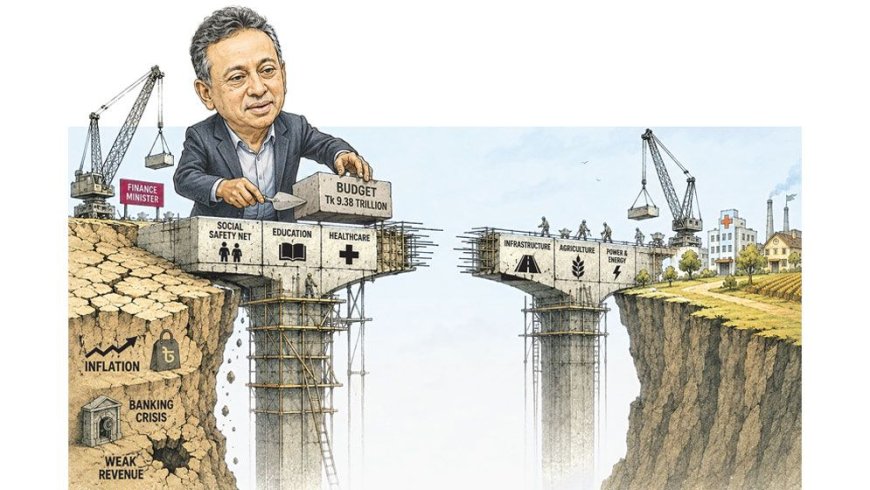
When Finance and Planning Minister Amir Khosru Mahmud Chowdhury rises in the 13th Jatiya Sangsad today to unveil the national budget for fiscal year 2026-27 (FY27), the occasion will be marked more by economic anxiety than celebration. It is the first budget of the newly elected BNP-led government, which took office in February following a closely watched general election. Yet the optimism surrounding the transfer of power has quickly given way to the realities of a fragile economy.
The administration has inherited an economy burdened by years of structural weaknesses, a troubled banking sector and persistent external shocks. It now faces the difficult task of honouring election pledges to expand social protection and improve public services while maintaining the fiscal discipline needed to curb inflation and restore macroeconomic stability.
Against this backdrop, the government is preparing to present the largest budget in the country's history, with a proposed outlay of Tk9.38 lakh crore—around Tk1.48 lakh crore higher than the original allocation of the previous fiscal year.
The finance minister has argued that a bold injection of public spending is necessary to revive economic activity, comparing the strategy to pouring water into a dry tube well to restore its flow. Economists, however, remain sceptical, questioning how such an ambitious expansion can be financed given Bangladesh's weak revenue performance and growing fiscal pressures.
Dr Zahid Hussain, former lead economist of the World Bank's Dhaka office, told the Daily Sun that Bangladesh has developed a tendency to announce large budgets without having the institutional capacity to implement them fully. Although the proposed budget stands at Tk9.38 lakh crore, he believes actual spending is unlikely to exceed Tk7–7.5 lakh crore under current conditions.
Economy under strain
The government enters the budget season amid a challenging economic environment. Data from the Centre for Policy Dialogue (CPD) and the Bangladesh Bureau of Statistics (BBS) point to multiple pressures, with inflation remaining the most immediate concern.
Inflation climbed to a 16-month high in May 2026, extending a prolonged period during which household purchasing power has steadily eroded. While nominal wages rose by 8.21% during the month, they have consistently failed to keep pace with rising living costs. Prices of essential commodities, including rice and edible oil, have recorded sharp increases, placing growing pressure on middle- and lower-income families.
The banking sector remains another major source of concern. Non-performing loans reached 32.26% of total outstanding loans at the end of March 2026, reflecting governance shortcomings, exchange-rate pressures and elevated borrowing costs. At the same time, private-sector credit growth slowed to a record low of 4.72%, limiting access to financing for businesses seeking to expand and invest.
Spending ambitions versus revenue realities
Perhaps the most debated aspect of the FY27 budget is the gap between planned expenditure and expected revenue.
To finance the Tk9.38 lakh crore budget, the government has set a revenue target of Tk6.95 lakh crore, including Tk6.04 lakh crore from the National Board of Revenue (NBR). Achieving that goal would require the NBR to collect roughly Tk2 lakh crore more than its expected receipts in the current fiscal year.
The challenge is considerable. During the July-April period of FY26, the NBR recorded a revenue shortfall of Tk1.04 lakh crore, with growth of only 10.6% against a target of 34.5%.
Dr Zahid Hussain argued that instead of undertaking fundamental tax reforms, policymakers appear increasingly inclined to place additional burdens on existing taxpayers and businesses—an approach he described as unsustainable.
To bridge the fiscal gap, the government plans to rely heavily on domestic borrowing, particularly from the banking sector, where borrowing is projected at around Tk1.2 lakh crore.
According to Dr Hussain, this strategy carries significant risks. Treasury bills and bonds currently offer returns of around 11–12%, encouraging banks to channel funds into government securities rather than private lending. Such a trend could intensify the crowding-out effect, restricting credit to businesses at a time when investment is essential for economic recovery. Continued reliance on bank borrowing to finance routine expenditures, rather than improving revenue mobilisation, could also deepen long-term debt vulnerabilities.
Delivering on promises
Despite fiscal constraints, the government has sought to fulfil key election commitments through expanded social spending.
The Family Card programme is set to cover 4.1 million households, backed by an annual allocation of Tk127 billion. A new Farmer Card initiative has also been introduced on a pilot basis to provide direct financial support to small farmers coping with rising input costs.
Significant increases are also expected in education and healthcare spending. Education expenditure is projected to rise to Tk1.36 trillion from Tk978 billion, while the health budget is likely to increase to Tk693 billion from Tk347 billion.
The challenge, however, extends beyond allocation. Historically, both sectors have struggled to utilise development funds efficiently, with implementation delays and procurement bottlenecks often resulting in reduced spending during revised budget cycles.
Development spending and reform agenda
A central feature of the government's growth strategy is a Tk3 trillion Annual Development Programme (ADP), approximately 30% larger than the original allocation of the previous fiscal year.
Of the total, Tk1.9 trillion will be financed through domestic resources, while Tk1.1 trillion will come from foreign loans and grants. Priority sectors include transport, communications and energy infrastructure.
The finance ministry has also announced plans to review roughly 1,300 ongoing projects to identify inefficiencies, eliminate waste and cancel projects tainted by corruption or lacking economic justification.
Economists argue that stronger institutions and improved governance will be essential if higher development spending is to generate meaningful results.
External pressures and LDC transition
The budget is also being framed against a backdrop of external uncertainty. Ongoing instability in the Middle East has disrupted LNG supplies and increased energy costs, forcing Bangladesh to purchase fuel at higher prices on the spot market and driving up subsidy requirements.
Meanwhile, Bangladesh's graduation from Least Developed Country (LDC) status remains a critical policy challenge. Earlier this month, the UN Committee for Development Policy endorsed Bangladesh's request for an extension of its graduation preparation period, although final approval rests with the UN General Assembly through ECOSOC.
If the requested extension until November 2029 is granted, it would provide valuable breathing space for exporters and policymakers. However, international bodies have emphasised that the additional time must be used to accelerate reforms rather than delay them.
For the ready-made garment sector, which recently experienced a decline in export earnings, the extension could offer an opportunity to strengthen competitiveness and prepare for the eventual withdrawal of preferential trade benefits.
Key questions
As parliament begins debating the budget, attention will focus on whether the government's assumptions are realistic.
One key question is whether inflation can be reduced to the targeted 7.5% while simultaneously expanding public spending on such a large scale. Economists warn that if fiscal pressures lead to excessive borrowing or monetary expansion, inflationary risks could intensify rather than ease.
Another major concern is investment. Business leaders argue that sustainable investment growth will depend not only on tax incentives but also on policy predictability, lower financing costs, improved public services and a more business-friendly regulatory environment.
Ambition meets economic reality
The FY27 budget represents a major test for the BNP-led government's economic strategy. By opting for an expansionary, investment-driven approach, the administration is betting that higher spending can revive growth, create jobs and restore confidence in the economy.
Whether that gamble succeeds will depend less on the size of the budget than on the government's ability to mobilise revenue, maintain macroeconomic stability and ensure effective implementation. As the budget debate unfolds, the central question will be whether the government's ambitions can be matched by economic realities.
What's Your Reaction?