








































Govt unveils plan to add 10,450MW of solar and wind power by 2030
The draft strategy aims to meet 20% of Bangladesh's annual electricity demand from renewable energy sources by 2030.

The government is set to approve Bangladesh's most ambitious renewable energy roadmap yet, replacing years of fragmented policymaking with a comprehensive five-year strategy aimed at reshaping the country's power sector.
The National Renewable Energy Development Strategy (2026–2030) is scheduled to be finalised at a high-level meeting of the Power Division tomorrow after extensive stakeholder consultations, according to an official notice seen by the Daily Sun.
Once approved, the strategy will serve as the government's primary policy framework for clean energy, introducing a detailed year-by-year implementation plan in place of the broad capacity targets that characterised previous policies.
The draft strategy aims to meet 20% of Bangladesh's annual electricity demand from renewable energy by 2030, a target officials say is crucial for reducing dependence on volatile global energy markets, containing fuel import costs and fulfilling the country's international climate commitments.
The need to diversify the energy mix has become increasingly pressing. The draft notes that Bangladesh currently has an installed electricity generation capacity of around 29,000MW, while peak summer demand has already exceeded 18,000MW.
Although renewable sources account for about 2,000MW of installed capacity across both grid-connected and off-grid systems, their actual contribution to total electricity generation remains minimal.
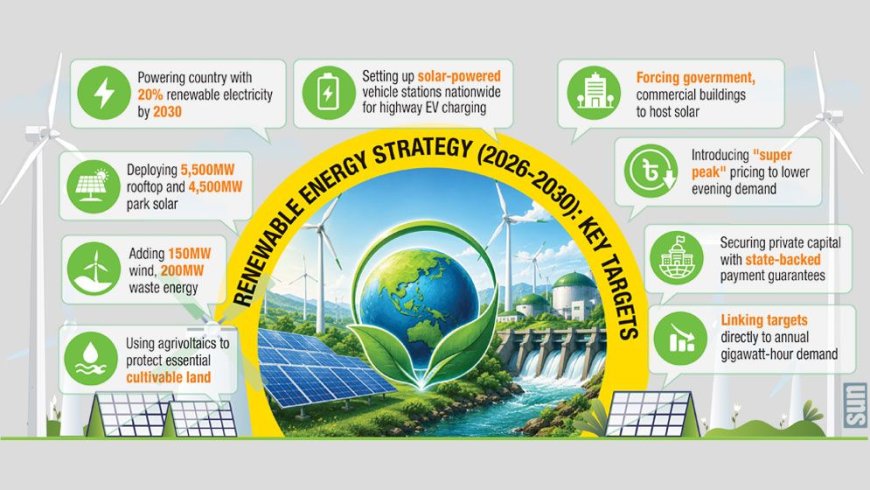
With electricity demand projected to grow by around 6% annually and reach as much as 25,000MW by 2030, the government plans to add approximately 10,450MW of new renewable energy capacity over the next five years.
The proposed expansion includes 5,500MW of rooftop solar, 4,500MW from utility-scale solar parks, 150MW of wind power, 200MW from waste-to-energy facilities and another 100MW from other renewable technologies.
Implementation will begin gradually in 2026 and 2027, focusing on policy reforms, land identification, competitive bidding and grid readiness. From 2028 onwards, the rollout is expected to accelerate through private investment, public-private partnerships, merchant power projects and rooftop Renewable Energy Service Company (RESCO) models.
To address Bangladesh's acute shortage of land, the strategy promotes agrivoltaics, enabling solar installations to coexist with agriculture, fisheries and livestock farming while preserving cultivable land.
It also proposes mandatory rooftop solar systems on government buildings, stricter building regulations requiring commercial and residential developments to reserve roof space for solar installations, and enhanced incentives under the net-metering programme.
Beyond solar power, the draft lays out policy frameworks for both onshore and offshore wind energy, electric vehicle (EV) charging infrastructure and nationwide energy efficiency initiatives. These include solar-powered EV charging stations along highways, expanded energy audits, revised office hours to maximise daylight use and "super peak" electricity pricing to reduce evening demand.
Energy experts have welcomed the strategy for providing greater policy certainty.
Shafiqul Alam, lead energy analyst at the Institute for Energy Economics and Financial Analysis, told the Daily Sun that the new framework addresses longstanding ambiguities in previous renewable energy policies.
"Previous policies created uncertainty over whether renewable targets referred to as percentage of installed capacity or peak demand," he said.
"The new strategy instead links the target to annual electricity demand measured in gigawatt-hours and provides a technology-wise implementation roadmap showing how different renewable sources will contribute over time."
Shafiqul also praised the integration of supply expansion with demand-side management.
"The implementation roadmap is much clearer than before. However, achieving the targets will ultimately depend on whether sufficient investment can be mobilised and projects are implemented on schedule," he said.
He further welcomed the proposal to provide government payment guarantees for selected utility-scale renewable energy projects, saying it could help ease investor concerns following recent revisions to project agreements.
Industry leaders also expressed optimism while cautioning that longstanding implementation challenges must be addressed.
Mostafa Al Mahmud, president of the Bangladesh Sustainable and Renewable Energy Association, told the Daily Sun that the draft strategy demonstrates policymakers now recognise the urgency of accelerating the country's green energy transition.
"The government's overall approach is highly positive and reflects many of the issues the industry has raised over the years," Mahmud said, adding that investors are likely to welcome commitments to promote public-private partnerships and green bonds.
However, he warned that limited land availability, inadequate grid connectivity and slow investment approval processes remain major obstacles to achieving the strategy's goals.
Mahmud also noted that recent fiscal measures affecting battery imports could discourage households from investing in rooftop solar systems unless the issue is addressed before the strategy is finalised.
"If the implementation roadmap is executed effectively and investment flows as planned, the country could make substantial progress towards building a cleaner, more secure and more diversified energy system over the next several years," he added.
What's Your Reaction?