







































"Use USSD Instead of Bangla QR for Micro-Level Transactions"
"Use USSD Instead of Bangla QR for Micro-Level Transactions"

USSD Could Be the Key to Expanding Cashless Payments Beyond Smartphones
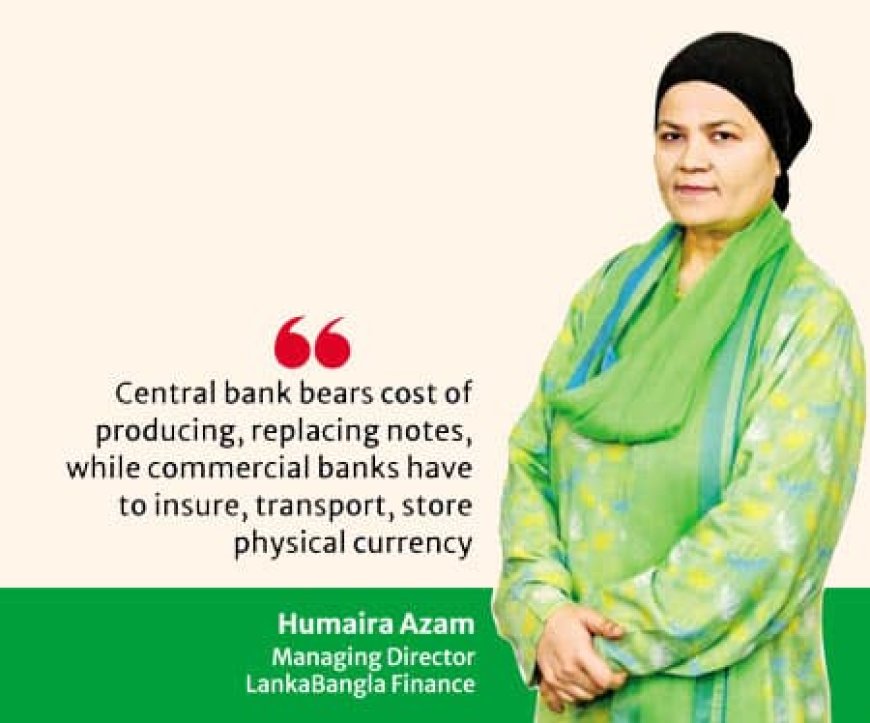
As Bangladesh Bank promotes Bangla QR as a unified platform for interoperable digital payments, financial-sector veteran Humaira Azam believes an even simpler technology—USSD (Unstructured Supplementary Service Data)—could play a crucial role in extending cashless transactions to every corner of society, including street vendors and small retailers.
Ms. Azam, managing director of LankaBangla Finance, says moving toward a cashless economy offers significant advantages, particularly by reducing the costs banks and financial institutions incur in handling, transporting and safeguarding physical cash. However, she argues that a digital-payment ecosystem built primarily around smartphones risks leaving a large segment of the population behind.
Drawing on her 36 years of experience in Bangladesh's financial sector, she questions the practicality of relying solely on QR-code technology.
“How many people actually own smartphones?” she asks.
Instead, she recommends adopting USSD, which works on basic mobile phones and does not require internet access.
“If we use the USSD system, then it can be popularised for everyone,” she says.
Her proposal comes as Bangladesh seeks to expand Bangla QR from banks and large businesses to millions of small merchants, including roadside tea stalls and neighborhood shops.
According to Bangladesh Bank, around 2.2 million merchants have already transitioned from multiple QR codes to Bangla QR, an interoperable system that enables merchants to receive payments from different banks and mobile financial service (MFS) providers through a single QR code.
Despite this progress, Ms. Azam says widespread adoption will require far more than technology.
“If you want to reach even a tea stall with this QR code, you need a dedicated team,” she says. “Someone has to visit the merchants, install the QR codes and train them on how to use the system.”
She believes the real challenge lies in onboarding millions of businesses and ensuring digital payment methods remain simple and convenient.
“Challenges certainly exist,” she says. “These businesses could number around 12 million, and that figure may continue to grow. The question is: how do you bring everyone onto the platform?”
Learning from Global Models
Ms. Azam believes Bangladesh can learn from countries that have successfully scaled digital payments while tailoring solutions to local realities.
She cites India’s Unified Payments Interface (UPI) as an example of how digital payments can be made widely accessible. However, she stresses that simplicity should remain Bangladesh’s top priority.
“If we use the USSD system, it can be made accessible to everyone,” she reiterates.
She also urges policymakers to avoid imposing taxes or other barriers that might discourage small merchants from adopting digital payment systems.
“Keep it simple and user-friendly. Bring merchants onto the platform first, observe their business performance and then determine an appropriate taxation framework,” she suggests.
'One Merchant, One QR'
Ms. Azam says one of the biggest strengths of Bangla QR is its "One Merchant, One QR" concept.
Previously, merchants often had to display multiple QR codes for different banks and mobile financial service providers. Bangla QR replaces that complexity with a single interoperable code, making digital payments easier for both businesses and customers.
“Ultimately, what we want is to build a cashless society,” she says.
Even so, she acknowledges that Bangladesh is still in the early stages of its digital-payment journey.
“Many more steps will be needed. There will be trial and error because people need time to learn and become comfortable with the system,” she says.
Lessons from China
Ms. Azam points to China as an example of how digital payments can become an integral part of everyday life.
“In China, people use WeChat and QR codes for everything—from paying utility bills to buying small items. The system works efficiently,” she notes.
She believes Bangladesh does not need to reinvent the wheel but can adapt proven international models while addressing local challenges.
“If flaws arise, we can study how other countries solved similar problems and apply those lessons here,” she says.
Reducing the Cost of Cash
Beyond convenience, Ms. Azam highlights the economic costs associated with maintaining a cash-based system.
Bangladesh Bank spends substantial amounts printing and replacing damaged banknotes, while commercial banks bear additional expenses for insurance, transportation, storage and security.
“Think about the millions of damaged notes that have to be reprinted. That's a real cost for the country,” she says.
She argues that reducing reliance on physical currency would significantly lower these operational costs while allowing more money to circulate productively within the economy.
“Cash sitting idle in vaults does not contribute to economic activity. It simply remains unproductive,” she says.
She adds that banks also spend heavily on insurance due to vault-capacity limits, secure transport and cash-handling infrastructure.
“When you consider insurance, transportation, security, armoured vehicles, reprinting costs and manpower, the expenses are enormous. Reducing cash usage eliminates many of these costs,” she says.
Building an Inclusive Cashless Economy
For Ms. Azam, the success of Bangla QR will ultimately depend on how deeply it penetrates everyday commerce beyond formal banking channels.
She envisions educational institutions accepting digital payments for tuition, hospitals and clinics processing payments around the clock, government service centres adopting cashless transactions and rural merchants becoming part of the digital ecosystem.
Achieving that vision, she says, will require a sustained, multi-year effort rather than a single policy initiative.
Authorities must continue expanding merchant coverage, deploying teams to install QR systems and educating both businesses and consumers about digital payments.
Responding to concerns that a cashless economy could reduce central bank earnings from issuing currency, she argues that such concerns overlook the broader financial burden of handling cash.
“People often look only at the revenue from issuing banknotes,” she says. “But have they considered the total operational cost of managing physical cash?”
For Ms. Azam, the debate should focus on the economy-wide benefits of reducing cash dependence rather than the income generated through currency issuance.
“A cashless society is extremely important,” she says. “There is a reason why advanced economies are already benefiting from digital payments. That is the direction we need to move toward.”
What's Your Reaction?