














































Tk17,000 crore rooftop solar investment window opens
Tk17,000 crore rooftop solar investment window opens

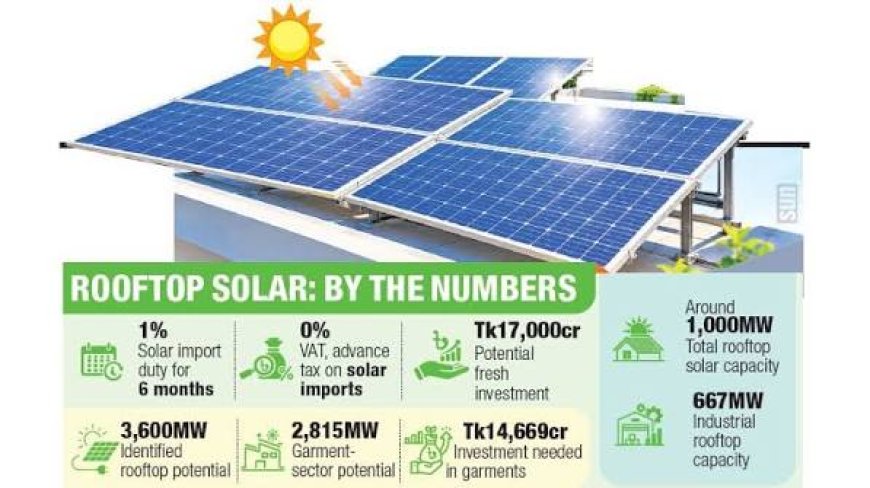
Industrial rooftops are emerging as a major new investment opportunity in Bangladesh, as tax breaks, low-cost financing and net metering combine to drive an estimated Tk17,000 crore in fresh solar investment.
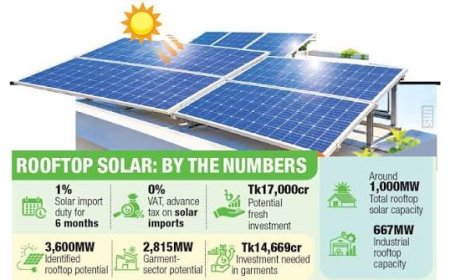
The National Board of Revenue (NBR) issued a gazette notification last Wednesday reducing import duties on solar equipment to 1% for six months and removing the existing 15% VAT and 2% advance tax, which had pushed the combined tax burden to as high as 64%.
The concessions cover key solar components, including mounting structures, inverters, battery management systems, SCADA and monitoring equipment, as well as solar modules imported by industrial and commercial entities.
According to the Institute for Energy Economics and Financial Analysis (IEEFA), rooftop solar capacity at industrial facilities has already reached 667 megawatts (MW), while total rooftop capacity nationwide, including smaller installations, is estimated to have surpassed 1,000 MW.
IEEFA estimates that further expansion could reduce daytime electricity demand by up to 6%.
Mohammad Hatem, president of the Bangladesh Knitwear Manufacturers and Exporters Association (BKMEA), said the industry had long urged the government to remove taxes on solar equipment.
“Factories need electricity to operate. Since the government is currently unable to fully meet electricity demand, solar power is the only solution,” he told the Daily Sun.
Hatem said rooftop solar installations could require around Tk17,000 crore in new investment and help address the country’s electricity shortfall, estimated at 4,000-4,500MW. Infrastructure Development Company Limited (IDCOL) is supporting the expansion through direct investment and foreign financing arrangements for factories.
M Masrur Reaz, chairman of Policy Exchange Bangladesh, said the latest tax relief builds on earlier measures introduced by the NBR, including duty reductions on inverters, battery packs, lithium cells and solar modules at the beginning of the fiscal year and clarification of HS-code issues in August.
He said the September notification extended the benefits to almost all major components of solar systems, rather than focusing only on panels. This is significant for large rooftop projects, which also require substantial investments in mounting structures, cabling, batteries and control equipment.
3,600MW potential on factory rooftops
An IDCOL assessment identified more than 3,600MW of solar potential across industrial and commercial rooftops nationwide, requiring an estimated Tk16,000-17,000 crore in investment.
The assessment identified 1,171 establishments suitable for immediate installation, with potential capacity of around 1,263MW. Another 4,712 establishments could add a further 2,358MWp.
The ready-made garment and textile sector accounts for the largest share, with around 2,815MW of potential requiring an estimated Tk14,669 crore in investment. A separate Centre for Policy Dialogue (CPD) study estimated rooftop solar potential in the garment sector at up to 1,768MWp.
IEEFA has also highlighted the potential for solar-powered irrigation. Converting one-third of Bangladesh’s predominantly diesel-powered irrigation pumps to solar could reduce annual diesel import costs by around $244 million, equivalent to roughly Tk3,000 crore.
Net metering and financing
Under the 2025 Net Metering Guidelines and the National Rooftop Solar Programme, which targets 2,000-3,000MW of additional capacity, consumers can supply excess solar electricity to the national grid.
The revised 2025 rules also require buildings with at least 1,000 square feet of usable rooftop space to install solar when applying for new electricity connections. In specified cases, industrial and commercial consumers must install solar capacity equivalent to at least 20% of their approved load.
A separate incentive announced in early September guarantees Tk10.50 per unit for surplus electricity generated by qualifying rooftop systems installed by February 28, 2027. The guaranteed rate will remain in effect until February 2030.
The government is also establishing a Tk1,500 crore fund to provide low-interest financing for renewable energy projects covering households, institutions and industrial facilities.
The loans will have a maximum tenure of 10 years, including a one-year grace period, and can finance rooftop solar systems, net metering equipment, solar home systems, irrigation pumps and related inverters, meters and batteries.
Energy economist Shafiqul Alam said the fund underscored the government’s focus on renewable energy. He added that involving IDCOL and the Palli Karma-Sahayak Foundation (PKSF) could help extend the benefits to rural areas, although low-income households would still require capital subsidies in addition to loans.
Early movers
Ha-Meem Group has installed 17MWp of rooftop solar across three factories with IDCOL financing, reducing diesel consumption by around 60%.
Walton Hi-Tech Industries currently has 33.8MWp of rooftop solar capacity and plans to expand it to 50MW. Gunze United Limited commissioned a 424kWp rooftop solar project featuring 722 panels at the Dhaka Export Processing Zone in August.
Industry stakeholders say solar generation during daylight hours aligns closely with factory operating schedules, making rooftop systems particularly suitable for industrial users.
IEEFA’s August analysis found that 239 large industrial establishments had installed 667MW of rooftop solar capacity. Including systems below 150kW, total rooftop capacity was approaching 1,000MW, contributing to an estimated 6% decline in daytime electricity demand between 2024 and 2026.
The government has set a target of increasing Bangladesh’s total solar capacity to 10,000MW within five years, Power, Energy and Mineral Resources Minister Iqbal Hasan Mahmud Tuku announced in July.
At the time, installed solar capacity stood at 797MW, according to figures from the Bangladesh Power Development Board and Power Cell.
What's Your Reaction?