










































Advanced tubeless kidney stone surgery now routinely performed at BMU
Advanced tubeless kidney stone surgery now routinely performed at BMU.

Advanced Tubeless Kidney Stone Surgery Now Routine at BMU
Bangladesh Medical University (BMU) has begun routinely performing Total Tubeless Mini-Percutaneous Nephrolithotomy (Mini-PCNL), an advanced minimally invasive procedure for removing kidney stones that can reduce treatment costs, shorten hospital stays and accelerate recovery.
The procedure is regularly being performed by a team of urologists led by Prof Dr Rafiqul Islam at BMU’s Department of Urology.
Prof Rafiqul Islam said the technique is cost-effective and allows most patients to return home within 48 hours of surgery. Although the procedure is still rarely performed outside BMU, the university is now conducting it regularly to minimise patients’ suffering and speed up recovery.
“This is a low-cost procedure. Patients can usually be discharged within 48 hours of surgery,” he told the Daily Sun.
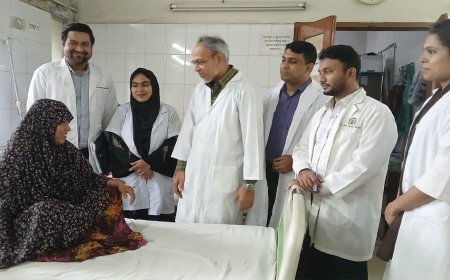
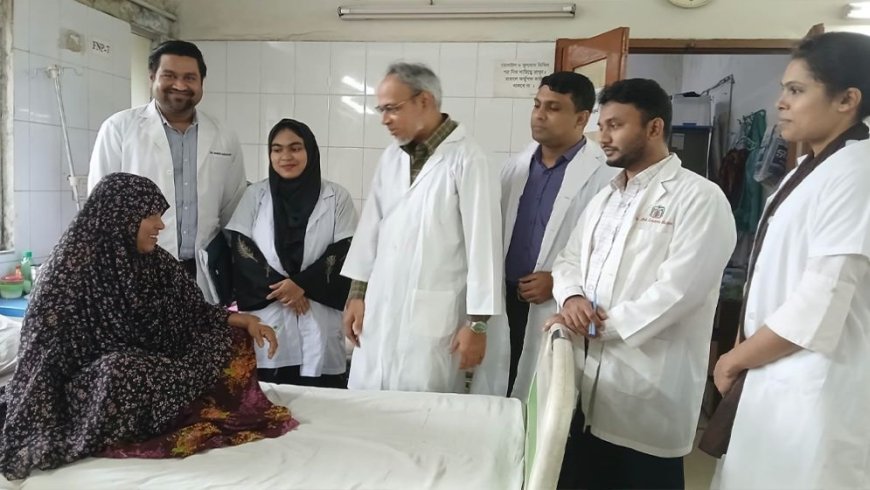
During a recent visit to Ward 4B of the Department of Urology, a patient, Haleema Khatun from Tangail, said she was admitted on 9 July after experiencing severe lower abdominal pain. Doctors at a local hospital had referred her to BMU, where tests confirmed a kidney stone in her right kidney.
“I was worried about the surgery and possible complications, but I never imagined the stone could be removed so easily,” she said.
Dr Nahid Hasan Rifat, a medical officer at the Department of Urology, said kidney stone cases are among the most common conditions treated at the department. Under Prof Rafiqul Islam’s leadership, Mini-PCNL, which was previously performed only occasionally at BMU, is now being carried out every week.
According to Dr Rifat, the procedure costs more than Tk100,000 at many private hospitals, while the same treatment at BMU costs around Tk10,000 to Tk12,000.
Mini-PCNL is a minimally invasive keyhole procedure used to remove medium-sized and large kidney stones through a small incision, generally measuring one centimetre or less, in the patient’s back. Compared with conventional open surgery and standard PCNL, it typically involves less bleeding and pain and allows faster recovery.
Explaining the Total Tubeless Mini-PCNL technique, Prof Rafiqul Islam said the procedure eliminates the need for drainage tubes and stitches after surgery.
In conventional PCNL, a drainage tube is often placed in the kidney following surgery and may need to be removed in a subsequent procedure four to six weeks later. Total Tubeless Mini-PCNL avoids the need for such a tube, potentially reducing infection risks and eliminating the need for another procedure.
Prof Rafiqul Islam said the technique is generally suitable for kidney stones measuring up to 25 millimetres, while larger stones may require standard PCNL involving a drainage tube.
“I introduced this procedure after considering the suffering patients go through. Our aim is to provide treatment that allows people to recover quickly, reduces their pain and minimises the need for repeated hospital visits,” he said.
He added that treatment selection depends on the size and location of the stone.
“It is not reasonable to perform a large incision for a small stone. That is why minimally invasive procedures such as Mini-PCNL have become an important standard treatment option,” he said.
According to the Institute for Health Metrics and Evaluation (IHME) at the University of Washington, more than 12.9 million people in Bangladesh are living with kidney disease, while around 17,000 people die from kidney-related illnesses every year.
Kidney-related conditions include chronic kidney disease associated with diabetes and hypertension, kidney stones, kidney cancer, urinary tract disorders, kidney inflammation and acute kidney injury.
A recent survey also found that kidney disease is the second-largest reason for Bangladeshis seeking medical treatment abroad after heart disease. While 29.8% of overseas medical travellers seek treatment for heart-related conditions, 17.3% travel abroad for kidney-related care.
What's Your Reaction?