



































































Spinners warn of possible factory shutdowns from February 1
Textile millers warn they will suspend production if the government fails to halt duty-free yarn imports within the month

Local textile millers have threatened to shut down spinning units indefinitely from February 1 if the government does not withdraw the duty-free yarn import facility by the end of this month.
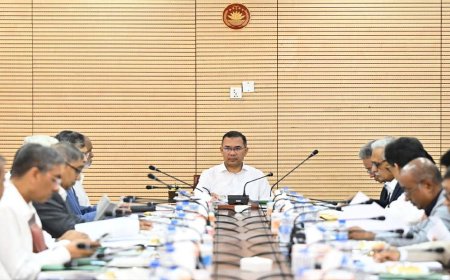
Speaking at a press conference at the Bangladesh Textile Mills Association (BTMA) office in Dhaka yesterday, BTMA leaders warned that the government would be responsible for any labour unrest triggered by factory closures. They also cautioned that a production halt would make it difficult for spinners to repay bank loans and meet other financial obligations.
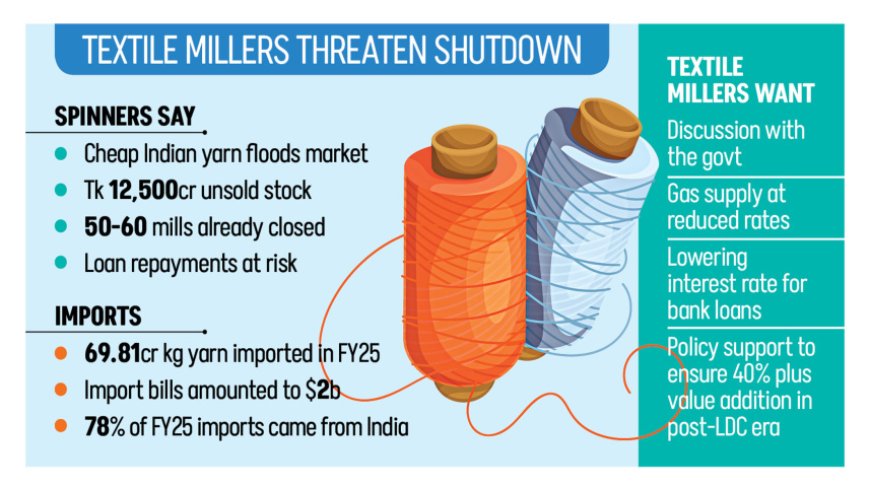
According to BTMA, domestic mills are currently burdened with unsold yarn stocks worth Tk 12,500 crore as cheaper Indian yarn continues to flood the local market. The warning comes amid opposition from apparel manufacturers and exporters to the commerce ministry’s proposal to withdraw duty-free benefits under the bonded warehouse facility for certain yarn imports.
BTMA leaders said local mills have sufficient capacity to meet domestic yarn demand. However, the Bangladesh Garment Manufacturers and Exporters Association (BGMEA) and the Bangladesh Knitwear Manufacturers and Exporters Association (BKMEA) argue that locally produced 10 to 30-count cotton yarn is more expensive than imported alternatives.
Describing the situation as a “national crisis” and an “emergency” for the spinning sector, BTMA President Showkat Aziz Russell said many mills are operating at only 60 percent capacity due to gas shortages, yet the government continues to collect taxes and VAT without adjusting gas prices.
He also warned against over-reliance on a single source, recalling difficulties faced by local millers when India previously suspended cotton exports. Russell said that after Bangladesh graduates from the least developed country (LDC) category in November this year, a minimum of 40 percent local value addition will be required to enjoy trade benefits, but the government has made no preparations to meet this requirement.
Russell further criticised the lack of dialogue with the government and termed the prevailing bank interest rate of around 16 percent as “misguided”.
Former BTMA director Razeeb Haider said the sector’s problems stem from long-term structural disadvantages caused by heavy subsidies provided by the Indian government to its textile and garment industry. He warned that Bangladesh risks losing competitiveness to Indian yarn.
He noted that cotton yarn imports rose from 35 crore kilogrammes in fiscal year 2022-23 to 69.81 crore kilogrammes in fiscal year 2024-25, with import values increasing from Tk 14,400 crore to Tk 26,400 crore. Nearly 78 percent of these imports in FY25 came from India, highlighting heavy dependence on a single supplier.
Haider stressed that local spinning mills are capable of supplying the full domestic requirement and said millers are seeking restrictions only on 10 to 30-count yarn imports, while allowing imports of other counts.
Russell welcomed the government’s decision to stop yarn imports through land ports earlier this year, saying sea-route imports now better reflect market realities. He warned that India’s subsidy-backed textile policies pose a serious threat to Bangladesh’s $23 billion primary textile sector.
BTMA Director Badsha Mia said cheap, subsidised Indian yarn has already forced 50 to 60 local mills to shut down over the years. He added that the sector is under growing pressure as international apparel brands increasingly source foreign fabrics.
As a result, Bangladesh exports around $42 billion worth of garments but imports $32 billion in raw materials, leaving a retention value of only $10 billion, excluding environmental and water costs, he said. While the bonded warehouse facility was initially necessary for the garment sector, Mia argued that the local backward linkage industry has now matured enough to support domestic demand.
What's Your Reaction?