
































Parliament Welcomes the Return of Democracy
Parliament Welcomes the Return of Democracy

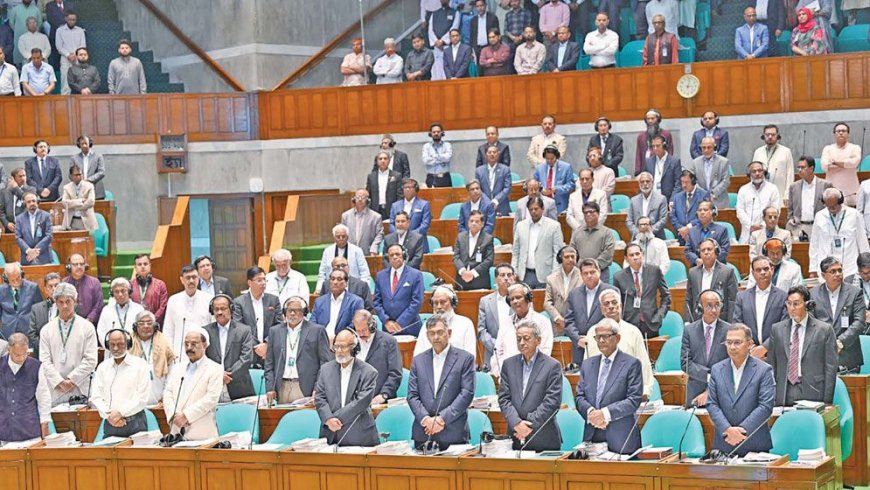
Democracy returned to Bangladesh’s parliament on Thursday as the 13th National Parliament held its first sitting after months under an interim administration, though the inaugural session was marked by a walkout by opposition MPs protesting the President’s speech.
Prime Minister Tarique Rahman called on lawmakers to rise above partisan divisions and transform the new legislature into a meaningful “people’s parliament”.
The opening sitting began at 11:05am with a recitation from the Holy Quran at the Jatiya Sangsad Bhaban. In the absence of the previous parliament’s Speaker and Deputy Speaker, BNP Standing Committee member and senior parliamentarian Khandaker Mosharraf Hossain presided over the session with the unanimous consent of lawmakers.
At around 10:55am, Prime Minister Tarique Rahman entered the chamber, where members from both treasury and opposition benches welcomed him by thumping their desks.
It was the first time Tarique Rahman attended the opening session of parliament as a member of parliament.
He proposed that the House elect a presiding member and nominated Khandaker Mosharraf Hossain to chair the session in the absence of former Speaker Shirin Sharmin Chaudhury and Deputy Speaker Shamsul Haque Tuku following the July uprising in 2024.
The proposal was supported by BNP Secretary General and Local Government Minister Mirza Fakhrul Islam Alamgir and endorsed by Syed Abdullah Mohammad Taher, deputy leader of the main opposition and Nayeb-e-Ameer of Bangladesh Jamaat-e-Islami.
Taher described Mosharraf as a widely acceptable and experienced parliamentarian. After lawmakers voiced approval by thumping their desks, Mosharraf took the Speaker’s chair, escorted by the sergeant-at-arms in accordance with parliamentary protocol.
According to the day’s agenda, the election of the Speaker and Deputy Speaker was the first order of business. The 13th parliament convened nearly 20 months after the interim government was formed following the July uprising.
Major (Retd) Hafiz Uddin Ahmed, member of parliament for Bhola-3, was elected Speaker under Mosharraf’s chairmanship, while Kaiser Kamal, MP for Netrokona-1, was elected Deputy Speaker.
President Mohammed Shahabuddin later administered the oath of office to both.
Only one nomination had been submitted for the Speaker’s post. Chief Whip Nurul Islam Moni proposed Hafiz Uddin Ahmed’s name, seconded by Whip Rakibul Islam Bakul. The motion was approved unanimously by voice vote.
Hafiz Uddin Ahmed has been elected to parliament seven times from Bhola-3. A decorated freedom fighter and recipient of the Bir Bikram gallantry award, he most recently served as Minister for Liberation War Affairs.
Similarly, Kaiser Kamal’s nomination for Deputy Speaker was proposed by Whip M Ruhul Quddus Talukder Dulu and seconded by Whip ABM Ashraf Uddin Nizan before being passed by voice vote. Kamal was elected to parliament for the first time in the 13th general election and currently serves as State Minister for Land.
Following the elections, the session briefly recessed while the President administered the oath to the new Speaker and Deputy Speaker in the President’s Room inside the parliament building.
The session resumed at about 12:45pm under Speaker Hafiz Uddin Ahmed but was briefly disrupted by a microphone malfunction. The Speaker continued proceedings using a handheld microphone before announcing a 20-minute recess, noting that the technical issue would be resolved shortly.
As the call to the Zuhr prayer had begun, he temporarily suspended the sitting.
The Speaker apologised for the disruption and thanked lawmakers for electing him unopposed.
“After 17 years, we have finally obtained a functional parliament,” he said. “The parliament has not been accustomed to democratic speeches for a long time, so we must wait patiently.”
The session resumed shortly after 1:30pm.
Speaker pledges neutrality
In his opening speech, Hafiz Uddin Ahmed paid tribute to the martyrs of the Liberation War and reflected on Bangladesh’s democratic journey.
He recalled that parliamentary democracy had been introduced in 1991 under the leadership of Khaleda Zia, when ruling and opposition parties worked together despite repeated disruptions to democratic governance.
He also noted that democracy had been “killed” in 1975 when a one-party system was introduced, ushering in periods of authoritarian rule. Nevertheless, he said the people of Bangladesh had consistently resisted autocratic regimes to defend democratic values.
Referring to the mass uprising in July and August 2024, he said students, political activists and ordinary citizens had overthrown what he described as a fascist government.
He offered prayers for those who died in the movement, including Abu Sayed, Mugdha and Wasim.
The Speaker described the 12 February election as the fairest he had witnessed in his experience of participating in ten national polls.
He expressed hope that both government and opposition parties would cooperate in the national interest and pledged to ensure the opposition could play an effective role in parliament. To maintain neutrality, he said he had resigned from the BNP Standing Committee.
“Our motto should be ‘Bangladesh First,’” he added.
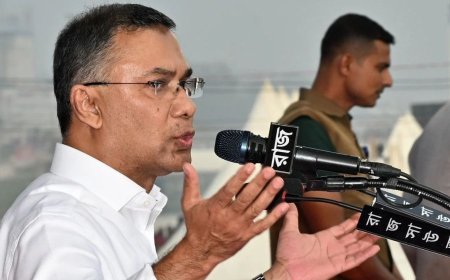
Congratulating the new Speaker and Deputy Speaker, Prime Minister Tarique Rahman said that from the moment of their election they no longer belonged to any political party but served as guardians of the national parliament.
He said that for more than a decade democratic rights had been curtailed and parliament had been turned into “a club of rights violators”, but that the new parliament consisted of representatives directly elected by the people.
Tributes to Khaleda Zia and July martyrs
A special discussion was held on the late former prime minister Khaleda Zia and the martyrs of the July mass uprising, after which parliament adopted a condolence motion.
Mirza Fakhrul Islam Alamgir said that throughout her 43-year political career Khaleda Zia had never compromised on democracy and independence.
He said her government had introduced major reforms in education and women’s development, including compulsory primary education and the establishment of the Open University, the National University and private universities and medical colleges.
Mirza Fakhrul also said that after being released from prison, Khaleda Zia had called not for revenge but for unity, saying: “Let us build a Bangladesh of love.”
Home Minister Salahuddin Ahmed said Khaleda Zia would have been happiest had she been present in parliament.
“Today the mother of democracy is no longer among us,” he said. “However, she lives among the people and will continue to live as an inspiration for democracy.”
He also paid tribute to the martyrs of the 1971 Liberation War and the July uprising.
Ordinances placed before House
Law Minister Md Asaduzzaman presented 133 ordinances issued by the interim government during its 18-month tenure from August 2024.
The ordinances were promulgated under Article 93(1) of the Constitution, which allows the president to enact laws in emergency situations when parliament is not in session.
Under constitutional rules, such ordinances must be placed before the new parliament during its first sitting and approved within 30 days or they lose legal validity.
Chief Whip Nurul Islam Moni later proposed a 14-member special committee, headed by Barishal-3 MP Zainul Abedin, to scrutinise the ordinances.
Opposition walkout during President’s address
Tensions rose later in the afternoon when MPs from the Jamaat alliance staged a walkout during the President’s address.
At around 3:30pm, as it was announced that President Mohammed Shahabuddin would enter the chamber, opposition MPs stood up and displayed red cards bearing the slogan “No betrayal with July”.
While members of the ruling party rose in line with parliamentary tradition to greet the President, a section of opposition MPs remained seated as part of their protest before leaving the chamber.
In his speech, President Shahabuddin called on all political parties to work together for the country’s future.
“The members of parliament from both the treasury bench and opposition are accountable to the nation for national progress and development,” he said. “If we work together with unity and a shared purpose, we can build a secure Bangladesh for future generations.”
Parliamentary committees formed
Five parliamentary committees were formed on the opening day, including the Business Advisory Committee and the House Committee announced by the Speaker.
Chief Whip Nurul Islam Moni also proposed the formation of the special committee, the Committee on Privileges and the Committee on Private Members’ Bills and Resolutions, which were approved by voice vote.
Following their election, both Speaker Hafiz Uddin Ahmed and Deputy Speaker Kaiser Kamal resigned from their party posts in the BNP in accordance with constitutional requirements that the offices remain politically neutral.
Dignitaries attend opening
The opening session drew a large number of dignitaries and diplomats.
Among those present in the VVIP gallery were the interim government’s Chief Adviser Dr Muhammad Yunus, former Law Adviser Asif Nazrul, Chief Election Commissioner AMM Nasir Uddin and members of the prime minister’s family, including Zubaida Rahman and Zaima Rahman.
Senior military officials, including Chief of Army Staff General Waker-Uz-Zaman and the chiefs of the navy and air force, were also in attendance.
Foreign diplomats present included the US ambassador Brent T. Christensen, British High Commissioner Sarah Cooke, Chinese ambassador Yao Wen, Indian High Commissioner Pranay Verma and Pakistani High Commissioner Imran Haider.
Among the visitors in the gallery was Nur Muhammad, the rickshaw-puller who carried the wounded July uprising martyr Golam Nafiz to hospital.
New minister sworn in
Separately, Advocate Ahmed Azam Khan, BNP vice-chairman and MP for Tangail-8, was sworn in as a minister on Thursday.
President Mohammed Shahabuddin administered the oath at the Jatiya Sangsad Bhaban at around 12:45pm in the presence of Prime Minister Tarique Rahman. Cabinet Secretary Nasimul Ghani earlier announced his appointment, although his specific portfolio has yet to be disclosed.
The sitting of the 13th National Parliament was adjourned until 11am on Sunday.
What's Your Reaction?