






















































Investment activity continues to weaken as machinery imports decline further
Growth in LC settlements for capital machinery stayed negative during July–March of FY26.

The momentum of new investment has slowed markedly, reflected in the continued drop in capital machinery imports—one of the clearest indicators of industrial expansion.
This downward trend has now extended over three consecutive fiscal years and persisted through the first nine months of FY2025–26.
Latest data from Bangladesh Bank show that growth in the settlement of letters of credit (LCs) has remained in negative territory throughout the period.
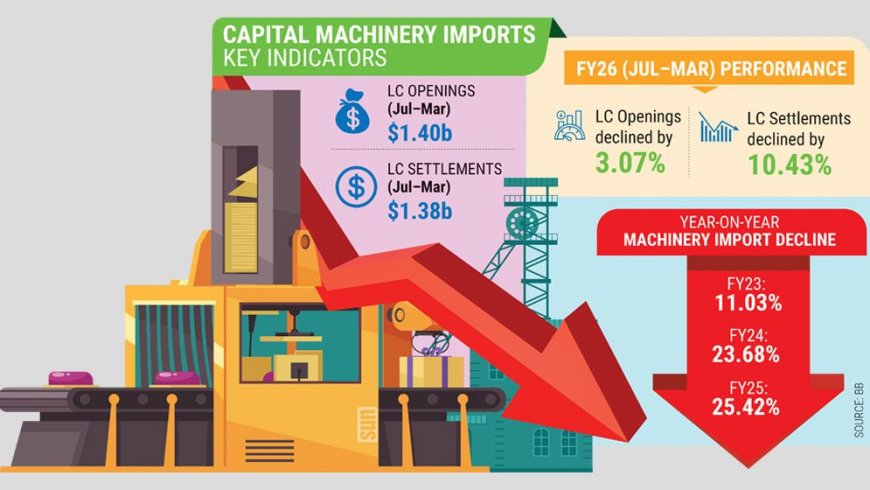
During July–March of FY26, LC openings for capital machinery imports stood at $1.40 billion, slightly lower than $1.44 billion recorded in the same period a year earlier. LC settlements declined more sharply, falling to $1.38 billion from $1.54 billion.
Overall, in the first nine months of the current fiscal year, LC openings and settlements dropped by 3.07% and 10.43%, respectively.
The contraction follows steep declines in previous years, with capital machinery imports falling by 25.42% in FY25 and 23.68% in FY24—pointing to a sustained slowdown in this key investment-linked sector.
Analysts say the decline signals stagnation in new industrial ventures and business expansion, constraining production growth and slowing the adoption of modern technologies. This, in turn, is eroding productivity and efficiency, weakening the competitiveness of exports.
The slowdown is also weighing on the labour market. Data from the Bangladesh Bureau of Statistics (BBS) show the unemployment rate rose to 4.63% in the October–December quarter of FY25, the highest in recent years. The number of unemployed people increased to 2.73 million, up by 330,000 from a year earlier.
Economists note that capital machinery plays a critical role in job creation, as it underpins the establishment of new factories and production facilities. A decline in this sector therefore raises concerns about shrinking employment opportunities.
Widening trade deficit
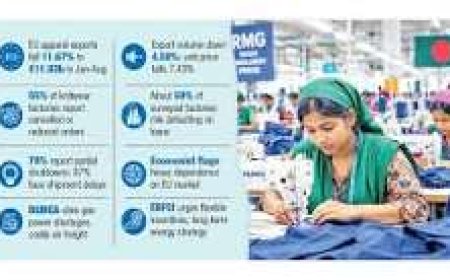
Bangladesh Bank’s analysis also indicates that global trade tensions and weaker demand in key markets have dampened exports, particularly in the ready-made garments sector.
In the first eight months (July–February) of the current fiscal year, the trade deficit reached $16.91 billion, up from $13.77 billion earlier—an increase of $3.13 billion in February alone.
Acknowledging the challenges, Finance and Planning Adviser Rashed Al Mahmud Titumir recently said the government aims to shift toward a more investment-friendly economic model.
“Industrial production is declining and unemployment has risen. As a result, the government is having to provide subsidies in various sectors. We want investment to increase, jobs to be created, and growth to strengthen,” he said.
Economists stress that sustainable growth depends on fresh investment, which drives employment, production, marketing, and exports. Capital machinery sits at the center of this process—when it weakens, the entire economic chain is affected.
They also point to declining investor confidence amid a dollar shortage, high interest rates, policy uncertainty, and broader economic challenges, all of which have dampened import activity.
Experts recommend urgent policy support, resolution of foreign exchange constraints, and market diversification to revive investment momentum. They add that earlier spikes in machinery imports were partly driven by large-scale infrastructure projects, which have since slowed.
Nevertheless, boosting both domestic and foreign investment remains critical for ensuring long-term economic stability.
What's Your Reaction?