


















































Pharmaceutical Industry Faces Energy, Cost and Skilled Manpower Challenges
API Park Production Remains Low Despite Tk1,600cr Investment

Bangladesh’s pharmaceutical industry is facing persistent challenges, including energy shortages, rising production costs, a shortage of skilled manpower and heavy reliance on imported pharmaceutical ingredients, while the country’s only dedicated API industrial park remains underutilised.
Industry stakeholders said the API Industrial Park, established nearly two decades ago to reduce dependence on imported raw materials and strengthen the domestic pharmaceutical supply chain, has yet to reach its full production potential.
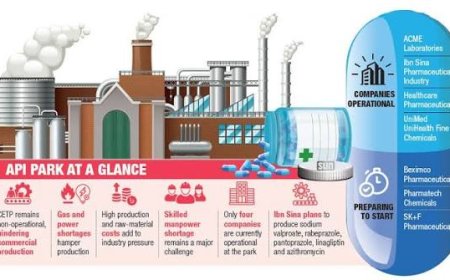
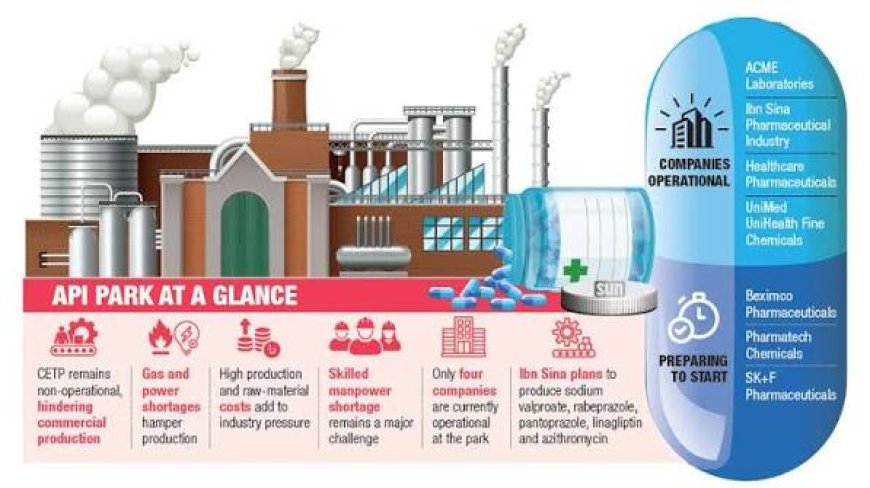
They identified the park’s non-operational central effluent treatment plant (CETP), unreliable gas and electricity supplies, high operating costs and a shortage of technically skilled workers as key barriers to commercial production and fresh investment.
Stakeholders stressed that uninterrupted 24-hour electricity, reliable gas connections and competitively priced raw materials are essential to making API manufacturing commercially viable.
The Bangladesh Small and Cottage Industries Corporation (BSCIC) established the API Industrial Park on 200 acres in Gazaria, Munshiganj, with 42 plots allocated for 25 industrial units. The project began in 2008 and was completed in June 2021, with operations originally expected to start in early 2022.
According to BSCIC officials, four companies are currently operating at the park — ACME Laboratories Ltd, Ibn Sina Pharmaceutical Industry PLC, Healthcare Pharmaceuticals Ltd (HPL) and UniMed UniHealth Fine Chemicals Ltd.
Three others — Beximco Pharmaceuticals Ltd, Pharmatech Chemicals Ltd and SK+F Pharmaceuticals Ltd — received layout approval in 2026 and are preparing to begin operations.
Energy crisis hampers production
Md Shamsul Alam, head of plant at Ibn Sina API Industry Ltd, said the company is currently conducting trial production but has yet to receive a gas connection.
“API manufacturing is largely reaction-based, so a continuous electricity supply is essential. Relying on generators and diesel makes production costly and difficult,” he said.
The company began research and development activities in 2023–24 and started trial production in December 2025. Several products are now undergoing stability testing, with commercial production of two or three low-volume, high-value APIs expected to begin this year once testing is completed.
Shamsul Alam said high raw-material costs, particularly for imports from India and China, were increasing production expenses. The non-operational CETP was another major obstacle.
“Gas and electricity shortages are major obstacles to operating the ETP,” he said.
Ibn Sina has invested nearly Tk100 crore in the project and submitted applications for 15 products to the Directorate General of Drug Administration (DGDA), seven of which have been approved.
The company initially plans to manufacture three or four of those products, including sodium valproate, rabeprazole, pantoprazole, linagliptin and azithromycin.
“There is certainly strong demand for these products in Bangladesh. Once we meet domestic demand for the products we are preparing to manufacture, we hope to export them to international markets,” he said.
Skilled manpower remains a concern
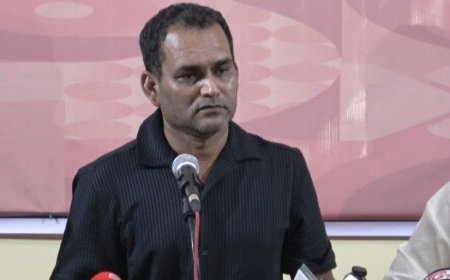
SM Murad Hossain, director of UniMed UniHealth Fine Chemicals Ltd, said the company had established a small laboratory at the park and was working to expand it, but had not yet started full-scale production.
“We have not taken a gas connection yet, although we understand that a gas line has reached the area,” he said.
The company had initially planned to begin operations in December, but the timeline could be delayed.
“API production involves extensive testing, and the process takes time. We may be able to start some production by June next year,” Murad said.
He said the company had been working on the project for around three years, with progress slowed partly by a shortage of experienced API professionals.
“One of the main problems is the shortage of skilled people with experience in API production. Such expertise is still very limited in Bangladesh,” he said.
Global conflicts and supply-chain disruptions have also affected the availability of pharmaceutical ingredients, making it harder for the company to source raw materials and advance its production plans.
For now, the company is focusing on relatively simpler APIs, while the Bangladesh Association of Pharmaceutical Industries is working with the government on guidelines and measures to support domestic API manufacturing.
Park investment reaches Tk1,600cr
Despite the obstacles, industry stakeholders say the API park has significant potential. Investment in the park has reached around Tk1,600 crore, while the project is expected to create employment for roughly 50,000 people once fully operational.
Authorities are also seeking to attract foreign investment, including through joint ventures with local companies.
Bangladesh remains heavily dependent on imports, sourcing around 85 per cent of its biological and non-biological small-molecule API requirements from overseas at an annual cost of about $1.5 billion.
The push to expand domestic API production has become more important as Bangladesh prepares to graduate from the least developed country category. Changes in patent-related flexibilities under the WTO’s TRIPS framework are also expected to increase the importance of local API manufacturing.
Sarwar Hossain, general manager of BSCIC’s Extension Division, said a stakeholder meeting would be held at the API park on Saturday to accelerate activities and address the challenges.
“After the meeting, I can give the details. Later, we will take the necessary initiatives to resolve the crisis,” he said.
What's Your Reaction?