






















































Government announces salt supply and loan support for leather sector
11,500 tonnes of salt to be distributed across the country

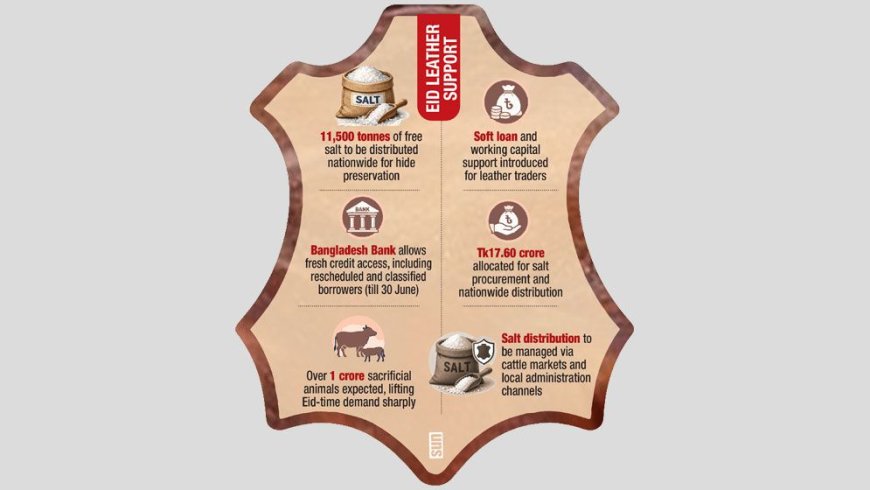
The government has announced a two-pronged support package for the leather sector ahead of Eid-ul-Azha, including the free nationwide distribution of 11,500 tonnes of salt and soft loan facilities to ease liquidity pressure on leather traders.
Officials said the measures, approved by a government taskforce on 17 May, are intended to stabilise the hide supply chain during the Eid season, when mass animal slaughter significantly boosts demand for preservation materials and working capital.
As part of the financial assistance, Bangladesh Bank has introduced special working capital support for leather traders, allowing fresh credit facilities even for borrowers with rescheduled or classified loans until 30 June.
Banks have also been directed to keep lending exposure to the sector at least at last year’s level to ensure sufficient liquidity during the seasonal peak.
On the supply side, the government has undertaken a Tk17.60 crore procurement initiative to distribute salt across the country to prevent raw hide spoilage after slaughter.
The move follows last year’s programme, under which more than 8,000 tonnes of salt were distributed through madrassas, orphanages and charitable organisations, helping preserve an estimated 13.8 lakh hides.
This year, demand is expected to increase further, with preliminary estimates suggesting that 80,000 to 85,000 tonnes of salt may be needed for proper hide preservation during Eid-ul-Azha.
According to the Ministry of Fisheries and Livestock, around 1.23 crore sacrificial animals — including cattle, buffaloes, goats and sheep — are expected this year, with total sacrifices likely to exceed one crore during the festival.
Despite ample national reserves, salt prices have risen sharply ahead of Eid.
The Bangladesh Small and Cottage Industries Corporation (BSCIC) said salt mills in greater Chattogram currently hold more than 1.10 lakh tonnes of stock, with additional supplies available at field level.
However, the price of a 74-kg sack of salt used for hide preservation has increased by around Tk250 over the past two weeks.
Mill-level prices now range between Tk930 and Tk950, up from Tk680 to Tk700 earlier this month.
Industry insiders attributed the hike to seasonal demand pressure, adverse weather affecting coastal production and inefficiencies in the multi-layered supply chain.
Salt Mill Owners Association President Nurul Kabir said mills had prepared for seasonal demand, but rainfall and poor weather conditions reduced field-level output, tightening short-term supply.
Traders said salt is cultivated on nearly 70,000 acres of coastal land in Chattogram and Cox’s Bazar before moving through a supply chain involving field collection, crushing mills and wholesale distribution.
To facilitate smooth Eid operations, authorities will distribute salt through cattle markets, retail outlets and local administration channels at district, upazila and union levels.
Dealer lists will also be circulated to improve coordination and monitoring.
The government is additionally working to strengthen sector governance by preparing a draft database of hide traders and warehouse operators, with plans to introduce formal registration in later phases.
At the same time, training programmes are being conducted for butchers and mosque imams on proper flaying and preservation methods to improve hide quality and minimise wastage during Eid.
The taskforce also recommended uninterrupted electricity supply with stable voltage at the BSCIC Leather Industrial City in Dhaka for at least three months after Eid to support tanning, processing and storage operations across the industrial zone.
What's Your Reaction?