








































Weak local investment discourages foreign capital inflow
Political uncertainty, energy crisis and weakening local investor confidence leave Bangladesh behind regional competitors

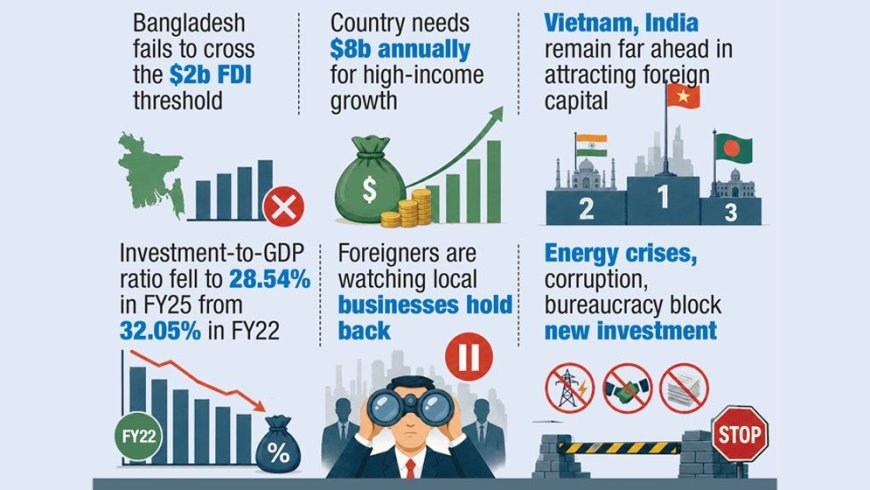
Bangladesh possesses many of the key advantages that typically attract foreign investment: a large domestic market, a strategic location connecting South and Southeast Asia, a youthful workforce, and one of the world’s largest garment export industries. Yet global investors continue to favour other destinations.
While neighbouring countries attract tens of billions of dollars in foreign direct investment (FDI) each year, Bangladesh remains stuck in a low-investment cycle, still struggling to surpass the $2 billion mark.
Economists and business leaders say the issue is no longer just about declining foreign confidence. Increasingly, local investors themselves are holding back — a development experts describe as the strongest negative signal for international investors.
“Foreign investors first look at domestic investors,” said Dr Mustafa K Mujeri, former chief economist of Bangladesh Bank, in an interview with the Daily Sun.
“If local investors are not expanding their businesses, foreign investors naturally become cautious. They assume local entrepreneurs understand the risks better than anyone else,” he added.
The warning comes at a critical time for Bangladesh’s economy, which is grappling with slowing private investment, mounting debt obligations, persistent energy shortages, and growing competition from regional manufacturing hubs such as India and Vietnam.
Far below potential
There are, however, some signs of recovery. According to the latest Bangladesh Bank survey, net FDI inflows rose by 39.36% in 2025 to $1.77 billion, compared with $1.27 billion in 2024.
The country also recorded a modest rebound in FY25, with net investment reaching $1.71 billion.
Still, economists argue that these figures remain far below the level needed to drive long-term industrial transformation. To achieve its goal of becoming a high-income economy, Bangladesh requires an estimated $8 billion in annual FDI. At present, the country’s FDI-to-GDP ratio stands at just 0.3%.
The contrast with regional peers is striking. Vietnam secured nearly $36 billion in FDI commitments in 2024, while India attracted more than $28 billion. Even smaller Southeast Asian economies such as Cambodia are outperforming Bangladesh in greenfield manufacturing investments.
Rupali Chowdhury, president of the Foreign Investors’ Chamber of Commerce & Industry (FICCI) and managing director of Berger Paints Bangladesh Ltd, said the country’s biggest challenge is competitiveness.
“Investors compare countries and ask why they should choose Bangladesh over alternatives like Vietnam — that is the first filter,” she told the Daily Sun.
She identified infrastructure gaps, weak logistics, and inconsistent policies as major barriers.
“Investors entering 20- to 25-year contracts often face sudden changes in gas prices and other terms. Without predictable adjustment mechanisms, disputes emerge and confidence erodes,” she said.
Domestic investment slowdown
Local economic indicators are also raising concern. Data from the Bangladesh Bureau of Statistics (BBS) shows that the investment-to-GDP ratio has gradually fallen from 32.05% in FY22 to 28.54% in FY25.
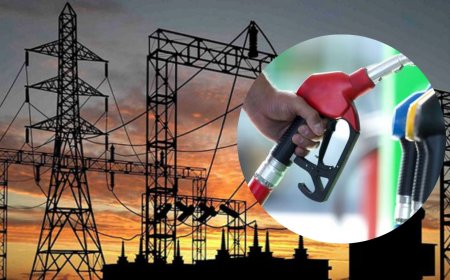
Business owners say expansion plans are being delayed due to erratic gas supply, load-shedding, and bureaucratic hurdles in obtaining utility connections.
Political transition has added to the uncertainty. Following the 2024 national election, many foreign companies adopted a cautious “wait-and-see” stance.
“Foreign investors do not invest for one year,” Dr Mujeri said. “They invest for decades.”
Energy security remains one of the biggest operational obstacles. Mahmud Hasan Khan, president of the Bangladesh Garment Manufacturers and Exporters Association (BGMEA), said rising raw material costs and energy shortages are putting exporters under pressure.
“No investor can establish a factory without guaranteed energy supply,” he told the Daily Sun, noting that the issue is especially important as Bangladesh seeks to expand into higher-value industries such as electronics and pharmaceuticals.
Institutional challenges
Despite the government’s introduction of a “One-Stop Service,” businesses say implementation remains ineffective.
“There is a one-stop service in theory,” one foreign investor said. “But in practice, businesses still have to move from office to office.”
Corruption, unofficial payments, and concerns that agreements signed under one government could be reversed by another continue to discourage investors.
Economist M Masrur Reaz warned that weak revenue collection, poor project governance, and political influence over project selection are worsening the country’s economic vulnerabilities.
He called for stronger tax administration, deeper capital markets, and greater transparency in public investment management.
Ashik Chowdhury, executive chairman of the Bangladesh Investment Development Authority (BIDA), acknowledged that although the 39.36% increase in net FDI is encouraging, overall inflows remain below potential.
He noted that the global decline in greenfield investment in 2025 hit developing economies particularly hard, and said BIDA is focusing on improving Bangladesh’s structural readiness.
“With global conditions still uncertain, we are preparing so that when the tide turns, Bangladesh will be in a stronger position to compete for serious investment,” he said.
Even so, analysts believe the outlook will remain difficult unless the country resolves its internal structural weaknesses.
As Dr Mujeri put it, “If local entrepreneurs do not feel confident enough to invest, foreign investors will never feel fully secure either.”
What's Your Reaction?