



















































Anti-Trump protests kick off across the US on “No Kings” Day
Anti-Trump protests kick off across the US on “No Kings” Day.

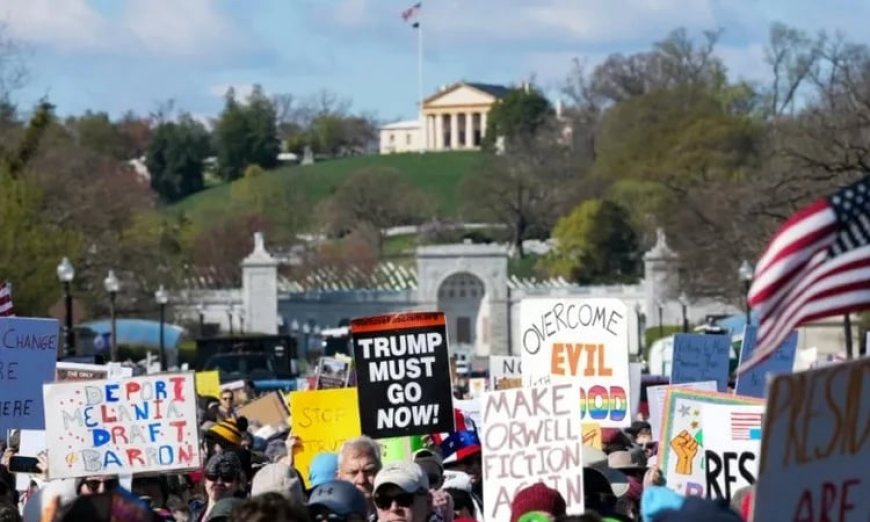
Mass demonstrations against Donald Trump erupted across the United States and abroad on Saturday, as millions voiced anger over what they describe as his authoritarian tendencies and disregard for the rule of law.
The protests mark the third nationwide mobilization in under a year by the grassroots “No Kings” movement, which has emerged as one of the most visible and vocal platforms opposing Trump since the start of his second term in January 2025.
This time, demonstrators are also reacting to a new flashpoint—the war against Iran launched by Trump in coordination with Israel, amid shifting objectives and uncertain timelines.
Rallies took place in major cities including Washington, D.C., Boston and Atlanta, where thousands gathered in public spaces to denounce authoritarianism. In Atlanta, 36-year-old military veteran Marc McCaughey said protesters were concerned about threats to the Constitution and a growing sense that “things aren’t normal.”
In West Bloomfield, near Detroit, demonstrators braved freezing temperatures, while in the capital, marchers crossed a bridge over the Potomac River to the Lincoln Memorial, a historic site of past civil rights protests, carrying signs reading “Trump Must Go Now!” and “Fight Fascism.”
The protest wave has also spread beyond US borders, with rallies in European cities such as Amsterdam, Madrid and Rome, where around 20,000 people marched under tight police security. Participants said they were rejecting a world “governed by kings.”
Organizers expect record turnout. The first “No Kings” protest day last June—coinciding with Trump’s 79th birthday and a military parade in Washington—drew several million participants nationwide. A second round in October reportedly brought out around seven million.
Saturday’s demonstrations aim to surpass those figures, as Trump’s approval rating dips below 40 percent and attention turns to the upcoming midterm elections in November, when Republicans risk losing control of Congress.
Critics accuse Trump of governing by executive order, using the Justice Department against political opponents, promoting fossil fuels while dismissing climate concerns, dismantling diversity initiatives, and increasingly relying on military force despite campaigning as a peace-oriented leader.
Naveed Shah of Common Defense, a veterans’ group aligned with the movement, said the administration has deepened US involvement in conflict while intensifying repression at home, targeting immigrant communities and deploying militarized force against civilians.
More than 3,000 rallies are planned nationwide, spanning cities, suburbs and rural areas—including remote locations like Kotzebue, Alaska. Notably, a growing share of participants now come from outside major urban centers, highlighting the movement’s expanding reach.
Minnesota has emerged as a focal point following its central role in debates over Trump’s immigration crackdown. In St. Paul, legendary musician Bruce Springsteen is set to perform his protest song “Streets of Minneapolis,” written in memory of two Americans killed by federal agents during January demonstrations.
What began in 2025 as a single day of protest has since grown into a broad-based national movement challenging Trump’s leadership and vision for the country.
What's Your Reaction?