



























































Teesta Cries for Survival as Northern Bangladesh’s Lifeline Runs Dry
Teesta Cries for Survival as Northern Bangladesh’s Lifeline Runs Dry

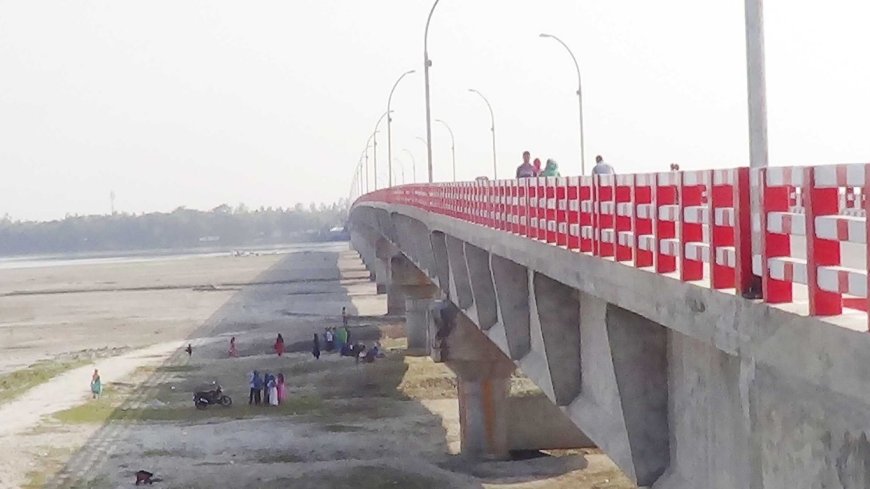
Once a mighty river that breathed life into northern Bangladesh, the Teesta now lies silent and broken — its shimmering waters replaced by stretches of barren sand, its flow reduced to a fading memory for the millions who once depended on it.
The lifeline of nearly two crore people is gasping for survival as its waters vanish, its banks erode, and its people cling to the memories of a river that once defined their lives.
Once a symbol of abundance, locals say, the Teesta now exists only in fragments — swelling briefly during the monsoon before retreating into a desert of cracked sandbanks as winter approaches. The river’s decline has cast a shadow of uncertainty over the Teesta basin, threatening farms, fisheries, and futures alike.
By late October, the mighty Teesta had already run dry — long before the dry season’s arrival.
According to the Water Development Board (WDB), the river’s flow at the Teesta Barrage point over the past 10 days averaged just 17,000 cusecs and continues to fall each day.
As the water disappears, so too do livelihoods. Farmers and fishermen along the Teesta’s banks say they are “dying along with the river,” WDB officials noted.
Experts trace the beginning of the Teesta’s decline to India’s construction of barrages at Gajoldoba near the river’s entry point and at Doani in Lalmonirhat, which disrupted its natural flow. Over the years, its life-giving waters have been diverted through canals, leaving vast stretches of the riverbed dry.
Standing on the banks of the Teesta today, one can almost hear what locals describe as the “sigh of a dying river,” echoing across endless sand where strong currents once surged.
The river’s navigability has declined so drastically that irrigation under the Teesta Barrage — Bangladesh’s largest irrigation project — now faces serious challenges in the coming dry season. Large portions of the riverbed lie exposed, marked only by shallow pools and scattered dunes, according to WDB officials.
Originating from Himalayan glaciers, the Teesta flows through India’s Sikkim, Darjeeling, and Jalpaiguri before entering Bangladesh through Dahagram in Lalmonirhat. From there, it meanders through Nilphamari, Rangpur, and Gaibandha before merging with the Brahmaputra. Once, its fertile chars produced rice, jute, maize, sesame, and vegetables in abundance — shaping the region’s agriculture, culture, and identity.
But the construction of the Gajoldoba Barrage in 1983 altered the river’s course, triggering water shortages in the dry months and devastating floods during the monsoon.
According to WDB data, over 20,000 families have been displaced by river erosion in the past decade, with nearly 35 kilometres of riverbank severely damaged. Recently, a 350-metre stretch of the Teesta bridge protection embankment at Mahipur in Lalmonirhat collapsed into the river.
In Kurigram’s Ulipur upazila, more than 100 homes have been lost to erosion, while in Gangachara over 50 families have been displaced. Hundreds more remain stranded in four villages of Rajarhat upazila.
For years, residents of northern Bangladesh have rallied under the slogan “Save Teesta, Save North Bengal.”
Environmental activists and locals have recently organised human chains, sit-ins, and torch processions across the Rangpur division, demanding urgent action.
During a recent 48-hour campaign along the 115-kilometre river stretch, thousands from Lalmonirhat, Kurigram, Nilphamari, Rangpur, and Gaibandha joined to demand the long-delayed Bangladesh-India Teesta water-sharing agreement and the implementation of the Teesta Master Plan.
The proposed master plan includes dredging the river, rehabilitating char dwellers, and repairing embankments, with an estimated cost of Tk8,000 crore.
According to sources in the Teesta River Protection Movement, Syeda Rizwana Hasan, advisor to the Ministry of Water Resources, confirmed that work on the Teesta Master Plan will begin in January 2026. The 10-year project will be implemented in two phases at a total cost of Tk12,000 crore — with Tk6,700 crore financed through Chinese loans and Tk2,450 crore from government funds in the first phase.
Teesta River Protection Movement coordinator and BNP central organising secretary Asadul Habib Dulu warned that if the government fails to initiate the project with its own funds before the election schedule is announced, a larger movement will be launched with Teesta basin residents.
“The government has already allocated Tk2,450 crore for the first phase. It’s time for action, not promises,” he said.
Ahsan Habib, superintending engineer of the WDB’s Rangpur region, said the Teesta’s water level has been falling since mid-October due to sedimentation.
He, however, assured that the barrage still holds enough water for the upcoming irrigation season but stressed the urgent need for large-scale dredging.
River expert Dr. Tuhin Wadud warned that unless the Teesta is scientifically dredged, the entire northern region could eventually turn into a desert.
“The Teesta’s decline has already disrupted the natural rhythm of the region’s seasons. India’s unilateral withdrawal of water has killed the river — and now it is the government’s responsibility to save it,” he said.
As the Teesta continues to shrink, its once vibrant rhythm is being replaced by silence — and with it, the fate of millions who depend on its flow hangs in the balance.
What's Your Reaction?