































































Growing demand and inadequate storage capacity are leaving the fuel sector increasingly vulnerable
Growing demand and inadequate storage capacity are leaving the fuel sector increasingly vulnerable.

Bangladesh’s energy sector is coming under increasing strain as fuel demand rises faster than storage capacity, leaving the country exposed to global market volatility and supply disruptions.
Despite steady growth in consumption, expansion of storage infrastructure has remained limited in recent years, making the system more vulnerable to external shocks. Analysts warn that without timely investment in strategic reserves and modern storage facilities, Bangladesh risks facing heightened energy insecurity in the years ahead.
Officials and industry data indicate that constrained storage capacity prevents the country from taking full advantage of periods of lower global oil prices, while sudden price spikes add to the financial burden on the state-run Bangladesh Petroleum Corporation (BPC). As a result, the fuel supply system has become both economically pressured and operationally fragile.
Demand rising, reserves falling behind
Fuel consumption in Bangladesh has grown significantly in recent years.
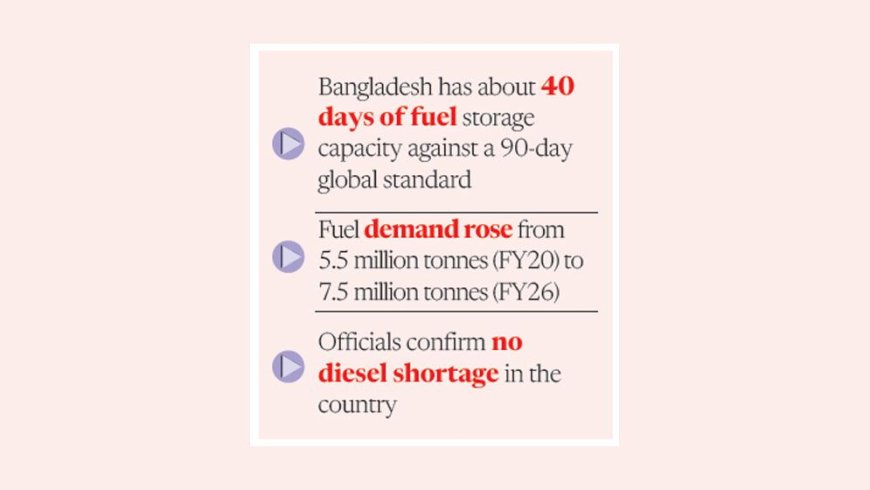
Data from BPC show total usage increasing from around 5.5 million tonnes in FY2019–20 to nearly 7.5 million tonnes in FY2025–26. Diesel accounts for about 70% of total demand, driven by its widespread use in agriculture, transport, and power generation.
The remaining 30% comprises petrol, octane, kerosene, furnace oil, and jet fuel. Overall demand is rising at an estimated annual rate of around 5%, with projections suggesting consumption could surpass 10 million tonnes within the next five years.
The country remains heavily reliant on imports, sourcing roughly 92% of its fuel from international markets, while only about 8% is produced domestically, mainly through condensate processing.
Limited storage capacity
Experts say Bangladesh lacks a strategic fuel reserve and depends largely on short-term operational stocks. On average, the country holds fuel equivalent to less than 40 days of consumption—well below the global benchmark of 90 days or more.
Fuel is stored across 27 depots under BPC and at Eastern Refinery, including river, railhead, and barge facilities. However, diesel reserves have at times dropped below 10 days of demand, raising concerns among policymakers.
Current storage capacity includes approximately 624,189 tonnes of diesel, 53,361 tonnes of octane, 37,013 tonnes of petrol, 144,869 tonnes of furnace oil, 64,118 tonnes of jet fuel, 36,941 tonnes of kerosene, and 16,219 tonnes of marine fuel.
Experts call for strategic reserves
Energy specialists have emphasised the urgent need to establish strategic fuel reserves to strengthen national energy security.
Professor M Tamim, Vice-Chancellor of Independent University, Bangladesh, said such reserves are critical for managing global supply shocks.
“A strategic reserve is meant for emergencies, not routine use. If key supply routes like the Strait of Hormuz are disrupted, financial capacity alone cannot guarantee fuel availability,” he said.
He noted that while Bangladesh may not need reserves on the scale of larger economies, a buffer covering 15 to 30 days of consumption could provide essential resilience during crises.
He also warned that panic-driven consumption could quickly deplete reserves and urged the government to expand both oil and LNG storage, alongside long-term investment in renewable energy.
Rising import costs amid global volatility
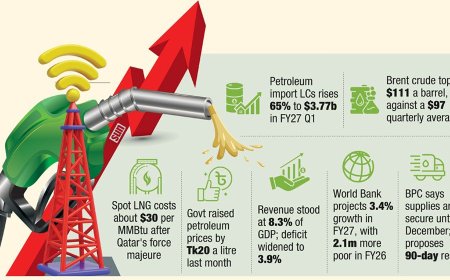
Geopolitical tensions in the Middle East have unsettled global energy markets, pushing up oil and gas prices. Brent crude recently climbed from around $80 per barrel to above $100 before easing slightly.
Liquefied natural gas (LNG) prices have also surged, rising from about $12 per unit to as high as $28. This has placed Bangladesh’s import-dependent energy sector under mounting financial pressure.
Officials estimate that fuel imports are now costing an additional Tk1,500 crore per month. A recent Ministry of Finance analysis projects that Bangladesh will need an extra $2.61 billion in foreign exchange to cover rising energy and fertiliser imports between March and June 2026.
Total import costs for oil, LNG, and fertiliser are expected to reach about $5.62 billion, up from $3.01 billion during the same period last year.
Slow progress on infrastructure
Although the government set a target in 2020 to build storage capacity equivalent to 60 days of demand, progress has been slow. Several projects—including storage tanks in Patenga and jet fuel facilities in Parbatipur and Pitalganj—remain incomplete.
Facilities developed under the Matarbari Single Point Mooring (SPM) project, with a capacity of about 128,000 tonnes, are also yet to become fully operational.
Bangladesh’s only refinery, Eastern Refinery, established in 1963, has an annual capacity of around 1.5 million tonnes. With national demand now near 7.5 million tonnes, the country relies heavily on importing refined fuel, adding to overall costs.
Government stance
Monir Hossain Chowdhury, joint secretary at the Energy Division, said the government is prioritising short-term supply stability while considering long-term expansion.
“Once the current situation stabilises, we will seriously consider expanding storage capacity. Right now, the focus is on maintaining supply and managing the ongoing challenges,” he said.
He added that recent global crises—including the COVID-19 pandemic and geopolitical tensions—have underscored the importance of strengthening energy resilience.
In a briefing on 15 April, he said there is no current diesel shortage. As of 14 April 2026, diesel stock stood at 101,385 tonnes, while petrol and octane reserves were 18,211 tonnes and 32,000 tonnes respectively. Pipeline supply, he noted, is sufficient to meet nearly two months of demand.
He also confirmed the arrival of a major shipment at Chattogram Port, including 109,000 tonnes of diesel and 27,000 tonnes of octane—the largest consignment since the crisis began—which is expected to ease supply pressure and support uninterrupted power generation and industrial activity.
What's Your Reaction?