















































Dhaka–Beijing cooperation must continue under new government: Yunus
He conveyed his appreciation to the Chinese government for its ongoing support and cooperation.

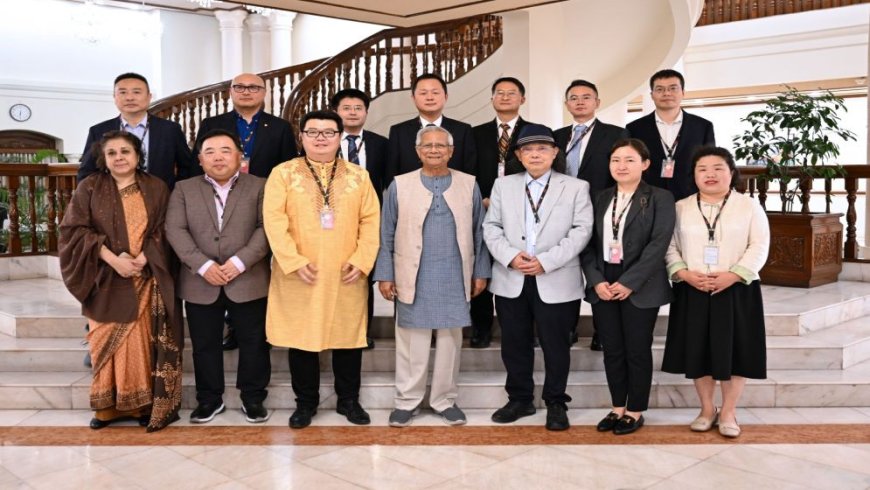
Chief Adviser Prof Muhammad Yunus has said cooperation between Bangladesh and China must continue even as a new government prepares to take office.
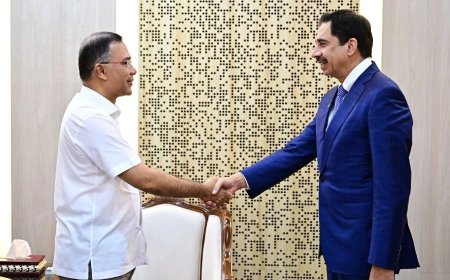
“In a few weeks, I will no longer be in this office and a new government will be formed, but the work between our two countries must go on,” he said during a recent meeting with a delegation from the China-Bangladesh Partnership Forum at the State Guest House Jamuna.
According to the Chief Adviser’s press wing, the delegation comprised senior Chinese academics, investors and industry leaders from the biomedical, infrastructure, digital and legal sectors.
Xin-yuan Fu, a prominent Chinese biomedical scientist and director of the West China School of Medicine at Sichuan University, praised Prof Yunus’ vision and said he looked forward to collaborating with Bangladeshi academics to improve people’s lives.
Andrew Zilong Wong, senior adviser to the board of Walvax Biotechnology, and Yuqing Yao, managing director of Walvax Biotech (Singapore), shared their experiences and expressed interest in working with Bangladesh. Walvax has exported vaccines to at least 22 countries and has established subsidiaries in the United Kingdom and Indonesia. The company is also exploring the localisation of PCV and HPV vaccines and has signed an agreement with a business partner in Indonesia as part of efforts to build local capacity.
Other members of the delegation included Jinsong Wang, vice president of the Robotics Society of Singapore; Yuan Feng, chair of the management committee of Fordall Law Firm; Li Ran, managing director of Beijing Wutong Asset Management; Gao Zhipeng, vice president for international investment and projects at China State Construction Engineering Corporation; Xu Tianzhao, investment director of China Hunan Construction Investment Group; Hua Jie, vice president of China CCC Engineering Group; Chen Shujian, general manager for overseas markets at PowerChina Overseas Investment Group; Professor Ma Xiaoyuan of Yunnan University; and Alex Wang Zekai, secretary-general of the China-Bangladesh Partnership Forum.
The delegation informed the Chief Adviser that they had interacted with Bangladeshi university students on artificial intelligence and digitalisation and expressed admiration for the talent and potential of the country’s youth.
During the meeting, Prof Yunus reflected on his long-standing relationship with China, which began through the microcredit movement.
“I had the opportunity to visit remote villages in China and witness how people’s lives were being transformed. Later, the Chinese government launched its own programmes inspired by these principles,” he said.
Recalling his visit to China in March, Prof Yunus said he met President Xi Jinping, who told him he had read his book and followed its principles.
“That was a very happy moment for me,” he said.
The delegation thanked the Chief Adviser and discussed opportunities for cooperation in health, infrastructure and digital sectors.
Highlighting the interim government’s priorities, Prof Yunus said healthcare remains the top concern.
“Our highest priority is healthcare—how to integrate digital technology so doctors and patients can connect effectively, medical histories can be stored digitally and appointments can be accessed easily,” he said.
He also stressed the importance of promoting social business models in the pharmaceutical sector.
“Medicines cost pennies to produce but are sold for dollars. We want to encourage social business pharmaceutical companies that focus on helping people rather than maximising profits,” he said.
Referring to the COVID-19 pandemic, Prof Yunus recalled Bangladesh’s advocacy for patent-free vaccines.
“We spoke out for patent-free vaccines and faced resistance. When the vote came, 10 countries abstained. They said rich countries would buy vaccines and donate them to poorer nations. We said we don’t need gifts. People were dying while others were making money. This is a shame,” he said.
Prof Yunus also outlined his vision of establishing a “health city” in northern Bangladesh.
“During my visit to China, I proposed building a 1,000-bed international hospital in northern Bangladesh. It is a poor region but strategically located near India, Nepal and Bhutan,” he said.
He explained that the proposed health city would include hospitals, medical colleges, research centres, vaccine production facilities, pharmaceutical industries and medical equipment hubs.
“All health-related activities would be located in one city, benefiting people from Bangladesh as well as India, Nepal and Bhutan,” he added.
Prof Yunus expressed his gratitude to the Chinese government for its continued support and cooperation.
Lamiya Morshed, principal coordinator for SDGs affairs and senior secretary to the government, was also present at the meeting.
What's Your Reaction?