






















































Industries Embrace Rooftop Solar Energy
Industries Embrace Rooftop Solar Energy

Bangladesh’s industrial sector is rapidly embracing rooftop solar as persistent energy shortages, rising electricity prices and growing pressure to reduce carbon emissions drive businesses toward cheaper and more dependable power sources.
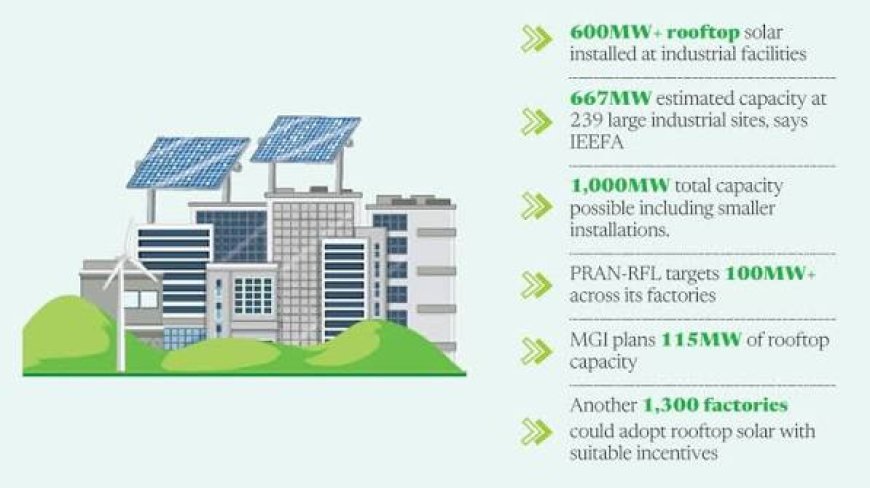
More than 600 megawatts (MW) of rooftop solar capacity has been installed at industrial facilities across the country, with export-oriented garment and textile factories accounting for the bulk of the projects, according to industry officials.
The transition has accelerated over the past two years as factories have faced worsening gas shortages and higher electricity tariffs, while international buyers have increasingly pushed suppliers to reduce their carbon footprint.
DBL Group has installed 5.5MW of rooftop solar across seven garment and textile factories and plans to add another 16MW at 10 facilities, including ceramic and garment units. Of the planned expansion, 8MW is expected to become operational this year, with the remaining capacity scheduled for next year.
“We are investing rapidly in solar power because of energy security concerns at our different businesses and pressure from international buyers to reduce carbon emissions,” said MA Rahim, vice-chairman of DBL Group.
Rahim said technological advances had shortened installation times, while solar-generated electricity at the group’s factories costs around Tk6-Tk6.50 per unit.
Industry officials said most of the country’s large rooftop solar installations had been developed over the past two years.
Although rooftop solar cannot meet an industrial facility’s entire electricity demand, it can support factory operations for three to four hours during daylight. Solar typically supplies 5-15% of a factory’s overall electricity requirements, though the share is significantly higher at some facilities.
Major companies that have adopted rooftop solar include Abul Khair Steel, Walton, Ha-Meem Group, PRAN-RFL Group, BSRM, Youngone Group, Meghna Group of Industries (MGI), Pacific Jeans Group, Team Group, Rising Group, Urmi Group, Microfiber Group, Palmal Group, Apex Footwear, Karnaphuli Shoe Industries and Masco Group.
A report published on August 4 by the US-based Institute for Energy Economics and Financial Analysis (IEEFA) said the government’s official figure put Bangladesh’s installed rooftop solar capacity at 418MW. However, IEEFA estimated that 667MW had already been installed on the rooftops of 239 large industrial facilities.
The institute said total rooftop solar capacity could reach 1,000MW if smaller installations were also taken into account.
PRAN-RFL Group plans to install more than 100MW of rooftop solar across its factories. It is already generating 35MW at 20 facilities and expects to add at least another 30MW this year. Two of its factories are also supplying electricity to the national grid.
Akij Bashir Group has installed 21MW at Janata Jute Mills, enabling the facility to meet its entire electricity demand through rooftop solar. It has also installed a 13MW system at Akij Glass’s factory in Habiganj, including an 8MW battery storage system that allows the facility to use solar-generated power at night.
The group began solar generation in 2022 and now has a combined rooftop capacity of 75MW. It is working to add another 28MW.
MGI has installed 64.84MW of rooftop solar across its factories, covering around 5% of its electricity demand. The company plans to add another 50MW, taking its total capacity to nearly 115MW.
Omera Solar, a subsidiary of East Coast Group, has installed between 130MW and 140MW at around 100 industrial facilities since 2021. Work is currently under way at 12 additional sites, which will add another 20MW.
Masudur Rahman, chief executive officer of Omera Solar, said the fastest growth in industrial rooftop solar had taken place over the past two years amid the worsening energy crisis.
Solar plants typically have a lifespan of 20-25 years and relatively low operating costs once installed, apart from maintenance, he said. With solar electricity costing around half as much as grid power or even less in some cases, the technology is becoming increasingly attractive to industrial investors.
The government has also introduced incentives to promote rooftop solar generation and encourage consumers to supply surplus electricity to the national grid through net metering.
Under the scheme, consumers who install rooftop solar systems with battery storage by February 28, 2027, and supply surplus power to the grid will receive Tk10.50 per unit for three years, through February 28, 2030.
The Energy Division has set the maximum generation cost for rooftop solar with battery storage at Tk8 per unit. A 20% profit margin and an 11.25% premium will be added under the special incentive scheme.
The cost advantage is substantial. Electricity costs around Tk12.73 per unit for small industries, while the average tariff for medium-pressure connections at large factories is Tk12.85 per unit and Tk12.75 for high-pressure connections. During periods of peak nighttime demand, the cost can rise to nearly Tk16 per unit.
Rooftop solar generation generally costs between Tk4 and Tk8 per unit. The cost of installing 1MW has also fallen to around Tk4 crore from approximately Tk5 crore five years ago, while installing the same capacity on the ground costs around Tk8 crore.
BGMEA President Mahmud Hasan Khan said financing for solar installations was available at 5% interest through Bangladesh Bank’s Green Transformation Fund and at 6% through IDCOL. However, he noted that borrowers seeking IDCOL financing were required to provide a 100% bank guarantee.
Industry experts said rooftop solar could be expanded to another 1,300 factories if appropriate financial and policy incentives were introduced.
Khandaker Golam Moazzem, research director at the Centre for Policy Dialogue, said Bangladesh needed to expand domestic gas production, renewable energy and electrified economic activities as part of a long-term strategy to address the energy crisis.
He also called for low-interest financing to make rooftop solar accessible beyond large corporations and enable small and medium-sized factories to adopt the technology. Green bonds and low-cost international financing could also be mobilised to support solar projects.
“The Bangladesh Bank would need to provide guarantees in this case,” Moazzem said.
What's Your Reaction?