















































Bangladesh’s apparel exports to the US face a setback
Bangladesh’s apparel exports to the US face a setback.

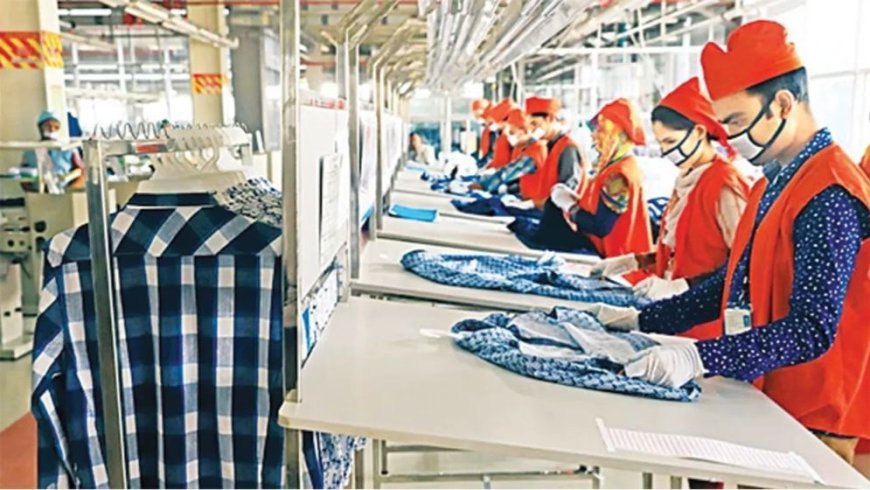
Bangladesh’s garment exports to the United States have suffered a significant setback, with the country’s reciprocal tariff policy emerging as one of the major factors behind the decline. Industry insiders, however, also point to weakening consumer demand in the US, high interest rates, and broader global economic pressures as key reasons disrupting export growth.
Data show that Bangladesh’s apparel exports to the US slowed sharply during the first quarter of 2026, raising concerns among stakeholders as competing countries such as Vietnam and Cambodia continued to record steady growth.
An analysis of data from the US Department of Commerce’s Office of Textiles and Apparel (OTEXA) also highlights another worrying trend — American buyers are paying lower prices for Bangladeshi garments.
BGMEA President Mahmud Hasan Khan said global trade is currently facing severe uncertainty due to US retaliatory tariffs, tensions in the Middle East, the energy crisis, and domestic political instability, all of which are putting mounting pressure on the export sector.
“The United States is Bangladesh’s largest export destination. Any slowdown there directly impacts the garment industry. Many global buyers have already reduced orders, while pressure on prices continues to rise,” he said.
He added that buyers are increasingly moving away from large-scale orders in favour of smaller, short-term purchases, warning that tougher challenges lie ahead.
According to OTEXA data, total US apparel imports in March 2026 fell 7.80 percent year-on-year to $5.99 billion. During the January–March period, imports declined 11.63 percent to $17.73 billion.
Bangladesh exported garments worth $664.9 million to the US in March 2026, marking an 8.08 percent decline from the same month a year earlier. Exports during the first quarter fell 8.38 percent to $2.04 billion.
Analysts say sluggish consumer spending in the US, elevated interest rates, uncertainty over import costs, new tariff measures, and ongoing supply chain complexities are weighing heavily on global apparel trade.
Among Bangladesh’s competitors, Vietnam maintained relatively stable growth, with exports rising 2.52 percent in March and 2.77 percent during the January–March period. Cambodia performed even better, recording export growth of 16.22 percent in March and 17.60 percent in the first quarter.
China, meanwhile, saw a sharp contraction, with exports plunging 37.24 percent in March and 52.91 percent during January–March. India’s apparel exports also declined by more than 27 percent.
Data further show that the unit price of Bangladeshi garments decreased during the period. In March 2026, the average unit price stood at $2.86 per piece, down 2.77 percent year-on-year, while the decline for the January–March period was 2.56 percent.
Export volumes also dropped. Bangladesh shipped 232.7 million garment pieces to the US in March, down 5.46 percent from a year earlier, while export volumes in the first quarter declined 5.97 percent overall.
Industry insiders say Bangladesh must now focus not only on increasing export volumes but also on raising unit prices and diversifying products. They warn that without expanding into higher-value fashion items and technical textiles, the country may struggle to sustain long-term competitiveness.
Despite ongoing global uncertainty, they believe Bangladesh remains one of the leading apparel suppliers to the US market. However, maintaining competitiveness will require improvements in production efficiency, supply capacity, and trade diplomacy.
BGMEA First Vice-President and KDS Group Managing Director Selim Rahman said the ready-made garment sector is facing multidimensional challenges arising from geopolitical uncertainty, disruptions in global trade systems, and Bangladesh’s upcoming post-LDC graduation.
He stressed that improving production efficiency, diversifying products, expanding into higher-value markets, strengthening trade diplomacy, and exploring new destinations are essential to overcoming these challenges.
Former BGMEA director Mohiuddin Rubel said that despite the negative trend in the US market, Bangladesh remains in a comparatively favourable position.
“China’s partial withdrawal from the market has created opportunities for Bangladesh. If the current challenges can be addressed, there is considerable potential ahead. Greater product diversification could further strengthen performance,” he said.
31.21pc export growth in April under exceptional circumstances
Bangladesh’s garment exports recorded 31.21 percent growth in April this year, but analysts caution that the figure should be viewed in the context of the unusually weak export performance in April 2025.
During April 2025, garment exports stood at $2.39 billion, while exports to the US fell to $490 million — one of the lowest levels in recent years.
Business leaders said exports and production slowed at the time due to Eid-ul-Fitr holidays. Uncertainty following the announcement of the United States’ “Liberation Day” tariff policy also prompted many buyers to suspend orders, while India’s decision to cancel transshipment facilities further complicated export operations. As a result, April 2025 was considered an exceptional month.
Uncertainty over US tariff policy continues
Although a recent court ruling temporarily suspended the United States’ 10 percent reciprocal tariff for certain parties, the duty remains in place for most importers, leaving exporters from Bangladesh and other countries facing continued uncertainty.
As a result, garment exporters are being forced to take a cautious approach to long-term planning and pricing strategies.
TAD Group Managing Director Ashikur Rahman Tuhin said growing instability in the global trading system has become a major challenge for Bangladesh’s export-oriented industries.
“Protectionist trade policies, additional tariffs, rising shipping costs, and supply chain uncertainty are making international business increasingly difficult. The ready-made garment sector is directly affected,” he said.
According to Tuhin, Bangladesh can no longer rely solely on low-cost production to ensure sustainability. Greater emphasis must now be placed on high-value products, technology-driven factories, skilled human resources, and faster delivery capabilities. He also highlighted the importance of exploring new markets and strengthening trade diplomacy.
BGMEA President Mahmud Hasan Khan called for realistic and long-term strategies to support the export sector, stressing the need to prioritise energy security and ensure uninterrupted gas and electricity supplies to industries.
He also urged the government to accelerate full operation of the Rooppur Nuclear Power Plant and increase investment in renewable energy.
At the same time, he emphasised that Bangladesh should reduce its dependence on the US market by expanding exports to the Middle East, Japan, Australia, Africa, and Latin America. He further called for improved port capacity, shorter lead times, modernised customs systems, and lower bank lending rates to support the sector’s competitiveness.
What's Your Reaction?