













































The disappearance of playgrounds in Dhaka is pushing children increasingly toward screen-based activities
The disappearance of playgrounds in Dhaka is pushing children increasingly toward screen-based activities.

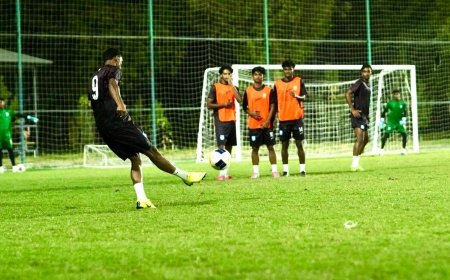
On a Friday afternoon at Mohammadpur Town Hall Shaheed Park, a small group of children played football while their parents watched from benches along the field — a scene locals described as increasingly uncommon.
Muntahina Rashid, whose son was among the players, said such outings are limited to once a week.
“Neither our apartment building nor his school has a playground. I’m a working parent, so Friday is the only day I can bring him here,” she said.
Even then, she remains uneasy. According to Rashid, drug users regularly gather at the ground, making the environment feel unsafe. Still, she continues to bring her son. “I come every week so that sports do not become just mobile games for him,” she added.
Her concerns appeared justified. As evening descended on the park, the pungent smell of cannabis drifted in from the nearby furniture market on the western side — something residents say happens almost every night.
“In our childhood, we made friends on playgrounds,” Rashid recalled. “We played together, learned teamwork and how to handle both victory and defeat. Today’s children are deprived of those experiences. They know virtual friends better than real ones.”
That deprivation is visible across Dhaka.
Visits to Lalmatia and Mohammadpur revealed that only one of Lalmatia’s three playgrounds remains properly usable. Of Mohammadpur’s six playgrounds — located around Iqbal Road, Town Hall, Salimullah Road and Tajmahal Road — only two are considered even partly functional.
Several nearby residential areas, including Mohammadi Housing, Ekota Housing and Nobinagar Housing, lack any playground or park altogether.
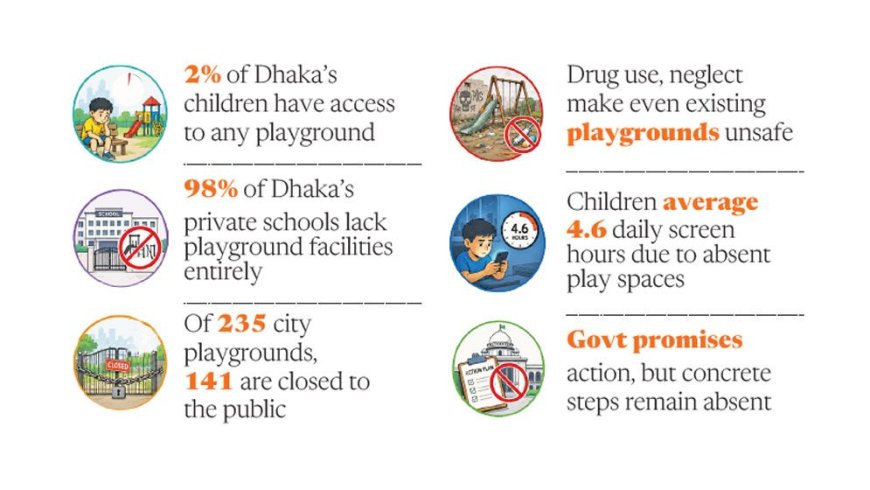
Urban planning standards recommend at least one playground for every 3,000 to 5,000 residents, serving children from early childhood to adulthood. Yet a study by the Bangladesh Institute of Planners found that Dhaka has only 235 playgrounds, 141 of which belong to institutions and are inaccessible to the general public.
Many of the remaining spaces are occupied by clubs, leased for fairs and commercial activities, or otherwise difficult to access.
A joint survey by the Bangladesh Bureau of Statistics and the Power and Participation Research Centre found that only 2% of children in the capital have access to a playground.
The Institute for Planning and Development (IPD) estimates that Dhaka requires an additional 795 playgrounds beyond the current number simply to meet demand.
The impact is increasingly evident in both schools and healthcare settings.
Research by the International Centre for Diarrhoeal Disease Research, Bangladesh (icddr,b) showed that schoolchildren in Dhaka spend an average of 4.6 hours daily in front of screens, including mobile phones, televisions, tablets and computers.
More than one-third suffer from vision problems, while 80% frequently experience headaches. Children exposed to screens for more than two hours a day sleep an average of just 7.3 hours — below the recommended 8 to 10 hours needed for healthy development. Around 14% are overweight or obese, with higher rates among those spending the most time on screens.
The World Health Organisation advises children aged 5 to 10 to engage in at least one hour of physical activity every day. Dhaka’s children are falling far short of that benchmark.
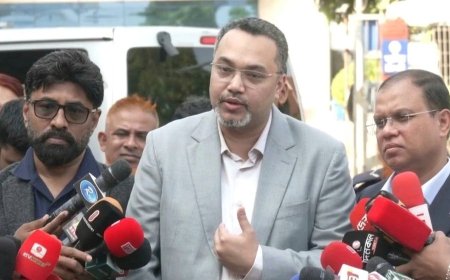
IPD Executive Director Dr Adil Mohammed Khan criticised the city’s development priorities.
“Our entire development philosophy is moving in the wrong direction,” he said. “We claim to work for future generations without considering their actual needs. There is no proper planning for children’s recreational facilities, let alone broader health infrastructure. We are neither creating enough new playgrounds nor ensuring public access to the existing ones.”
Schools are doing little to fill the gap.
According to the Department of Primary and Mass Education, Dhaka has 338 primary schools, 450 NGO-run schools and more than 11,000 kindergartens, while 98% of private schools lack playgrounds.
As a result, children are being denied spaces to play both at school and in their neighbourhoods.
Professor Md Kamal Uddin of the psychology department at the University of Dhaka, who researches cyber aggression and parent-child relationships, said the problem requires action on multiple fronts.
“You must provide children with healthy recreational opportunities. If safe playgrounds are unavailable, they will naturally turn elsewhere for entertainment,” he said.
He urged parents to monitor screen use more carefully and called on authorities to make playground facilities mandatory when approving new schools.
Officials at the Local Government Division acknowledged the concern.
Parimal Sarkar, joint secretary of the Urban Development Wing, told the Daily Sun: “We feel the same concern because we also have children. Efforts are underway to encourage children back into playgrounds and to create more recreational spaces. The prime minister has given clear directives on this issue.”
He added that the matter would be discussed at an upcoming meeting with city corporation administrators.
“Once the budget for the next fiscal year is allocated, we will prioritise building new playgrounds in urban areas,” he said.
What's Your Reaction?