
















































Tk1,044cr Cost Surge, Timeline Triples as Divisional Hospitals Remain Unfinished
Tk1,044cr Cost Surge, Timeline Triples as Divisional Hospitals Remain Unfinished

A flagship government project aimed at decentralising specialised healthcare has been hit by soaring costs and repeated delays, leaving newly constructed hospital buildings unable to treat patients because critical medical equipment has yet to be procured, according to an Implementation Monitoring and Evaluation Division (IMED) report.
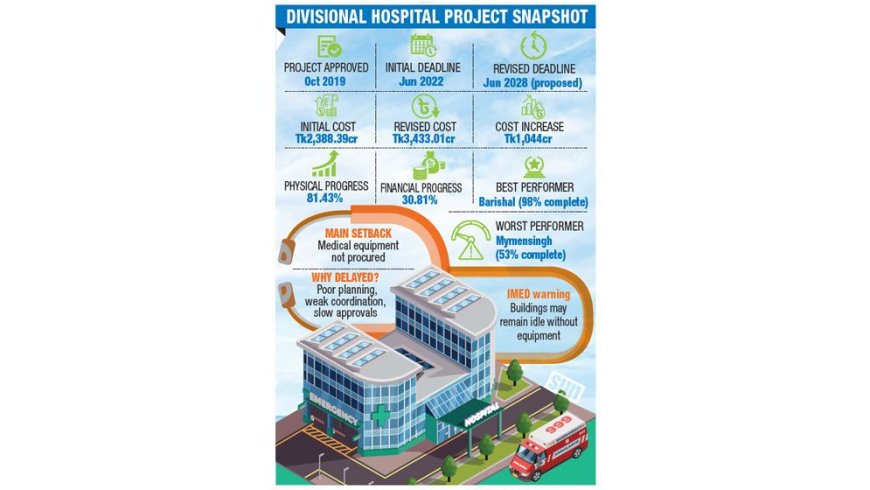
The Tk3,433.01 crore initiative to establish comprehensive cancer, cardiac and kidney treatment centres in all eight divisional cities is now headed for another deadline extension after its cost increased by Tk1,044 crore and its implementation period effectively tripled.
The project was originally approved by the Executive Committee of the National Economic Council (ECNEC) in October 2019 with a budget of Tk2,388.39 crore and a completion target of June 2022.
After its first revision, the deadline was extended to June 2026. That target will also be missed, with authorities now planning to push completion to June 2028.
According to the IMED report, although construction has advanced considerably after years of work and billions of taka in spending, the hospitals remain far from operational because procurement of sophisticated medical equipment has fallen far behind schedule.
The project was designed to expand access to advanced cancer, cardiac and kidney care outside Dhaka, easing pressure on the capital's overcrowded hospitals by bringing specialised treatment closer to patients across the country.
By April 2026, physical progress had reached 81.43%, indicating that construction was nearing completion. However, financial progress stood at only 30.81%, highlighting a substantial gap between infrastructure development and the procurement of costly medical equipment.
The report says procurement of diagnostic machines, operation theatre equipment, furniture, IT systems and vehicles has barely begun. As a result, completed hospital buildings cannot begin treating patients even after construction is finished.
IMED warned that unless procurement is expedited, several newly built facilities could remain idle for an extended period, delaying the healthcare services the project was intended to provide.
The report attributes the setbacks to a range of institutional shortcomings rather than a single cause. Frequent changes in project leadership, slow administrative approvals, weak coordination between the Public Works Department (PWD) and the Directorate General of Health Services (DGHS), delayed procurement planning, design revisions and limited implementation capacity have all contributed to the delays.
It also notes that procurement planning failed to progress alongside construction, creating a growing disconnect between completed infrastructure and operational readiness.
Progress varies significantly across the eight project sites. Sher-e-Bangla Medical College Hospital in Barishal has achieved around 98% physical progress, followed by MAG Osmani Medical College Hospital in Sylhet (97%), Kuwait-Bangladesh Friendship Government Hospital in Dhaka (96%) and Khulna Medical College Hospital (94%).
Rangpur Medical College Hospital has reached 80% completion, Rajshahi Medical College Hospital 71%, Chattogram Medical College Hospital 62.5%, while Mymensingh Medical College Hospital lags behind at just 53%.
According to IMED, the uneven progress reflects inconsistent contractor performance, weak supervision and varying standards of project management rather than differences in engineering complexity.
The report also cites delayed fund releases, disruptions caused by the COVID-19 pandemic, political changes, contractor replacement and broader management failures as factors slowing implementation.
While inspectors found the overall quality of construction to be satisfactory, they identified several engineering deficiencies, including non-compliance with the Bangladesh National Building Code (BNBC), inadequate concrete curing, poor workmanship and other defects requiring corrective measures.
IMED also questioned whether public funds had been used efficiently, noting that several hospital buildings included expensive architectural features—such as granite flooring, decorative wall finishes and ornamental exteriors—that added to project costs without improving healthcare delivery.
The report recommends fast-tracking procurement of specialised medical equipment, strengthening coordination among implementing agencies, speeding up administrative approvals, improving project management and urgently rectifying construction defects.
It warns that without immediate intervention, Bangladesh could end up completing hospital buildings years before they are capable of functioning as hospitals, raising serious concerns about planning, value for money and the management of one of the country's largest public healthcare investments.
What's Your Reaction?