








































The unheard journeys of young Bangladeshi migrants living in France
The unheard journeys of young Bangladeshi migrants living in France

I live in a small town in western France with just 7,500 residents — hardly the kind of place one would expect to encounter a Bangladeshi community. Four years ago, on my way home from the market, I stopped to chat with a neighbour at the corner of the narrow lane leading to my house. Suddenly, I thought I heard people speaking Bangla — an unexpected sound in a rural area that is far from cosmopolitan, especially in a country where the Bangladeshi diaspora is still relatively small.
Curious, I walked a few steps and found two young men studying the Bangla script decorating my front door. When I asked if they were from Bangladesh, they seemed just as surprised — most people in France would more readily assume they were “Indian.” That was how I met Sahel and Shimul, then 17 and 18, who were apprentices at two nearby fine-dining restaurants. Since then, we’ve kept in touch, and through them I’ve met a dozen of their friends living in the area or in the nearby city of Nantes. Over time, I’ve listened to their stories — stories that reveal how, despite multiple hardships, many have managed to build promising futures in France.
No reliable data exists on the exact number of Bangladeshis living in France, partly because a significant share are undocumented. The most credible estimates place the population between 50,000 and 80,000, with the first arrivals reaching France in the late 1980s, mostly seeking political asylum. While many received refugee status, many others did not and remained in the country irregularly. These early arrivals, who came as adults, form the core of today’s Bangladeshi community.
About 15 years ago, a new trend began: the arrival of very young migrants — essentially children — travelling alone from Bangladesh. They typically arrive at age 15 or 16, full of hope but with almost no understanding of the country they have reached. Few speak English, almost none know French, and they generally have no contacts here. Most are from the Sylhet region. They are part of the few thousand unaccompanied minors of various nationalities — mainly from French-speaking African countries, Afghanistan, Nigeria, Sudan, and other conflict-affected areas — who arrive in France each year. The share of Bangladeshis varies annually, usually between 3% and 7% of all applicants.
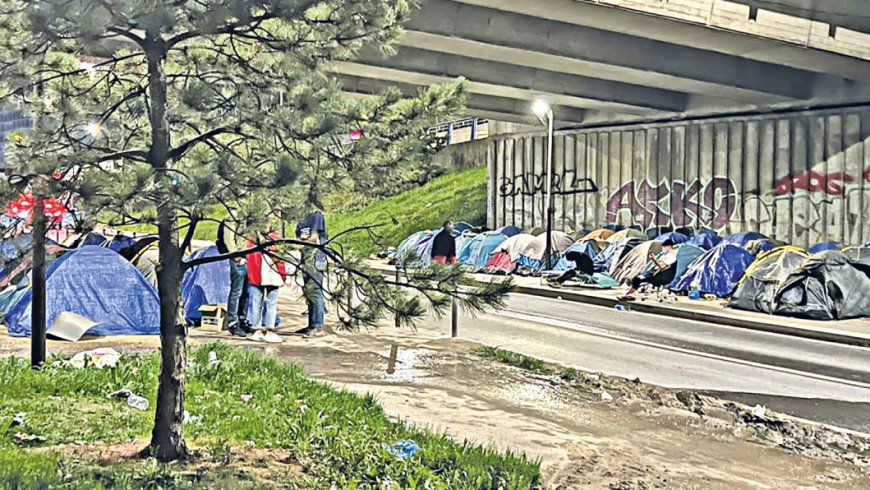
In theory, French law grants an important protection: anyone recognised as under 18 cannot be deported and must be placed under State care. This means shelter, food, healthcare, and schooling should be provided immediately, even before their age claim is officially verified. In practice, however, the State often falls short, leaving many youths to fend for themselves. In Paris, it is now common to see rows of tents where young migrants seek fragile refuge. NGOs play a crucial role in helping them navigate the system, gain recognition as minors, find meals, or connect with host families.
Roughly a quarter of these newcomers are eventually recognised as minors and granted legal status. Those who fail to prove their age lose State protection, though only around 3% are actually deported. NGOs report that Bangladeshi youths are more frequently recognised as minors than others — possibly due to unconscious biases among judges, who often question birth certificates and instead rely on physical appearance. Bangladeshi teenagers, who tend to appear more physically slight than some of their African counterparts, may inadvertently benefit from this.
Where they apply also matters. Success rates are generally higher outside Paris, prompting young migrants — through rapidly formed networks — to move to regions known for being “easier.” This explains why the area where I live has seen the arrival of many such youths, some of whom end up being hosted and educated in small towns like mine. While many young migrants still fall through the cracks — an issue made worse by shrinking social service budgets — thousands do receive the protection prescribed by law.
Once under State care, these youths live in dedicated centres or supervised hotels until their schooling is complete. They enter mainstream French schools and typically pursue two- to three-year vocational training in high-demand sectors such as masonry, plumbing, electrical work, or cooking — the last being the option chosen by nearly all Bangladeshi youths.
Their apprenticeships split time between classroom instruction and hands-on training in restaurants. After two years, they earn a basic diploma and can extend their studies for a higher qualification. Most Bangladeshis begin working immediately after the first diploma, eager to move beyond the modest apprentice stipend. With training in French cuisine — and restaurants facing acute labour shortages — they have little difficulty finding jobs. Salaries rise quickly, often exceeding €2,000 within a year or two, well above France’s minimum wage of €1,400.
Every young Bangladeshi I have met is focused on saving as much money as possible, determined to open a restaurant of their own. Sahel, now 21, opened his just weeks ago; his friend Joynal, two years older, took over a fast-food business in southern France last year. Their maturity and entrepreneurial drive are remarkable. While opening a full-scale “Indian” or French restaurant is financially out of reach at the beginning, their savings make it feasible to secure loans for fast-food ventures that can become profitable quickly. At the same time, they are eager to explore the world: many have already visited several European countries, staying with fellow Bangladeshis. Yet they remain committed to sending money and gifts to their families back home.
Having attended French schools and worked in French restaurants, they quickly become fluent in the language — unlike many older compatriots. This fluency, combined with their skills, strengthens their prospects of gaining French citizenship, freeing them from the burdensome residency renewal process and allowing them to travel more freely.
Associations working with young migrants confirm that such success stories are common among Bangladeshis who arrive as minors. Their progress is rooted in strong mutual support, effective use of local resources, determination, and extraordinary resilience.
Of course, not everyone’s path is so smooth. Some live highly precarious lives as undocumented migrants — rarely going outside, working off the books as dishwashers or cleaners. Others never even made it to France, having fallen victim to smugglers en route, their journeys ending tragically in Libya or the Mediterranean. Regardless of their eventual outcomes, all endure daunting hardships. For some, like Sahel and a few friends, the journey involved obtaining a tourist visa to Dubai, then paying €2,000 for a visa to Italy before travelling to France by train. Others pay 8–12 lakh taka to be smuggled from the Gulf to Turkey, cross the Mediterranean to Greece, and slowly make their way west — a perilous trip, especially for teenagers leaving home for the first time. Some take the most dangerous path of all, through Libya.
Once in France, they must find help to avoid sleeping rough, navigate the complex process of age verification, and adapt to a new school system, new food, and the demanding rhythm of apprenticeships — often without any prior work experience. They must deal with homesickness, build new support networks, secure housing, manage finances, plan careers, and face the anxiety of potentially losing legal protection when they turn 18. Many shoulder pressure from families who expect remittances soon after their arrival, unaware of the reality on the ground. It is a heavy burden — especially for teenagers.
Not long ago, I was invited to lunch at the apartment Sahel shares with several friends. The Bangla food was plentiful and delicious; the atmosphere lively and warm. They enthusiastically shared their dreams — one wanted to learn Japanese sushi because “it’s popular in France,” another spoke about a prospective marriage that might bring his future wife to France, and a third asked me to help him fill out a visa application for Canada. I left feeling deeply impressed by their optimism and drive.
It would be unwise to encourage young Bangladeshis to take this path, given its dangers and the exploitation they risk from unscrupulous smugglers. Not every teenager has the strength to endure such a journey, and France’s capacity to support unaccompanied minors is increasingly strained. Yet those who have succeeded despite everything deserve recognition and admiration.
What's Your Reaction?