


























































Spain demands answers as death toll from high-speed train crash climbs to 40
Spain demands answers as death toll from high-speed train crash climbs to 40

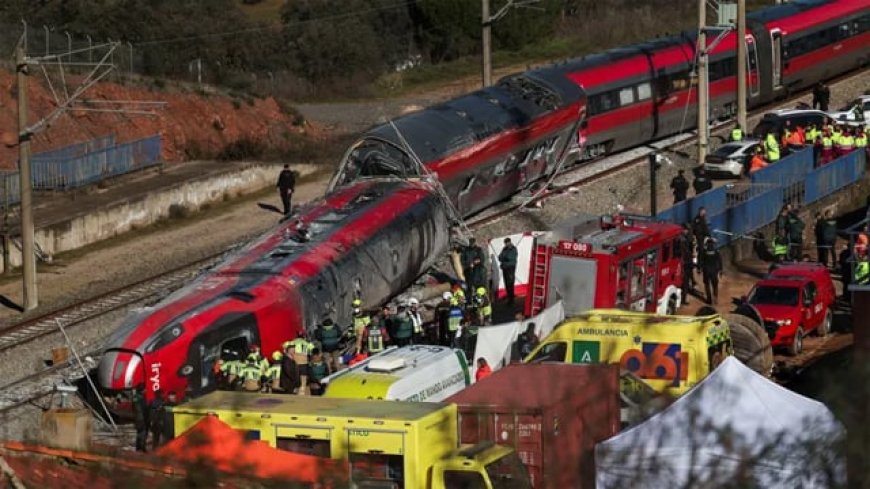
The death toll from a high-speed train collision in southern Spain climbed to 40 on Monday, prompting the government to pledge a comprehensive investigation into the cause of the disaster.
The crash, which occurred late Sunday, is Spain’s deadliest rail accident since 2013, when 80 people were killed after a train derailed on a curved track near the northwestern city of Santiago de Compostela.
The latest incident involved a train operated by private rail company Iryo, travelling from Malaga to Madrid, which derailed near Adamuz in the Andalusia region. The train crossed onto the opposite track and collided with an oncoming service, causing both trains to derail.
Andalusian regional government head Juan Manuel Moreno confirmed at a news conference that 40 people had died, revising the previous toll of 39. He said it would take between 24 and 48 hours to determine the final number of fatalities.
Earlier on Monday, heavy machinery was brought in to lift badly damaged carriages and allow rescue teams improved access to the wreckage.
More than 120 people were injured in the crash, with 41 still receiving treatment in hospitals in the nearby city of Cordoba, Moreno said.
As rescue efforts continued, relatives and friends of missing passengers took to social media, sharing photographs in hopes of locating loved ones.
“This is a day of sorrow for all of Spain, for our entire country,” Prime Minister Pedro Sanchez told reporters during a visit to Adamuz, as he announced three days of national mourning. “We will find the answers, and once the cause of this tragedy is known, it will be disclosed with complete transparency.”
Aerial images released by the Guardia Civil showed the two trains lying far apart, with emergency crews in high-visibility clothing working at the scene.
Officials said the derailment occurred on a straight stretch of track and that both trains were travelling within the permitted speed limit — unlike the 2013 crash, which happened on a curve.
Transport Minister Oscar Puente described the accident as “extremely strange,” noting that the first train was almost new and the track section had been recently renovated.
Iryo said the locomotive, built in 2022, had undergone inspection just three days before the crash. The company said the train veered onto the adjacent track for reasons that remain unknown. About 300 passengers were on board the Malaga-to-Madrid service.
Renfe, which operated the second train travelling to the southern city of Huelva, said it was carrying 184 passengers.
Renfe president Alvaro Fernandez Heredia told Spanish public radio RNE that human error had “virtually been ruled out” and that excessive speed was not a factor. He said both trains were travelling slightly above 200 kilometres per hour, below the 250-kilometre-per-hour limit for that section.
“The cause is likely linked to Iryo’s rolling stock or an infrastructure problem,” he said.
Spain has the largest high-speed rail network in Europe, spanning more than 3,000 kilometres and linking major cities such as Madrid, Barcelona, Seville, Valencia and Malaga.
Survivor Lucas Meriako, who was on the first train, told La Sexta television the experience was “like a horror movie.”
“We felt a very strong impact from behind and thought the whole train was going to collapse. Many people were injured by shattered glass,” he said.
In Adamuz, residents rushed to the town hall with water, blankets and other supplies as news of the crash spread. “We brought whatever we could,” said Manuel Munoz, a 60-year-old olive oil factory worker.
Condolences poured in from around the world, including messages from Pope Leo XIV and French President Emmanuel Macron.
What's Your Reaction?