




















































Seven tremors in a matter of days: experts caution that a major earthquake could hit at any moment
Seven tremors in a matter of days: experts caution that a major earthquake could hit at any moment.

The recent wave of earthquakes indicates that pressure long trapped in the region’s subduction zone — where one tectonic plate slips beneath another — is attempting to break free, significantly heightening the risk of a major quake in Dhaka and its surrounding areas, experts have warned.
On Thursday, a 3.6-magnitude tremor struck Ghorashal in Narsingdi at 4:15pm, according to Farzana Sultana, assistant meteorologist at the Bangladesh Meteorological Department (BMD).
This was the seventh tremor since the 5.7-magnitude earthquake on 21 November, which had its epicentre at Madhabdi in Narsingdi, just 25 km from Dhaka. At a depth of 10 km, it was the strongest among the recent quakes.
Between Friday and Saturday (21–22 November), four tremors shook Dhaka and nearby areas within about 31 hours.
A major quake possible within months — or decades
Earthquake expert and retired Dhaka University professor Syed Humayun Akhtar said two more tremors were recorded in Sylhet and Teknaf on Thursday, both within the vast collision zone of the Burma and Indian tectonic plates.
He noted that seismic activity in Bangladesh originates mainly from two sources: the Dawki Fault in the north, and the Madhupur Fault together with the eastern subduction zone.
“In our region, the Indo-Asia plate interaction is key. The portion of the Indian Plate sliding beneath us forms the subduction zone — beginning at Sunamganj and Kishoreganj, running along the Meghna, and continuing into the Bay of Bengal just west of Teknaf,” he explained. “To the east is the Burma Plate, and beneath it the Indian Plate is sinking.”
He added that the Sylhet–Chattogram–Cox’s Bazar belt has not seen a major earthquake in a thousand years, allowing immense stress to accumulate over centuries. This stored energy could be released at any time — today, tomorrow, or decades from now — and the longer the delay, the more powerful the eventual quake.
Prof Humayun said the recent shocks suggest the plates are still locked, but small ruptures are beginning to open up. The 21 November quake may have created a narrow “test path” for stress to escape, and subsequent tremors indicate that this rupture is expanding.
“As a result, a magnitude 7 to 8 earthquake is possible within the coming months or years. If such a quake strikes this zone, Dhaka will be the worst affected,” he warned.
High vulnerability, low preparedness
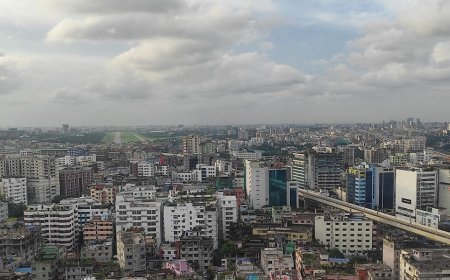
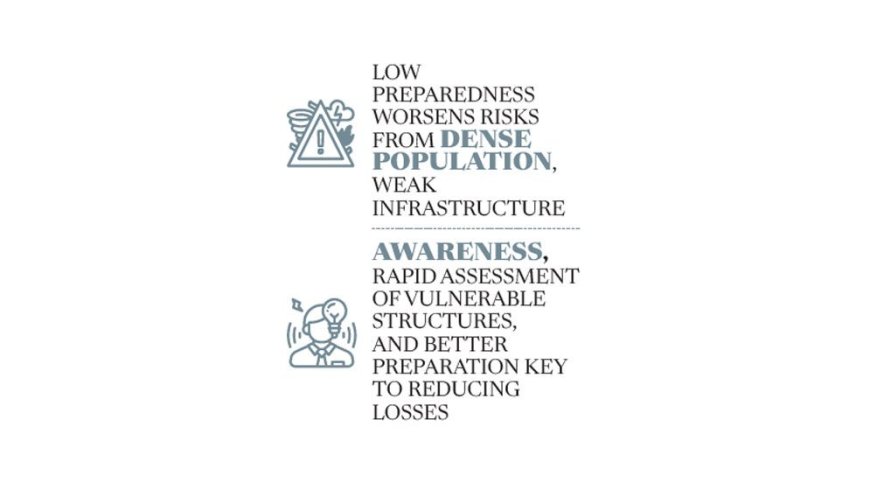
Prof Humayun emphasised that Dhaka sits at the “highest point of seismic risk” due to extreme population density, fragile infrastructure, poor earthquake resilience, fire hazards from ruptured gas and electrical lines, and the possibility of water system failures.
He said urgent preparedness measures — especially public awareness campaigns and drills — are essential to reduce losses and prevent long-term psychological trauma.
The 5.7-magnitude tremor on 21 November was, he said, the strongest felt at the surface in Bangladesh in recent memory, leaving Dhaka residents deeply shaken.
Dr Mehedi Ahmed Ansary, a geotechnical-earthquake engineering expert at BUET, criticised the absence of effective government action.
“The government should immediately hold a meeting with all relevant stakeholders and experts. They say they are monitoring the situation, but they do not have the capacity to do so,” he said.
He also noted that the National Disaster Advisory Council, formed earlier, became inactive after only a few meetings. “I was part of it, but the government no longer convenes us,” he added.
Dr Ansary warned that although many committees and plans exist on paper, “none are actually functioning,” and called for urgent building safety inspections by authorities and residents.
Only a fraction of buildings assessed
An official from RAJUK reported that only 3,252 of the 2.1 million buildings in Dhaka and Gazipur have been evaluated for seismic risk.
Using the FEMA-310 guideline, RAJUK has completed rapid visual assessments of 2,705 educational institutions, 207 hospitals, 36 police stations and 307 other buildings.
Of these, 579 structures — including 568 educational institutions, five hospitals, three fire stations and three other buildings — have undergone Preliminary Engineering Assessments (PEA).
Only 187 buildings have completed the more detailed engineering assessment (DEA), leading RAJUK to recommend retrofitting.
Additionally, RAJUK has advised the demolition of 42 high-risk buildings in Dhaka and Gazipur.
What's Your Reaction?