






















BNP government prepares first budget amid economic strain and difficult trade-offs
BNP government prepares first budget amid economic strain and difficult trade-offs

The BNP-led government is drafting its first national budget under tight fiscal pressure, scaling back earlier spending plans amid weak revenue growth, persistent inflation and global uncertainty.
While expectations had centred on a large, reform-oriented package, internal assessments suggest a more cautious stance is now emerging.
The economy remains under strain, with households grappling with high prices and an uncertain external environment. Against this backdrop, the FY2026–27 budget is being shaped within strict limits, prompting a rethink of earlier expansionary ambitions.
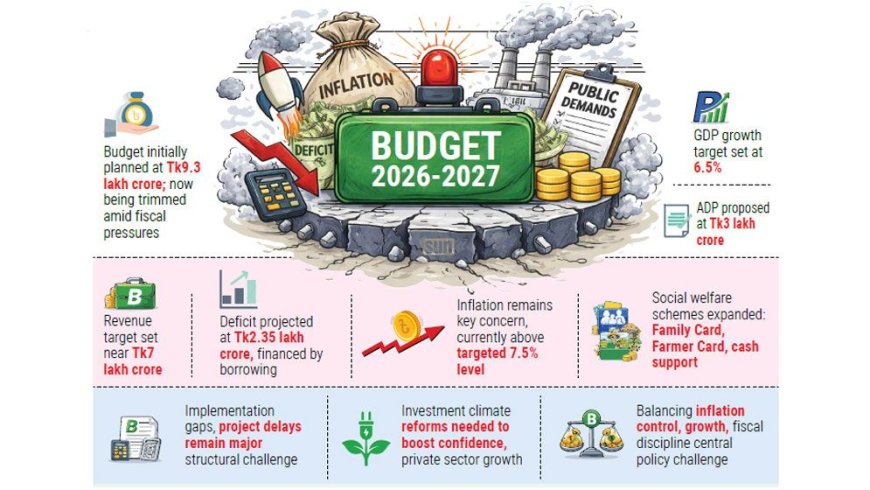
Initial projections by the Finance Division placed the budget at Tk9,30,000 crore, but that figure is now being revised downward due to external shocks, including the Middle East conflict, and subdued revenue prospects.
The Planning Commission is considering an Annual Development Programme (ADP) of around Tk3,00,000 crore, while the revenue target may be set near Tk7,00,000 crore. Inflation is projected at about 7.5% and GDP growth at 6.5%.
These projections were discussed at a meeting of the government’s Coordination Council on fiscal, monetary and exchange rate matters.
Despite fiscal constraints, the budget is expected to carry a strong political signature. As the first full budget of the new administration, it is likely to introduce welfare initiatives such as Family Card, Farmer Card and Health Card schemes.
Officials also anticipate a clearer outline of a revised pay structure for government employees, alongside broader institutional reforms and a development roadmap aimed at raising living standards.
The scale of the proposed budget marks a sharp departure from historical benchmarks. The last full budget under a BNP-led government in FY2007 stood at Tk69,740 crore, focused on poverty reduction, infrastructure and expanding the tax base without increasing the burden on citizens.
Nearly two decades later, the party is set to unveil a budget on June 11 that could exceed Tk9,30,000 crore—more than Tk8,00,000 crore higher than its last tenure.
For comparison, the current FY2025–26 budget is Tk7,90,000 crore, later revised to Tk7,88,000 crore. While Bangladesh’s budgets typically grow by 12–15% annually, the upcoming proposal could rise by around 25%.
This expansion could push the fiscal deficit to Tk2,35,000 crore, to be financed through Tk1,16,000 crore in external borrowing and Tk1,19,000 crore from domestic sources.
Economists warn that inflation remains the most pressing macroeconomic challenge, driven by both domestic pressures and global instability. They stress the need to balance growth and employment with inflation control and fiscal discipline.
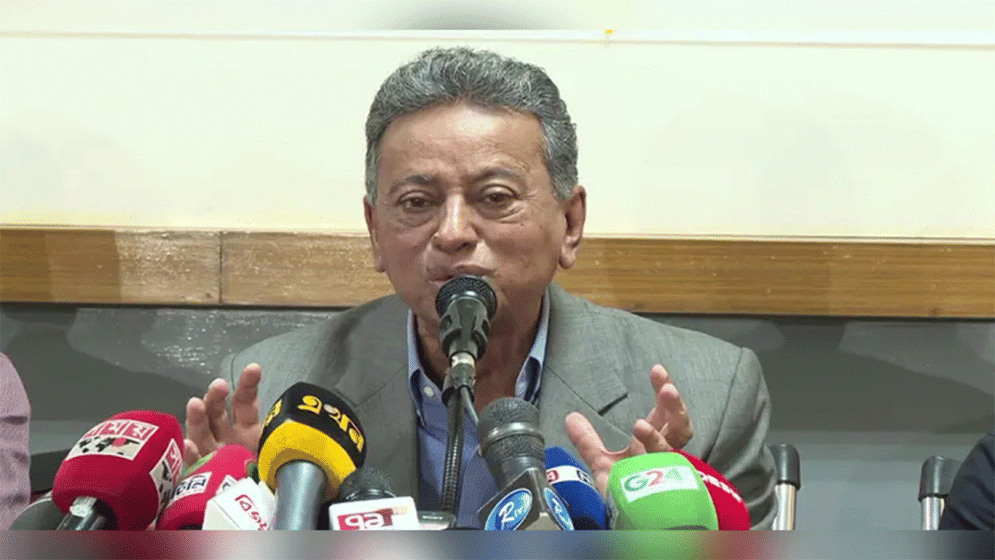
Former adviser AB Mirza Azizul Islam said the effectiveness of the budget would depend more on implementation than size, citing delays and inefficiencies in project execution as persistent problems. He emphasised the need for stronger planning, monitoring and delivery.
He also underscored the urgency of tackling inflation through improved market management, stronger supply chains and targeted policy interventions, while calling for reforms to create a more investment-friendly environment.
Zahid Hussain, former lead economist of the World Bank’s Dhaka office, cautioned against overreliance on borrowing or monetary expansion.
“Without stronger revenue mobilisation, a large budget risks depending on bank borrowing or money creation—both of which could crowd out private investment and fuel inflation,” he said, stressing the importance of a balanced and sustainable fiscal approach.
The economy’s size is projected at Tk68,00,316 crore for the upcoming fiscal year. GDP for the current year was initially estimated at Tk62,44,500 crore but later revised down to Tk61,21,910 crore.
Growth is expected at 6.5%, with inflation targeted at 7.5%, though recent data shows inflation at 8.71% in March, down slightly from 9.13% in February.
Finance Division officials say the overall framework has been approved by the Coordination Council, though revisions remain possible. Ministries are preparing spending proposals within set ceilings, with allocations likely to be adjusted.
Development spending is set to increase significantly, with the ADP potentially reaching Tk3,00,000 crore—Tk70,000 crore higher than the original allocation for the current year and Tk1,00,000 crore above the revised figure.
Funding is expected to come from Tk1,90,000 crore in domestic resources and Tk1,10,000 crore from external sources.
The budget is expected to prioritise welfare programmes aligned with the government’s election pledges, alongside investments in skills development, employment generation, food security, healthcare expansion and financial sector reforms.
There is also a growing focus on the “creative economy,” including film, music, sports and rural culture, with initiatives already underway to recruit sports and music teachers in primary schools and provide incentives for athletes.
The government plans to bring 50 lakh families under the family card scheme next fiscal year, while farmer cards will be issued to eligible farmers, fishers and livestock owners. Low-income households are already receiving monthly support, with Tk9,600 crore allocated for social safety programmes.
Under the “Notun Kuri” initiative, young athletes aged 12–14 will receive scholarships, while additional allocations are expected for public sector pay adjustments and job creation, estimated at Tk1,00,000 crore.
Officials say the broader goal is to steer the economy toward $1 trillion by 2034. Despite external shocks, policymakers acknowledge limited scope for major spending cuts, instead focusing on prioritising essential expenditure, reducing waste and improving efficiency.
What's Your Reaction?