
















































Tight regulations and rising uncertainty trigger sharp drop in industrial imports
Tight regulations and rising uncertainty trigger sharp drop in industrial imports

Industrial imports continue to decline across a wide range of sectors in Bangladesh, as prolonged import curbs, tight monetary conditions and ongoing political uncertainty weigh heavily on trade and manufacturing.
More than three years after Bangladesh Bank introduced strict measures to manage an acute dollar shortage, many of those restrictions remain—complicating import processes and slowing industrial growth despite some recent stabilisation in foreign exchange reserves.
Banks are still exercising extreme caution in opening letters of credit (LCs), requiring extensive paperwork, multiple approval layers and heightened scrutiny, which importers say is hampering business.
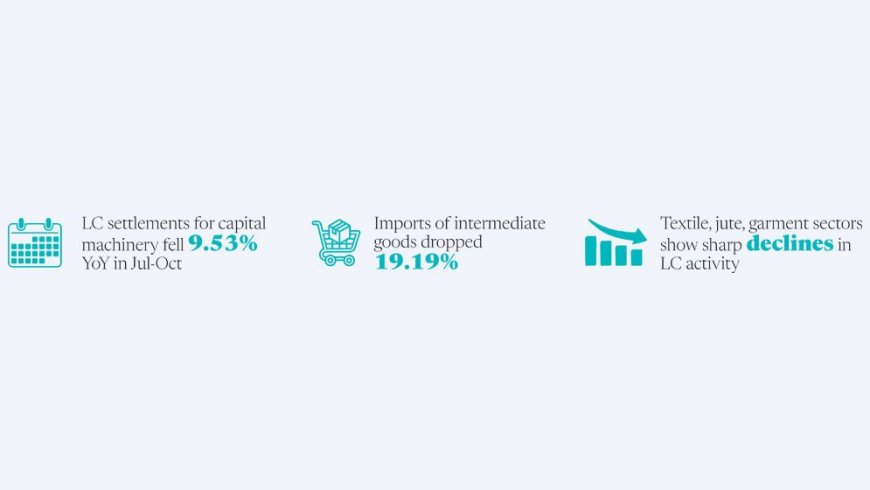
Bangladesh Bank data shows that in the first four months (July–October) of the 2025–26 fiscal year (FY26), LC settlements for capital machinery fell to $628 million—down 9.53% from $694 million during the same period of FY25. The drop reflects a broader pullback in industrial investment, as firms delay new machinery purchases amid liquidity stress and policy uncertainty.
Declines are evident across major industries. LC openings for textile machinery plunged 37.63%, with settlements down 26.47%. Jute imports saw LC openings fall to zero and settlements slump 83.86%. The garment sector also saw weaker activity, with LC openings down 13.78% and settlements slipping 0.36%, despite some earlier months showing temporary gains.
Imports of intermediate goods dropped 19.19% over the July–October period. Among them, clinker and limestone imports declined 19.98% in LC openings and 22.6% in settlements. BP sheet imports fell by 51.02% and 54.50%, while tin plate imports dropped 64.38% in openings and 22.7% in settlements. Scrap vessel imports shrank as well, with openings down 34.06% and settlements nearly unchanged at a 0.96% decline.
Non-ferrous metal imports fell sharply—51.48% in openings and 38.66% in settlements. Iron and steel scrap imports dropped 14.93% and 28.25%, respectively.
Industrial raw material imports slipped 1.62% overall during the period. Crude edible oil imports declined 9.61% in LC openings and 6.05% in settlements. Raw cotton imports dropped 8.17% in openings and 17.32% in settlements, while cotton yarn fell 10.33% in openings and 1.05% in settlements. Synthetic fibre and yarn imports declined 16.81% and 9.61% respectively.
A few items showed mixed trends. LC openings for seeds surged 77.24%, even as settlements fell 32.71%. Textile fabric imports saw openings fall 10.28%, though settlements rose slightly by 1.39%.
Business leaders warn of a deteriorating investment climate
Shams Mahmud, president of the Bangladesh Thai Chamber of Commerce and Industry, told the Daily Sun that higher interest rates may help tame inflation but are undermining investment. He noted that production costs have risen, working capital loans have become harder to sustain, and LC approvals remain difficult due to the dollar shortage.
He added that banks are being encouraged to invest in treasury bonds, further tightening liquidity for industrial borrowers, and that most businesses are focused solely on keeping operations afloat amid political uncertainty rather than investing in expansion.
BKMEA president Mohammad Hatem cited fuel shortages and limited access to bank loans as additional obstacles. He criticised the central bank’s contractionary stance, noting that rising borrowing costs come at a time when industries need supportive policies, not tighter controls. “I don’t see anything positive on the horizon. In such circumstances, who would invest?” he said.
Former DCCI president Rizwan Rahman stressed that economic recovery is impossible without political stability and institutional trust. He warned that investors will not risk capital without assurances of safety, urging the government to restore law and order and rebuild public confidence.
Dr Mustafa K Mujeri, executive director of INM and former chief economist of Bangladesh Bank, cautioned that rising lawlessness, politically motivated cases and attacks on businesses are damaging both the economy and social cohesion. Without corrective action, he warned, Bangladesh risks sliding into a deeper economic and political crisis.
Import restrictions persist despite reforms
Bangladesh Bank introduced stringent import controls in 2022—including 100% cash margins for LCs, higher tariffs and suspended bank financing for many goods—to conserve depleted reserves. Although reforms after August 2024, including a shift to a market-based exchange rate, have eased the dollar crunch and boosted reserves, many earlier restrictions remain intact.
Foreign exchange reserves currently stand at $31.21 billion, according to Bangladesh Bank data released on 1 December.
Central bank officials confirmed that 100% cash margins are still required for a wide range of items—such as motor vehicles, electronics, luxury goods and even ready-made garments. Bank financing for these categories remains suspended, constraining trade and industrial activity.
Syed Mahbubur Rahman, managing director and CEO of Mutual Trust Bank, welcomed the move toward a market-based exchange rate but called for full liberalisation. He argued that the dollar supply has stabilised enough to justify lifting the remaining restrictions, which he believes would help revive economic activity and allow the market to determine the currency’s true value.
What's Your Reaction?