













































Government employees’ salaries proposed to be raised by up to 142%
Lowest basic salary set at Tk 20,000, highest at Tk 160,000 under Pay Commission proposal

Government employees’ salaries are proposed to be increased by as much as 142 percent, with the highest basic pay set at Tk 160,000 and the lowest at Tk 20,000, a recommendation that has drawn concern from economists.
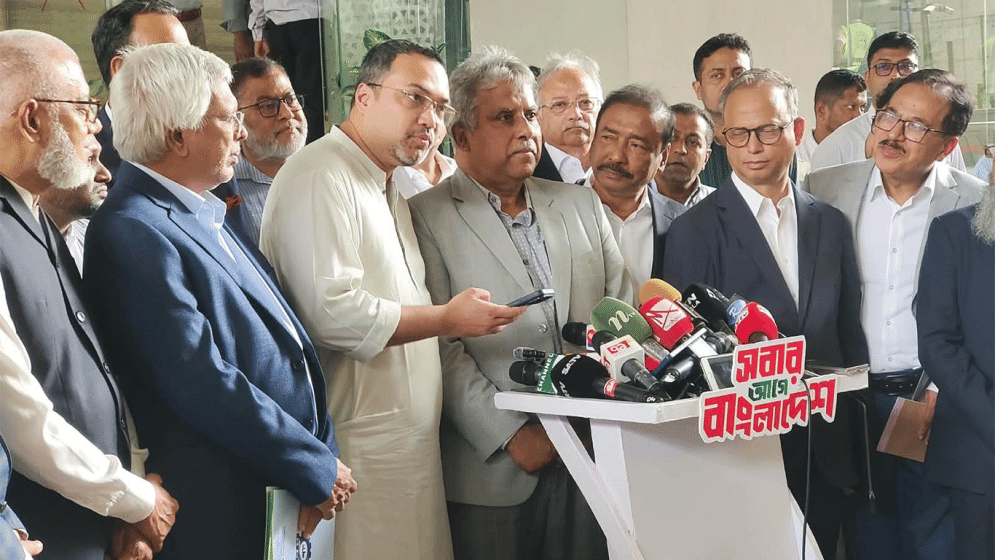
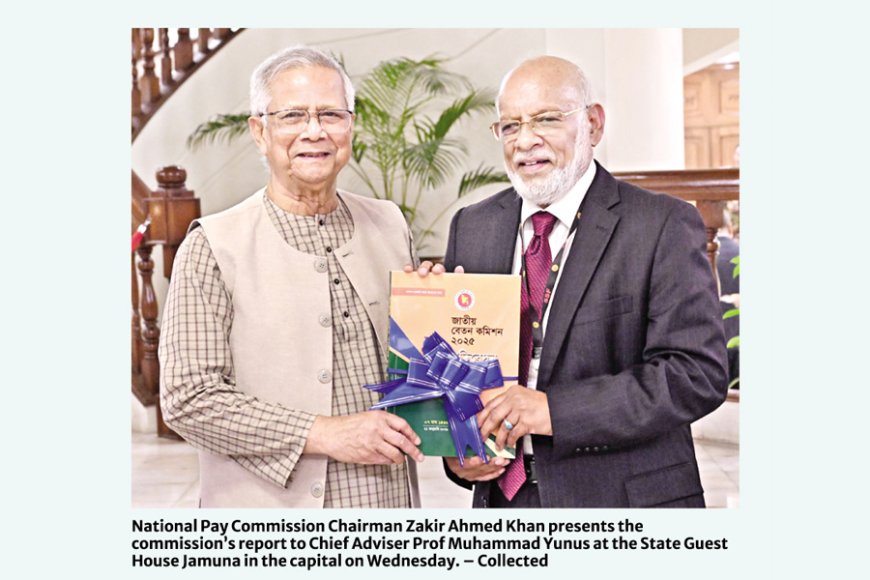
The Pay Commission submitted its report to Chief Adviser of the interim government Professor Muhammad Yunus on Wednesday. Commission Chairman Zakir Ahmed Khan and other members formally handed over the report at the Chief Adviser’s office. The current pay scale was last revised in 2015.
Chief Adviser’s Press Secretary Mohammad Shafiqul Alam shared a brief of the proposed pay structure on his verified page, noting that the number of grades in public-sector employment would remain unchanged.
According to the recommendations, the starting basic pay for a 20th-grade employee would rise to Tk 20,000 from the existing Tk 8,250—an increase of more than 142 percent. For grade-1 officials, the basic pay is proposed at a fixed Tk 160,000, up from Tk 78,000, representing a 105 percent hike. The starting basic pay for grade-2 employees is recommended to double to Tk 132,000 from Tk 66,000.
The commission has also proposed revising special allowances for different grades to between 10 and 15 percent once the new pay scale is implemented. In addition, it recommends raising the “Baishakhi allowance” to 50 percent from the current 20 percent.
Pension-related benefits are also set for significant increases. Pension payments are proposed to rise by between 55 percent and 100 percent, depending on existing benefit levels. The commission further suggests increasing the monthly medical allowance for pensioners aged over 75 to Tk 10,000 from Tk 8,000.
Finance Adviser Dr Salehuddin declined to specify when the new pay scale might take effect, saying the report would be reviewed by several committees before final approval. However, finance ministry officials said around Tk 360 billion has been earmarked in the revised budget for the current fiscal year, raising the possibility of partial implementation from January 1.
Officials estimate that full implementation would cost around Tk 800 billion annually—about 11 percent of the national budget and nearly 14 percent of the revenue budget.
The scale of the proposed hike has alarmed economists, particularly given the prevailing economic slowdown and high inflation. They warn that financing such a large increase would be extremely challenging amid weak revenue mobilisation.
Former World Bank lead economist Dr Zahid Hussain cautioned that full implementation would inject a substantial amount of money into the economy, potentially fuelling inflation, increasing pressure on living costs, and triggering wage demands in the private sector. He noted that the government currently lacks the fiscal capacity to support the proposed structure.
He said financing would require either a sharp increase in revenue mobilisation or significant cuts in other expenditures. However, revenue collection in Bangladesh has historically been low, and raising it by 25 percent to fund the pay scale is unrealistic. At the same time, scope for reducing spending is limited, as allocations under the Annual Development Programme (ADP) have already fallen. Further cuts, he warned, would harm private investment, incomes and livelihoods.
Dr Mustafizur Rahman, Distinguished Fellow at the Centre for Policy Dialogue (CPD), said the proposed pay scale would not substantially boost real incomes of public servants due to sustained inflation over the past decade. He stressed the need for a clear implementation plan with a defined timeline and emphasised the importance of transparency, accountability and efficiency in public service delivery. He also urged proactive efforts by the National Board of Revenue (NBR) to strengthen resource mobilisation.
Failure to mobilise adequate revenue, he warned, would force the government to rely on borrowing, adding to fiscal stress and inflationary risks.
Dr M Masrur Reaz, Founder and CEO of Policy Exchange Bangladesh, said while increasing public-sector pay is necessary to narrow the gap with the private sector and improve motivation, the timing is inappropriate. He noted that implementing the proposal would require an additional Tk 800 billion at a time when economic growth has slowed and revenue collection has been severely affected.
He pointed out that the NBR is already facing a revenue shortfall of more than Tk 460 billion, while inflation has remained elevated for the past three months. In such circumstances, he said, many countries adopt austerity measures, suggesting that delayed or phased implementation would be more prudent than immediate action.
What's Your Reaction?