



























































The EV sector is expanding rapidly, but the charging infrastructure is struggling to keep pace
Experts caution that the existing infrastructure is insufficient to support large-scale EV adoption.

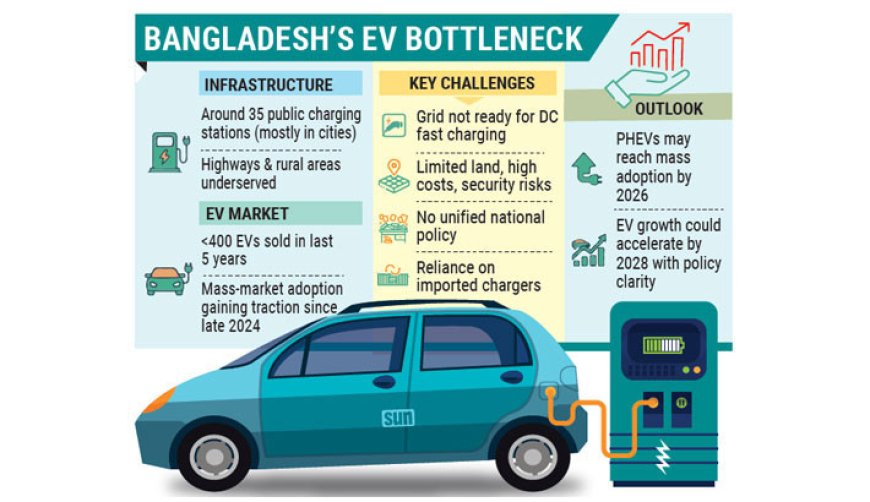
Bangladesh’s electric vehicle (EV) sector is gradually expanding, but the growth of essential charging infrastructure is lagging far behind.
Industry leaders and energy specialists warn that the lack of public charging facilities, unreliable electricity supply, and unclear government guidelines are holding back the country’s transition to cleaner transport.
Currently, only around 35 public EV charging stations are operational nationwide, mostly concentrated in major cities. As a result, highways and rural regions remain largely without access.
This shortage has intensified “range anxiety” among EV users, making long-distance travel difficult and reducing the appeal of EVs for everyday use.
Imran Hossain, deputy manager (corporate sales) at BYD Bangladesh, noted that the domestic EV market is still in its infancy compared to global standards.
“The number of EVs in Bangladesh is still very limited,” he said.
He added that BYD provides home chargers and portable charging cables to offer customers added convenience, estimating that 33 to 35 charging stations are currently active.
He expressed hope that by next year, each of the country’s 64 districts will have at least one charging station — a milestone that would mark substantial progress.
Experts, however, emphasise that the existing infrastructure is far from sufficient for mass EV adoption.
They pointed out that the national grid cannot yet support high-capacity DC fast chargers, which are crucial for long-distance travel.
Private investors also face slow returns due to the small number of EVs on the road, while inconsistent regulations make long-term planning uncertain.
Although multiple government agencies — including SREDA, BERC, the Power Division, and the Road Transport Division — are involved in the EV sector, a unified national policy has yet to be formed.
Shoeb Ahmed, divisional director of Deepal Bangladesh, said acquiring suitable land for charging stations in high-traffic zones remains a major challenge.
“Land costs are high, and many potential sites lack the required power capacity for DC fast chargers,” he said.
“Setting up substations requires significant investment and long approval procedures. While DC chargers are expensive, they are indispensable for public charging networks.”
He added that security concerns also pose risks, as highway charging facilities are prone to theft and vandalism. Deepal currently runs 22 charging stations across the country, with plans to expand.
EV uptake in Bangladesh remains slow. Of the nearly 30,000 vehicles sold in the past five years, fewer than 400 were electric — most of them in the luxury category.
Industry players believe that the government’s updated EV duty structure could accelerate growth by 2028, while plug-in hybrid vehicles (PHEVs) might see broader adoption as soon as next year.
SREDA’s 2024 guidelines propose integrating solar and hybrid energy systems into charging stations to reduce pressure on the national grid, particularly in remote locations.
Research is ongoing into battery-swapping systems for two- and three-wheelers, though wider use will require standardised batteries and supply chains.
Despite the hurdles, companies like BYD and Deepal remain optimistic. They believe that as coverage improves and consumer confidence grows, Bangladesh’s EV sector will gain strong momentum.
Experts also underline the need to standardise charging connectors, payment systems, and communication protocols across all networks.
They further note that limited local manufacturing leaves Bangladesh dependent on imports, slowing installations and raising costs. Coordinated state support, financial incentives, and domestic production are essential for building a sustainable nationwide charging system.
Conversely, high land costs in major urban centres continue to impede expansion, while many two- and three-wheeler owners depend on informal charging points — a practice that carries significant safety risks.
What's Your Reaction?