













































Labour court: A second injustice for workers
Not a single case is resolved within the legally mandated timeframe; hearing schedules routinely extend beyond prescribed disposal deadlines.

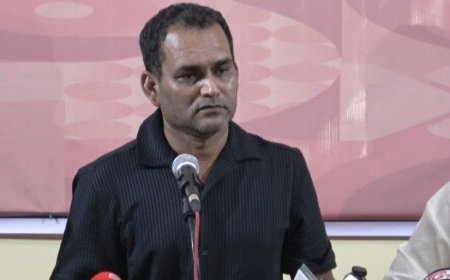
Md Abdur Rahim has been making the long journey from Lakshmipur to Dhaka for the past 12 years.
A transport worker, he filed a case in the labour court in 2014 after being denied his wages and service benefits. On Wednesday (29 April), he appeared once again before the First Labour Court in Dhaka, only to have his next hearing scheduled for 2 July — 63 days later.
He left the courtroom with the quiet fatigue of someone whose anger has long since worn out.
“I came here seeking my unpaid wages and service benefits,” he said. “Instead, I have spent a significant amount on travel and legal costs. I had hoped for a swift resolution, but now I am facing loss, deprivation, and suffering for a second time.”
Abdur Rahim’s story is far from unique.
Across Bangladesh’s 14 labour courts — institutions established to safeguard workers’ rights and ensure faster justice than regular civil courts — countless workers have found a stark gap between legal promise and lived reality.
For many, entering a labour court marks not relief but the beginning of a prolonged second struggle: years of travel expenses, lost income, dwindling savings, and, often, no final verdict in sight.
Twelve times longer than the law allows
The Bangladesh Labour Act, 2006 clearly stipulates that cases must be resolved within 60 days of filing. In exceptional circumstances, a single extension of up to 90 days is permitted, setting an absolute maximum of 150 days.
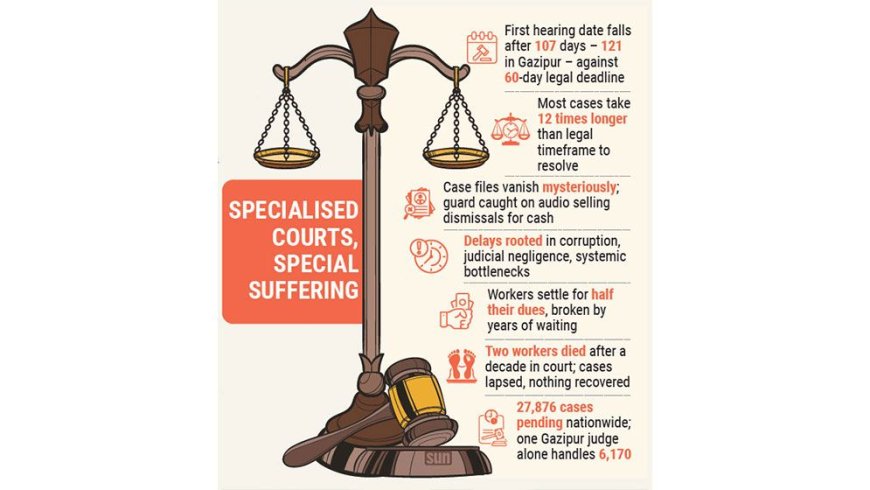
In practice, however, a Daily Sun review of around 50 ongoing cases in Dhaka, Gazipur, and Narayanganj reveals that verdicts take an average of five years — over 12 times the legal limit and 30 times the original 60-day deadline.
None of the cases examined were resolved within the statutory timeframe, except those closed through pressured or unequal settlements.
Delays begin from the outset.
Advocate Sufian Mahmud Husseinee noted that even the first hearing is often scheduled beyond the 60-day window, with no notice issued to the defendant during that initial period. Despite four months of 2026 already passing, many cases filed in late 2025 have yet to receive their first hearing date.
Once proceedings begin, adjournments further stretch timelines. Courts typically fix the next hearing three to four months later. The review found that the average gap between hearings is 107 days — exceeding the law’s entire initial timeframe. In Dhaka, the average gap is 97 days; in Gazipur, it rises to 121 days.
Specific cases highlight the pattern. Hearings held on 27 April in the First Labour Court were followed by next dates roughly 97 days later. Abdur Rahim’s own case, heard on 29 April, received a comparatively shorter gap, with the next hearing on 2 July.
RMG worker Yeasmin’s case, heard on 28 April, was adjourned to 27 August — a three-month gap, similar to the previous one. Cases in the Third Labour Court on 27 April saw adjournments of 114, 117, and 119 days.
“Repeated adjournments and long delays must end. Hearing dates should fall within 7 to 15 days,” said Supreme Court lawyer Advocate Md Kamruzzaman.
Workers who ran out of time
Fatema, a 38-year-old garment worker from Manikganj, lost her job in 2019 and filed a case the same year. Six years later, it remains unresolved. Each trip to Dhaka drains her limited resources.
Jubayer Hossain from Cumilla filed his case in 2013 after an alleged unfair dismissal. Thirteen years on, he still has no clarity on when a verdict will come.
“The hearing date gets pushed back by months each time. I didn’t realise this when I filed the case, but now I understand the suffering involved,” he said.
Some never see the end.
Mohammad Ali from Jashore, who filed his case in 2014, died in 2024 with his claim unresolved. Kartik Chandra, who had worked in Dhaka before returning to Bhola, died in late 2025 after 11 years of litigation. Both had spent heavily on legal and travel costs, and both left without justice.
Mohammad Ahsan Ullah, now 65 and a former president of the United Commercial Bank Employees’ Association, filed his case in 2014. Although the labour court delivered a verdict in 2024, his employer challenged it, prolonging the dispute at the Labour Appellate Tribunal. His last hearing there was on 23 March, with the next scheduled for 19 July — 118 days later.
“Some of my acquaintances have already died without getting remedy,” he said. “Will my fate be the same?”
Forced settlements: the other way out
Unable to endure years of litigation, many workers settle — often for far less than their rightful dues.
On 28 April, at the Gazipur labour court, Mintu Mia, a 48-year-old garment worker from Mymensingh, agreed to a settlement after years of delay. He had filed his case in 2021, claiming over Tk6 lakh, but eventually accepted Tk2.5 lakh after repeated adjournments and a court transfer.
“I thought the court would ensure I received my service benefits,” he said. “But after years of uncertainty, I felt there was no guarantee of justice.”
Barrister Samira Tanzin Chowdhury observed that such outcomes are often strategic. Employers exploit delays, knowing that financially strained workers are more likely to concede.
“Delay becomes a weapon. For a destitute worker, every day without a verdict benefits the stronger party,” she said, calling for stricter timelines and a dedicated legal aid system.
Labour rights activist Alam Hossain echoed this concern, noting that workers face victimisation both at the workplace and within the justice system. Advocate Husseinee added that the difficulty of securing justice discourages many from filing cases at all.
Corruption in the corridors
Beyond systemic delays, there are signs of deeper malpractice.
An audio recording obtained by this correspondent captures a Dhaka labour court staff member, Kibria, allegedly offering to make case files disappear, arrange bail under false identities, and influence outcomes in exchange for money. When contacted separately, he reportedly admitted involvement in such activities.
The Department of Inspection for Factories and Establishments (DIFE), responsible for enforcing labour laws, has also been criticised for weak penalties.
In fiscal year 2024–25, DIFE filed 796 cases and resolved 414, imposing total fines of Tk34,50,530 — averaging just over Tk8,000 per case. Critics argue that such minimal penalties fail to deter violations by large employers.
A geography that punishes the poor
Bangladesh has 14 labour courts, with three in Dhaka and two in Chattogram. The rest are scattered across major regions, though some industrial areas remain without access.
For many workers, attending a hearing requires long-distance travel, often at significant cost and loss of income — all for brief proceedings that lead to another distant date.
Fatema has endured this since 2019. Rahim for 12 years.
“There should be a labour court in every district,” said garment worker and union leader Soma Munshi, pointing out that many workers cannot afford to attend hearings at all.
Legal experts have suggested expanding courts in industrial zones and integrating them into existing judicial complexes to improve access and reduce costs.
The numbers keep climbing
As of 31 March 2026, labour courts across Bangladesh had 27,876 pending cases — up from 22,737 a year earlier. Dhaka’s three courts alone account for over 14,000 cases, while Gazipur’s single court handles more than 6,000.
By contrast, courts in regions like Sylhet, Rajshahi, Rangpur, and Barishal have fewer than 100 cases each. The imbalance highlights how backlogs concentrate in major industrial hubs where demand for justice is highest.
Labour law also requires specialised expertise, yet not all judges assigned to these courts have adequate training, contributing to delays and inconsistent rulings.
Labour leader Taslima Akhter stressed the need for more courts and better oversight, while Samira Chowdhury emphasised training and structural reform.
“Unless meaningful reforms are implemented, labour courts will remain accessible in name, but justice will remain out of reach,” she said.
Abdur Rahim will return again on 2 July. After 12 years, he still does not know how many more journeys lie ahead.
What's Your Reaction?