
















































Experts Urge Dhaka to Avoid Rushing into Mecca Defence Pact
Experts Urge Dhaka to Avoid Rushing into Mecca Defence Pact

Experts Urge Bangladesh to Carefully Weigh Mecca Defence Pact
Experts have called on Bangladesh to thoroughly evaluate the strategic, security, economic and diplomatic consequences before deciding whether to join the Mecca Joint Defence Agreement signed by Saudi Arabia, Türkiye and Pakistan on August 7.
The comments followed State Minister for Foreign Affairs Humayun Kabir’s remarks on Monday that Bangladesh was interested in joining the alliance.
Former diplomats, academics, researchers and security analysts warned that Dhaka must ensure any such move does not disrupt its long-standing policy of maintaining balanced relations with major regional and global powers or pull the country into conflicts unrelated to its national interests.
Former ambassador Humayun Kabir said it was still unclear whether Bangladesh had received a formal invitation to join the alliance. He noted that reports indicated Saudi Arabia, Türkiye and Pakistan had also encouraged Iran to become part of the arrangement.
The agreement states that an attack on any one of its three signatories would be considered an attack on all, broadly resembling Article 5 of the NATO treaty.
Independent researcher Altaf Parvez said it remained uncertain whether the pact would eventually establish a unified command structure similar to NATO. He also suggested that the three signatories could seek to expand the alliance by bringing Bangladesh into it.
According to Parvez, shifting geopolitical dynamics following the recent US-Iran conflict have encouraged Muslim-majority countries to reassess their strategic positions. He said Saudi Arabia and Türkiye could increasingly seek Bangladesh’s support as they compete for greater influence in the Muslim world.
Some analysts described the Mecca pact as part of a broader trend of strategic diversification, with countries reconsidering their defence arrangements in response to changing regional security dynamics.
Security analyst Air Commodore (retd) Ishfaq Ilahi Choudhury, however, advocated that Bangladesh retain its traditional non-aligned foreign policy.
He pointed out that countries including Egypt, the UAE, Oman, Kuwait and Qatar have not joined the pact and urged Dhaka to examine why Saudi Arabia, Türkiye and Pakistan—despite having no common borders—chose to establish such a trilateral defence arrangement.
He argued that the security challenges confronting the three countries are significantly different from Bangladesh’s circumstances. Pakistan faces tensions along its borders and internal security challenges, Saudi Arabia remains concerned about Iran and the Houthis, while Türkiye has longstanding disputes involving the Kurds and Greece.
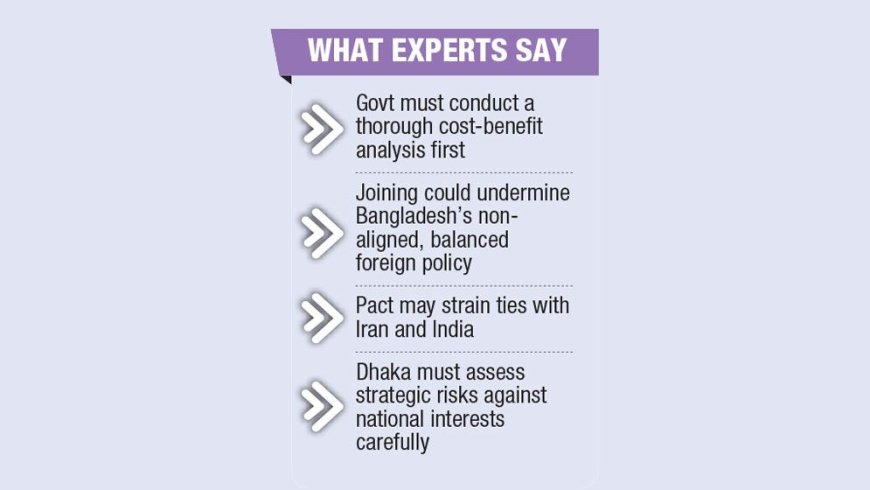
“Are we facing similar problems?” he asked, warning that Bangladesh’s participation could strain ties with Iran and its allies while also creating complications in relations with India.
He also questioned whether joining the pact would offer meaningful solutions to Bangladesh’s energy and investment challenges.
Parvez stressed that the economic implications of the agreement should also be carefully considered, given the importance of Gulf countries as major centres of global investment and finance. He said Dhaka should closely monitor how seriously the three signatories implement the pact before making any commitment.
He further warned that the emergence of competing defence alliances could create additional pressure on countries such as Bangladesh, Nepal and Sri Lanka, particularly as they struggle with the economic consequences of instability in the Middle East.
Prof Sabbir Ahmed of Dhaka University’s Department of Political Science also urged the government to examine the underlying objectives of the agreement.
He said joining such an alliance could be risky for Bangladesh given its military capabilities and geographical position. A comprehensive cost-benefit analysis, he argued, should be completed before any decision is made.
He also recommended consulting relevant stakeholders and experts and clearly explaining to the public the rationale behind any decision to join the proposed defence arrangement.
What's Your Reaction?