














































Country loses nearly Tk6,000 crore annually due to Adani power deal
Country loses nearly Tk6,000 crore annually due to Adani power deal

Bangladesh is losing nearly Tk6,000 crore annually under a controversial electricity purchase agreement with India’s Adani Group, according to a government review committee, which estimates the deal is costing the country an additional $400–500 million each year.
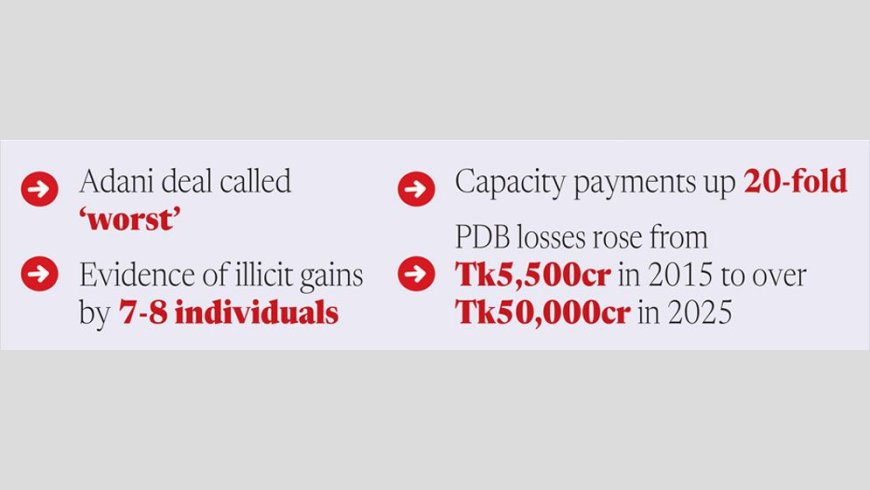
The committee found evidence of widespread corruption linked to the contract, suggesting that a future elected government could annul the agreement and seek compensation. Investigators identified illicit financial gains involving seven to eight individuals.
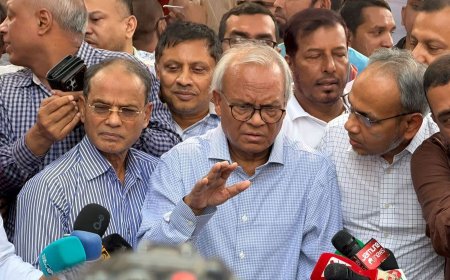
The findings were presented at a press conference on Sunday at the Power Division by the National Committee reviewing contracts signed under the Electricity and Energy Rapid Supply Enhancement (Special Provisions) Act, 2010. The committee said the interim government lacks the mandate to act, placing responsibility on the next elected government. It recommended initiating arbitration in Singapore to cancel the Adani power purchase agreement, describing it as the “worst” contract in Bangladesh’s power sector.
According to the committee, instructions related to the Adani deal originated from the office of former prime minister Sheikh Hasina. Evidence also indicates that several individuals involved received multi-million-dollar benefits.
Following the formation of the interim government, a five-member committee was established on 5 September 2024, chaired by retired High Court judge Moinul Islam Chowdhury. Other members included BUET professor Abdul Hasib Chowdhury, former KPMG Bangladesh COO Ali Ashraf, former World Bank lead economist Dr Zahid Hussain, and University of London law professor Mustak Hossain Khan.
The committee submitted its report on 20 January, with findings released to the media on Sunday. The report shows Bangladesh Power Development Board (PDB) losses surged from Tk5,500 crore in 2015 to over Tk50,000 crore in 2025.
Electricity is purchased at Tk12.35 per kilowatt-hour but sold at Tk6.63. During the Awami League government’s tenure, power generation increased nearly fourfold, while payments to private producers rose more than elevenfold. Capacity payments increased about twentyfold.
Despite no fuel or infrastructure constraints, between 7,700 and 9,500 megawatts of generated electricity remains unused. Annual capacity payments alone range between Tk99,000 crore and Tk165,000 crore.
The committee noted that electricity from HFO-based plants costs 40–50% more than justified, gas-based power 45% more, and solar power 70–80% above reasonable rates. Contracts signed under emergency legislation prioritised the interests of a small group over national interests, it said.
Large private power producers with multiple contracts benefited disproportionately, while select domestic and foreign sponsors gained from sovereign guarantees and access to international arbitration. The concentration of contracts gave certain sponsors excessive negotiating power.
Among the most controversial deals is the Adani agreement, which involves electricity generation outside Bangladesh, increasing national risk. Other costly projects include the SS Power coal plants, Summit Meghnaghat facilities, Reliance’s India-based power supply deal, and the coal-based Payra plant, built despite the port’s limited operational capacity.
Recent pricing shows Adani electricity costing 4–5 cents per kilowatt-hour more than comparable alternatives. Summit Meghnaghat-2 recorded nearly double the unit cost of other gas plants, while Summit Barishal exceeded comparable HFO plants. SS Power emerged as the most expensive coal-based option.
The committee found that political backing and bureaucratic collusion enabled these contracts, leading to rising subsidies, growing arrears and mounting losses.
It recommended full disclosure of all power purchase contracts, reinstating competitive procurement, establishing an independent energy oversight body, and cancelling contracts proven corrupt under international standards.
Committee chair Moinul Islam Chowdhury said decisions on the Adani deal now lie with the power division and urged the next elected government to act swiftly.
Professor Mustak Hossain Khan said Bangladesh pays nearly $1 billion annually in foreign currency under the Adani agreement and 40–50% more than justified rates. Of the estimated $25 billion total cost, about $10 billion (Tk1.2 lakh crore) is unnecessary, placing a heavy burden on the economy.
Although Maheshkhali was initially considered, Jharkhand was selected without documented justification. Pricing followed no technical or institutional analysis. While Bangladesh previously imported electricity from India at 4.46 cents per kilowatt-hour, the Adani deal fixed rates at 8.61 cents, later rising to 14.87 cents.
The deal also transferred coal price risk, transmission costs, taxes and political risk to Bangladesh, while applying an unfavourable dollar-denominated interest rate of 1.25%. Bangladesh currently owes Adani around $500 million, and the company has threatened international arbitration.
Professor Mustak said experts believe the evidence could support a strong fraud case internationally, though delays could weaken Bangladesh’s position. He stressed the issue ultimately requires political commitment.
Dr Zahid Hussain said the contracts clearly favoured a small group over national interests. Between 2011 and 2024, payments to independent power producers rose elevenfold while generation increased only fourfold. With utilisation at just 40–50%, excess capacity costs $900 million to $1.5 billion annually, pushing PDB towards bankruptcy.
He warned that avoiding shortages would require an 86% increase in wholesale electricity prices, undermining Bangladesh’s industrial competitiveness against regional peers.
What's Your Reaction?