










































Khaleda Zia, the formidable and uncompromising political leader, has passed away
“The political legacy of Bangladesh’s first female prime minister began with the restoration of democracy in 1991 and remains deeply influential.”

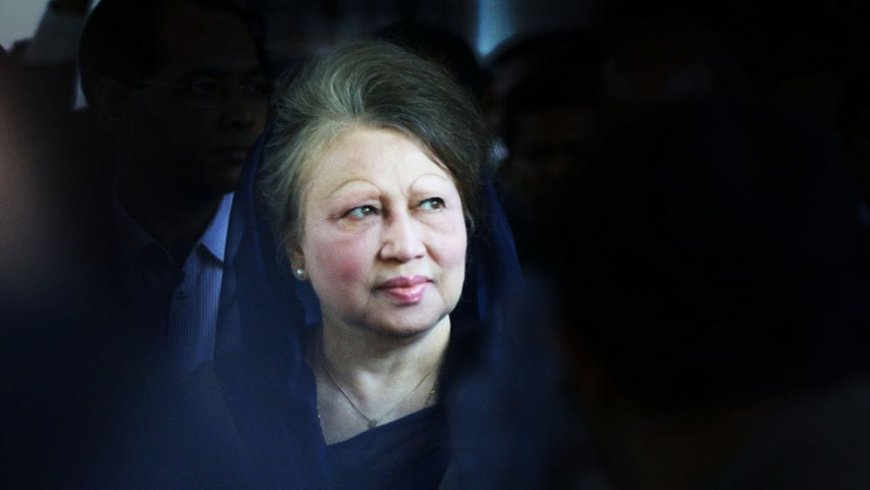
BNP Chairperson Begum Khaleda Zia, widely known as an uncompromising champion of democracy in Bangladesh, passed away on Tuesday morning while receiving treatment at Evercare Hospital in the capital. She was 80.
“Our beloved Deshnetri Begum Khaleda Zia passed away around 6:00am, shortly after Fajr prayers,” BNP Secretary General Mirza Fakhrul Islam Alamgir told reporters at a press briefing outside the hospital.
The three-time former prime minister had long been battling multiple health complications, including heart and lung conditions, liver and kidney ailments, diabetes, arthritis, and eye-related problems. She had a permanent pacemaker and had previously undergone cardiac stenting. She was admitted to Evercare Hospital on November 23 on the recommendation of her medical board after being diagnosed with infections in her heart and lungs and pneumonia.
After returning from London on May 6, where she had received advanced medical treatment, Khaleda Zia had been undergoing regular check-ups at Evercare Hospital.
Bangladesh’s first female prime minister leaves behind a formidable political legacy that took shape with the restoration of democracy in 1991. She assumed office following the 1991 national election and went on to introduce the parliamentary system of government, as well as the caretaker government framework to ensure free, fair, and credible elections.
Although Khaleda Zia had been imprisoned since 2018, her party and family repeatedly appealed to the then government to allow her to seek treatment abroad. Those requests were denied by the Awami League government.
She is survived by her son, BNP Acting Chairman Tarique Rahman, along with numerous relatives and admirers. Tarique Rahman returned to Bangladesh on December 25 after 17 years in exile. Khaleda Zia’s younger son, Arafat Rahman Koko, passed away several years ago in Malaysia.
Born in Dinajpur in 1945, Khaleda Zia began her education at Dinajpur Missionary School and later completed her matriculation from Dinajpur Girls’ School in 1960. Her father, Iskandar Mazumder, was a businessman, while her mother, Tayeba Mazumder, was a homemaker. Affectionately known as “Putul,” she was the second of five siblings.
In 1960, she married Ziaur Rahman, then a captain in the Pakistan Army, and continued her studies at Surendranath College in Dinajpur until 1965. During the Liberation War in 1971, Ziaur Rahman revolted against the Pakistani forces and joined the struggle for independence.
Following the assassination of Ziaur Rahman on May 30, 1981, the BNP faced a deep political crisis. At that time, Khaleda Zia—who had no prior involvement in politics—joined the party and was appointed vice-chairperson on January 12, 1984. She was elected BNP chairperson on May 10 the same year and was re-elected to the post in January 2010.
Under her leadership, the BNP formed a seven-party alliance in 1983 and spearheaded a mass movement against the autocratic rule of Hussain Muhammad Ershad. Despite repeated restrictions on her movement and multiple detentions, Khaleda Zia remained resolute, earning a reputation as an “uncompromising leader.”
In the 1991 parliamentary election, the BNP secured a single majority. Khaleda Zia contested five constituencies across three consecutive elections and won in all of them. She was sworn in as Bangladesh’s first female prime minister on March 20, 1991, and formally took office under the restored parliamentary system on September 19 the same year.
What's Your Reaction?