






















































At Least 7 Dead After Twin Quakes Hit the Philippines
At Least 7 Dead After Twin Quakes Hit the Philippines

Two powerful offshore earthquakes struck the southern Philippines on Friday, killing at least seven people and causing widespread structural damage in towns near the epicentre, as authorities warned of strong aftershocks.
The first quake, with a magnitude of 7.4, hit waters off the town of Manay in Davao Oriental province and initially triggered a tsunami alert for areas within 300 kilometres (186 miles) of the epicentre. However, the warnings for both the Philippines and Indonesia were later lifted.
A second quake, measuring magnitude 6.8, struck the same area about seven hours later, prompting a fresh tsunami warning. The Philippine Institute of Volcanology and Seismology (Phivolcs) cautioned that waves could reach more than one metre (3.2 feet) above normal tides and urged residents in coastal communities to “immediately evacuate” to higher ground or move inland.
Phivolcs Director Teresito Bacolcol described the twin tremors as a “doublet” — two distinct but closely related earthquakes occurring along a major trench off the country’s eastern seaboard.
Initial reports indicated damage to homes, buildings, and bridges, though the full extent was still being assessed. Civil defence official Ednar Dayanghirang confirmed at least seven fatalities in towns and cities near the epicentre.
The twin quakes were among the strongest to hit the Philippines in recent years. The country, located on the Pacific “Ring of Fire,” experiences more than 800 earthquakes annually. The disaster came just two weeks after a magnitude 6.9 offshore quake killed 74 people on Cebu island — the country’s deadliest in over a decade.
Vehicles Shaking, Gates Rattling
Verified footage shared on social media showed residents in Davao City holding onto vehicles as they swayed during the quake, with metal gates rattling nearby.
Richie Diuyen, a disaster official in Manay, said the quake lasted 30 to 40 seconds, damaging homes, cracking roads, and rendering some bridges impassable. “We couldn’t stand earlier. I’m 46 years old, and this is the strongest earthquake I’ve ever felt,” he said by phone.
President Ferdinand Marcos Jr said authorities were assessing the situation and that search-and-rescue teams were being deployed as soon as conditions allowed. “We are working round the clock to ensure that help reaches everyone who needs it,” he said in a statement.
Warning of Strong Aftershocks
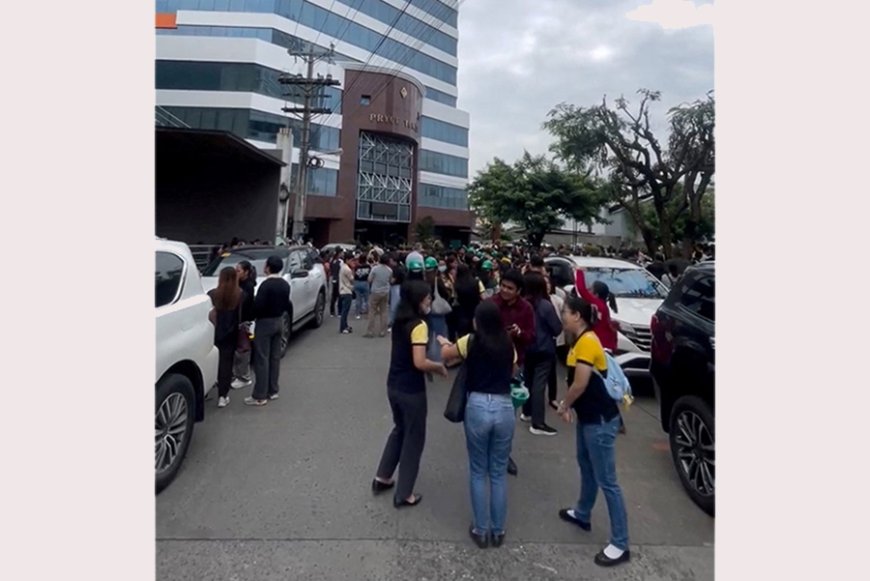
Phivolcs warned residents to expect aftershocks and to stay away from coastal areas. Verified videos from the southern Philippines showed office workers evacuating buildings, lamps swaying, and furniture toppling as structures creaked during the tremors.
Across the sea, footage from Indonesia’s Sulawesi island showed fishing boats returning to shore and children playing on beaches where the tide had suddenly receded.
Phivolcs later revised the first quake’s magnitude down to 7.4 from 7.6, with a depth of 23 km (14 miles). The second quake was adjusted to 6.8 from 6.9, at a depth of 37 km (23 miles).
Davao del Norte Governor Edwin Jubahib said the quake triggered panic among residents. “Some buildings were reported damaged. It was very strong,” he told broadcaster DZMM.
What's Your Reaction?