






































9th Pay Scale Approved, Bringing Up to 142% Increase in Basic Pay
Full implementation to be carried out in three phases to help curb inflation

National Pay Scale 2026 Approved, Basic Salaries to Rise by Up to 142%
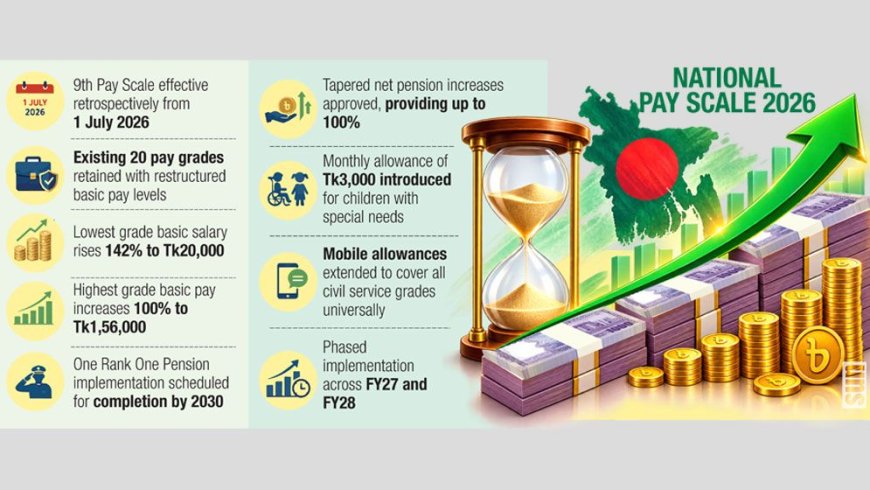
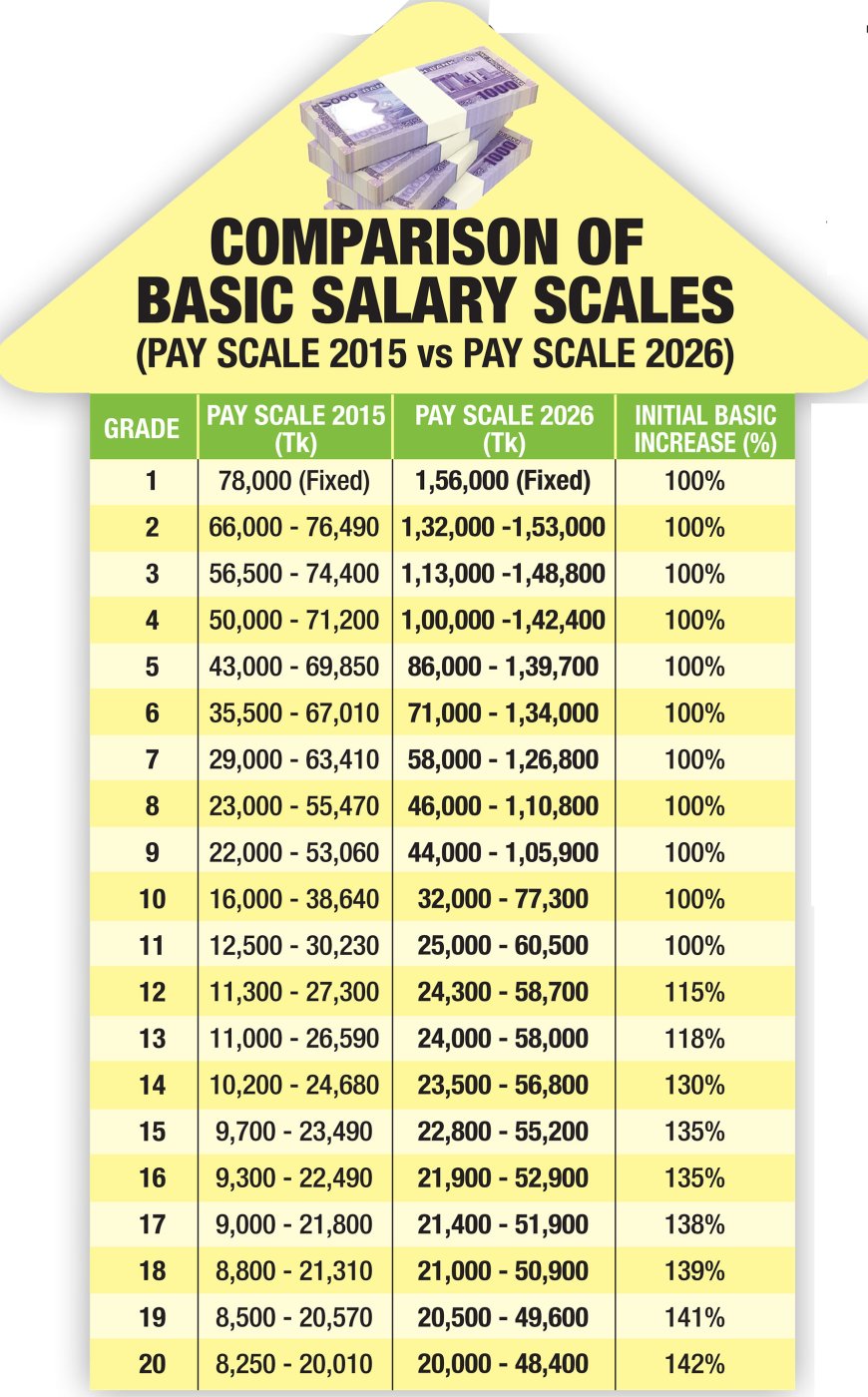
The Cabinet on Monday approved the National Pay Scale 2026, increasing the minimum basic salary of government employees from Tk8,250 to Tk20,000 and the maximum from Tk78,000 to Tk156,000. The revised pay structure will be introduced in three phases between 1 July 2026 and 1 July 2027.
The new pay scale has been made effective from 1 July 2026, while various allowances will come into force from 1 January 2028. Retired government employees will also receive pension increases ranging from 55% to 100%.
The decision was taken at a Cabinet meeting chaired by the prime minister. The existing 20-grade structure will remain unchanged, while the Joint Services Instructions 2026 for the armed forces have also been approved in line with the revised pay scale.
Lower-grade employees will receive the largest increases. Basic salaries for Grades 1 to 11 have been doubled, while increases for Grades 12 to 20 range between 115% and 142%.
Grade 12 salaries will rise from Tk11,300 to Tk24,300, an increase of 115%, while Grade 13 salaries will increase from Tk11,000 to Tk24,000, or 118%.
For Grade 14, the basic salary will rise from Tk10,200 to Tk23,500, a 130% increase. Grades 15 and 16 will see their salaries rise from Tk9,700 and Tk9,300 to Tk22,800 and Tk21,900 respectively, representing increases of 135% each.
Grade 17 salaries will increase from Tk9,000 to Tk21,400, Grade 18 from Tk8,800 to Tk21,000, Grade 19 from Tk8,500 to Tk20,500, and Grade 20 from Tk8,250 to Tk20,000. The corresponding increases are 138%, 139%, 141% and 142%.
The revised structure will also narrow the gap between the highest and lowest basic salaries. The ratio will fall from 1:1.945 to 1:1.78, which the government says will help create a more equitable pay structure.
Briefing reporters after the meeting, Cabinet Secretary Nasimul Gani said the necessary laws, gazettes and statutory regulatory orders would be issued soon, with the process expected to begin immediately.
He said the previous national pay scale was introduced in 2015 and that rising inflation and living costs had made a revision necessary. Although the previous government began the process in 2025, it did not complete or formally announce the new structure.
According to Nasimul Gani, the government held eight meetings after receiving the Pay Commission's report before finalising the decision.
He said the revised salaries were designed to compensate employees as much as possible for losses in real income caused by inflation and the rising cost of living.
Former interim government Finance Adviser Dr Salehuddin Ahmed welcomed the decision, saying the new structure should have been introduced earlier. However, he warned that the higher salaries could put additional pressure on the private sector and suggested that the government also consider reducing unnecessary manpower in the public sector.
Pension increases
The government has also approved significant increases in the net pensions of retired government employees.
The election manifesto had pledged to introduce an “One Rank One Pension” (OROP) system for both military and civilian personnel. However, immediate implementation would create substantial financial pressure, while information on civilian employees who retired before 2019 is unavailable.
The government therefore plans to introduce OROP gradually by 2030. Until then, pension increases will be applied according to different slabs.
Pensioners receiving a monthly net pension of up to Tk9,000 will receive a 100% increase. Those receiving Tk9,001-Tk20,000 will get a 75% increase, while pensioners receiving Tk20,001-Tk30,000 will receive 65%.
Those receiving Tk30,001-Tk40,000 will get a 60% increase, while pensioners receiving Tk40,001 or more will receive a 55% increase.
The government says the structure is designed to provide greater benefits to long-serving pensioners receiving relatively low pensions.
New allowances
Government employees with children who have special needs will, for the first time, receive a monthly allowance of Tk3,000 per child.
The mobile allowance will also be extended to employees across all grades. Previously, the benefit was available only to Grade 5 employees. The expansion has been introduced in view of rising internet and digital communication costs.
Three-phase implementation
Although the new pay scale is effective from 1 July 2026, full implementation will be gradual because of its financial implications and the potential impact on inflation.
Employees in Grades 10 to 20 will receive priority because of their comparatively lower incomes. The revised basic salaries will be implemented in three phases from 1 July 2026 to 1 July 2027.
Allowances will take effect from 1 January 2028, while pension increases will be implemented separately.
The government expects the phased approach to help contain inflationary pressure.
A separate committee has also been formed to review the judicial service pay structure. The Bangladesh Judicial Service Pay Scale will be finalised based on the committee's recommendations and implemented in phases from 1 July 2026.
Additional annual cost estimated at Tk105,580 crore
Around 2.4 million military and civilian employees, along with more than 900,000 retired employees and other eligible beneficiaries, are expected to benefit from the revised pay structure.
The additional annual government expenditure is estimated at Tk105,580 crore. The government says the required funds have already been incorporated into the budgets of the relevant fiscal years under the Medium-Term Budget Framework.
The new pay scale was approved after consideration of the reports prepared by the National Pay Commission 2025 and the Armed Forces Pay Committee 2025. A secretaries' committee subsequently reviewed the recommendations before they were placed before the Cabinet.
The government said the decision took into account its financial capacity, the overall economic situation, inflation, living costs, employees' living standards and the need for a balanced salary structure.
The Finance Division will issue detailed gazettes, orders and instructions covering salary fixation, allowances, pensions and other post-retirement benefits.
Nasimul Gani said government employees had gone nearly 12 years without a salary increase, despite pay structures generally being revised every five years.
He said this had affected their living standards, adding that the government had attempted to strike a balance between employees' needs and the state's financial capacity.
On demands for time scale and selection grade benefits, he indicated that the existing rules would remain in effect unless a new decision was taken.
What's Your Reaction?