

































































Fuel Import Costs Surge as Oil Prices Climb
Annual Fuel Import Bill Could Hit $18–20 Billion as BPC Assures Supplies Through December, Analysts Say

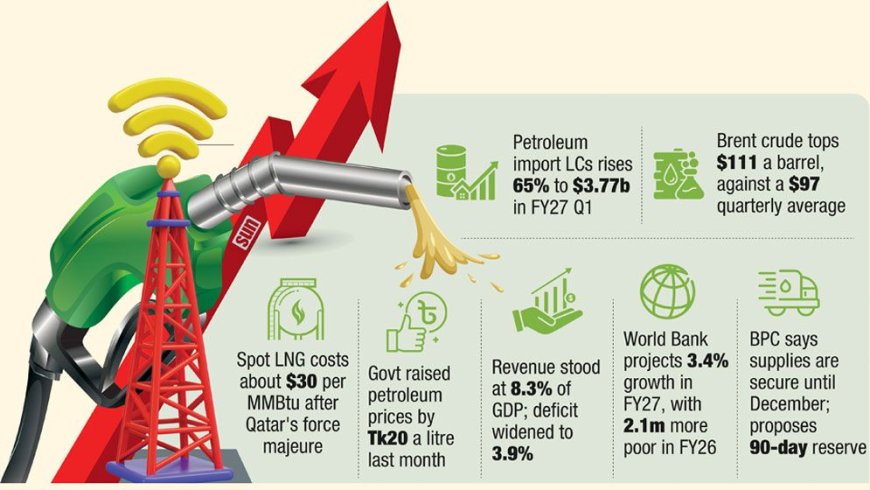
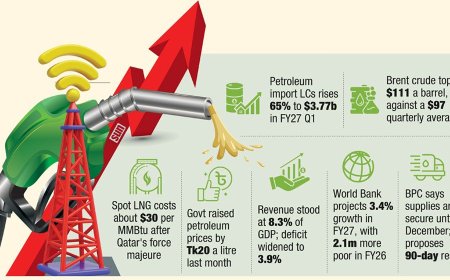
Bangladesh opened letters of credit (LCs) worth $3.77 billion for petroleum imports during July–September, marking a 65% increase from $2.28 billion in the same period last year, according to Bangladesh Bank data. The sharp rise comes as the Middle East crisis pushes up international oil and gas prices.
The increase largely reflects higher global prices rather than a substantial rise in import volumes. Brent crude climbed above $111 a barrel on Tuesday amid concerns over attacks on energy infrastructure and shipping routes in the Gulf. The benchmark averaged $97 a barrel during the quarter, compared with $69 a year earlier, according to international media reports.
The surge in energy costs adds to the pressure on an economy already grappling with sluggish growth, persistent inflation, limited fiscal capacity and vulnerabilities in the banking sector.
The World Bank's latest Bangladesh Development Update forecasts economic growth of 3.4% in both FY26 and FY27, citing continuing energy shortages, rising business costs and weak investment. Growth could improve to 3.9% in FY28 if energy supplies become more reliable and structural reforms accelerate.
Shafiqul Alam, lead analyst for Bangladesh Energy (South Asia) at the Institute for Energy Economics and Financial Analysis (IEEFA), warned that the country's annual fuel import bill could climb to $18 billion–$20 billion from the current $12 billion–$13 billion.
"If the crisis becomes prolonged, the expenditure could rise further," he said.
Prime Minister's Adviser on Finance and Planning Rashed Al Mahmud Titumir said Bangladesh had incurred an additional $4.12 billion in energy expenditure over the past eight months.
Import Costs Mount, Foreign Exchange Under Pressure
Bangladesh's LCs for crude oil imports tripled to $629 million in the first quarter of FY27, up from $209 million in the corresponding period a year earlier.
LCs for other petroleum imports, mainly gas, increased to $2.42 billion from $1.13 billion. In contrast, LCs for refined petroleum products declined to $724 million from $946 million.
Settlements against petroleum import LCs rose 26% to $2.93 billion, indicating a growing outflow of foreign currency to meet energy requirements.
Bangladesh consumes more than 6.8 million tonnes of petroleum annually, with diesel accounting for over two-thirds of total demand. The country also relies on imports for more than one-third of its natural gas requirements.
Following QatarEnergy's declaration of force majeure, Bangladesh turned to the spot market to secure liquefied natural gas (LNG) at around $30 per million British thermal units (MMBtu), nearly three times the pre-war price.
IEEFA's Shafiqul Alam said that purchasing the same volume of LNG as in 2025 could more than double spending on LNG imports alone, significantly increasing the government's subsidy burden.
He noted that garment exports and remittances remain Bangladesh's principal sources of foreign exchange, leaving the economy vulnerable if energy import expenses continue to climb.
A prolonged increase in fuel costs could compel the government to borrow more, potentially reducing the funds available for other development priorities.
Inflation and Economic Growth Face Fresh Risks
Rising international oil and gas prices are pushing up transportation, electricity and industrial production costs, raising the risk of further inflation and diminishing household purchasing power.
Last month, the government increased the prices of all four major petroleum products by Tk20 per litre, marking the steepest adjustment since August 2022, when fuel prices surged following Russia's invasion of Ukraine.
Passing higher costs on to consumers places additional pressure on households and businesses. Alternatively, absorbing the increases through government subsidies would further strain public finances.
Selim Raihan, executive director of the South Asian Network on Economic Modeling (SANEM), said higher energy import costs could increase subsidy requirements, put pressure on foreign exchange reserves, weaken the taka and accelerate inflation.
"This could force the government to divert funds from development and social spending," he said.
Bangladesh's limited fiscal capacity further complicates the situation.
According to the World Bank, government revenue stood at 8.3% of GDP in FY26, among the lowest ratios globally. Meanwhile, the fiscal deficit widened to 3.9% of GDP from 3.5% in FY25.
The report also estimated that approximately 2.1 million additional people fell into poverty in FY26, as job creation stagnated and women experienced employment losses.
Shafiqul Alam warned that inadequate fuel supplies to industrial facilities could undermine economic growth and employment.
Fuel Supplies Secure for Now, Says BPC
Despite mounting concerns over energy costs, available evidence does not establish that Bangladesh is heading towards a crisis similar to the one experienced by Sri Lanka.
The World Bank has noted that the country's external sector has demonstrated resilience, supported by robust remittance inflows and improving foreign exchange reserves. However, these positive developments do not eliminate the risks associated with persistently high energy import bills.
The Bangladesh Petroleum Corporation (BPC) has assured that fuel supplies remain adequate and are secured through December, with no immediate threat of a shortage.
To strengthen long-term energy security, the corporation has proposed establishing a fuel price stabilisation fund, maintaining strategic reserves equivalent to 90 days of demand, expanding domestic refining capacity and accelerating the implementation of the Single Point Mooring project.
The proposed stabilisation fund, however, remains at the conceptual stage, with its operational framework yet to be finalised.
SANEM's Selim Raihan stressed the need to accelerate investment in renewable energy to reduce Bangladesh's dependence on imported fuels, ease pressure on foreign exchange reserves and improve energy security over the long term.
What's Your Reaction?