











































Banks, Collateral Disputes and Court Cases Delay Factory Revival Funds
Banks, Collateral Disputes and Court Cases Delay Factory Revival Funds

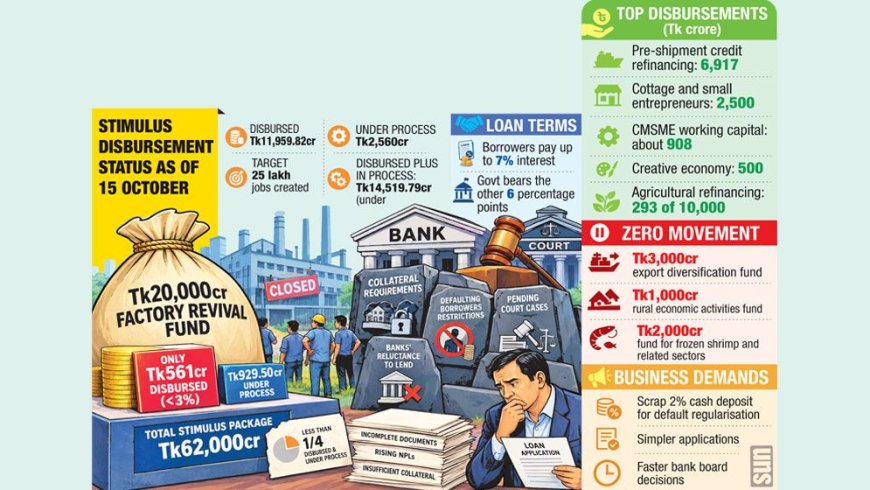
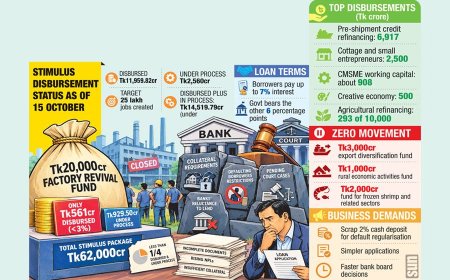
Only Tk561 crore, less than 3% of the Tk20,000 crore fund earmarked for reopening closed factories, had been disbursed as of 15 October, with business leaders blaming stringent collateral requirements, restrictions on defaulting borrowers, pending court cases and banks’ reluctance to lend.
Another Tk929.50 crore is being processed, according to Bangladesh Bank data.
The fund is part of a Tk62,000 crore stimulus package designed to revive economic activity and support businesses. Five months after the package was announced, Tk11,959.82 crore, less than one-fifth of the total allocation, had been disbursed, while Tk2,560 crore was under process. Combined, the two amounts total Tk14,519.79 crore, representing less than one-quarter of the package, according to a Bangladesh Bank press release.
Bankers, meanwhile, have attributed delays in approving loan applications to rising non-performing loans, inadequate collateral and incomplete documentation.
Initially announced at Tk60,000 crore, the stimulus package was subsequently expanded to Tk62,000 crore. It aims to boost industrial production, support businesses, increase exports and generate employment for 2.5 million people through the reopening of factories, expansion of production and development of the agricultural sector.
The Tk20,000 crore fund specifically targets large industrial and service-sector enterprises that have closed completely or partially, or are operating below capacity because of working-capital shortages.
Export-oriented businesses and enterprises with strong export potential have been given priority under the scheme.
Eligible entrepreneurs can obtain loans at an interest rate of up to 7%, with the government subsidising the remaining six percentage points of interest. However, businesses facing difficulties primarily because of poor management, technological inefficiencies or marketing problems are not automatically eligible for assistance.
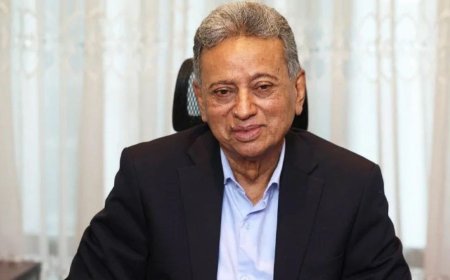
Former Bangladesh Bank chief economist Dr Mostafa K Mujeri emphasised the importance of thorough scrutiny before approving loans. He cautioned that disbursing funds merely to meet targets could create additional problems for the banking sector.
Bangladesh Bank Executive Director and spokesperson Arief Hossain Khan said applications submitted by banks were being reviewed and processed promptly. He added that banks could file cases again if applications were rejected after borrowers had withdrawn their existing cases as part of the application process.
Businesses Face Multiple Lending Barriers
Business leaders have identified restrictions on defaulting borrowers, collateral requirements, pending litigation and banks’ reluctance to provide financing as the main obstacles to accessing the fund.
Anwar-ul Alam Chowdhury (Parvez), president of the Bangladesh Chamber of Industries, told the Daily Sun that banks were hesitant to finance closed factories and frequently demanded mortgages as security.
Entrepreneurs unable to provide sufficient collateral were consequently struggling to obtain loans, he said.
Chowdhury also called for assistance for factories that remain operational but face the risk of closure, as well as businesses experiencing working-capital shortages.
Mohammad Hatem, president of the Bangladesh Knitwear Manufacturers and Exporters Association, said entrepreneurs were eager to access the fund but were receiving insufficient cooperation from banks.
According to Hatem, some banks were refusing to accept applications, while others were discouraging potential applicants. He also highlighted complexities in the central bank's circular governing the scheme.
Mahmud Hasan Khan, president of the Bangladesh Garment Manufacturers and Exporters Association, noted that restarting an existing factory was generally quicker than establishing a new one.
He urged the authorities to relax certain lending conditions to accelerate fund disbursement and bring closed factories back into operation.
Business leaders have also proposed eliminating the requirement for borrowers to deposit 2% in cash to regularise their default status, simplifying application procedures and expediting decisions by bank boards.
Disbursement Varies Across Schemes
Bangladesh Bank data show significant differences in disbursement across the various refinancing and financing schemes included in the stimulus package.
The pre-shipment credit refinancing scheme recorded the highest disbursement, at Tk6,917 crore.
The special financing scheme for cottage and small entrepreneurs received Tk2,500 crore, while approximately Tk908 crore was disbursed under the working-capital refinancing scheme for cottage, micro, small and medium enterprises.
The scheme for closed industrial and service-sector enterprises received Tk561 crore, with another Tk929.50 crore under processing.
The creative economy financing scheme received Tk500 crore, while the agricultural refinancing scheme disbursed Tk293 crore against its Tk10,000 crore allocation.
The overseas employment financing scheme received Tk200 crore.
Meanwhile, the refinancing scheme for agro-based special economic centres in northern Bangladesh disbursed Tk48.67 crore from its Tk3,000 crore allocation. The startup financing scheme disbursed Tk32.59 crore, with a further Tk5 crore under process.
Several other schemes were still awaiting disbursement. These included Tk1,000 crore allocated for employment financing for unemployed youths, Tk527 crore for green factory buildings and industries, and Tk98 crore for leather goods and footwear exporters.
No funds had been disbursed or were under process under three schemes: Tk3,000 crore allocated for export diversification through refinancing, Tk1,000 crore for rural economic activities and Tk2,000 crore for the frozen shrimp and related sectors.
What's Your Reaction?