

















































Rising Asylum Rejection Rates Put Bangladeshis at Greater Risk in Europe
RISING ASYLUM REJECTIONS PUT BANGLADESHIS AT RISK IN EUROPE

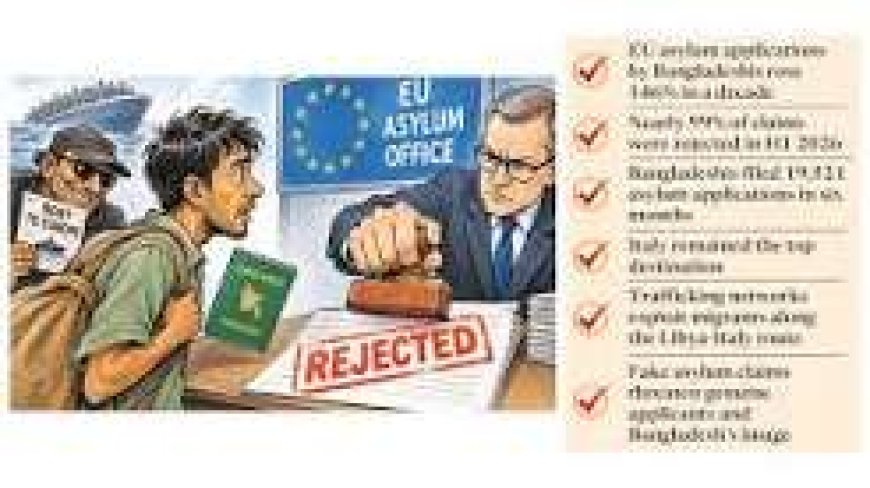
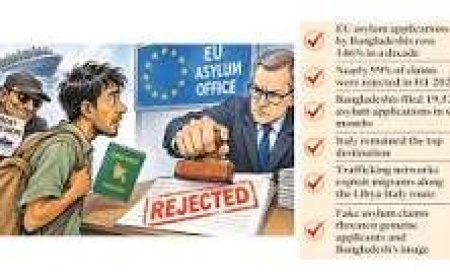
The number of Bangladeshis seeking asylum in European Union (EU) countries has more than doubled over the past decade, but an overwhelming majority of their applications are being rejected, leaving increasing numbers of migrants vulnerable to irregular migration, human trafficking and exploitation by organised criminal networks.
According to data from the European Union Agency for Asylum (EUAA), nearly 99% of asylum applications submitted by Bangladeshis were rejected in the first half of 2026, compared with 94% in 2016.
Migration experts warn that economic difficulties, limited opportunities for legal migration and expanding human trafficking networks are driving more Bangladeshis towards dangerous routes to Europe. Many fall victim to false promises of employment, asylum opportunities and legal residency.
Shakirul Islam, chairperson of the Ovibashi Karmi Unnayan Program (OKUP), said an organised international trafficking network was operating from villages across Bangladesh to Libya and Italy, exploiting people desperate for better economic prospects.
Referring to an OKUP field survey conducted in Madaripur, he said 402 of the 699 households surveyed had reported irregular migration to European countries, primarily Italy, through the Libya route.
“The network involves Bangladeshi operatives at different stages of the journey, while local militias control parts of the trafficking operations in Libya,” he said.
He added that traffickers frequently deceive prospective migrants by claiming that entering Europe through irregular routes would automatically make them eligible for asylum.
EUAA figures show that approximately 15,000 Bangladeshis applied for asylum in EU countries in 2016. The number increased to 36,901 in 2025, while a further 19,521 applications were submitted during the first six months of 2026.
Bangladesh accounted for approximately 4% of all asylum applications in EU+ countries in 2025, ranking as the fourth-largest country of origin for asylum seekers after Afghanistan, Venezuela and Syria.
The number of applications rose to 18,865 in 2017 before declining to 13,740 in 2018. It climbed again to 15,843 in 2019 but dropped to 11,570 in 2020 amid the Covid-19 pandemic.
The upward trend resumed in 2021, with 20,110 applications, followed by 33,729 in 2022 and 40,332 in 2023. Applications peaked at a decade-high of 43,236 in 2024 before declining to 36,901 in 2025, reflecting a broader reduction in asylum applications across Europe.
Italy remained the most popular destination for Bangladeshi asylum seekers for three consecutive years between 2023 and 2025, followed by France and Greece.
Meanwhile, European authorities have stepped up the processing of asylum applications to reduce accumulated backlogs. In 2025, they processed 43,523 applications submitted by Bangladeshis, exceeding the number of new claims filed during the year.
As a result, the number of pending Bangladeshi asylum applications declined from 47,778 in 2024 to 41,692 in 2025.
Although the overall asylum recognition rate across EU+ countries stood at 29% in 2025, nearly 99% of applications submitted by Bangladeshis were rejected in the first half of 2026.
Experts link the growing number of asylum applications to a combination of limited employment opportunities in Bangladesh, declining agricultural earnings partly driven by climate change, restricted legal migration channels and the growing influence of human trafficking networks.
Shakirul said the Italian embassy considered the rising number of asylum applications from Bangladeshis a clear misuse of the asylum system.
Concerns over human trafficking have also been highlighted in the US State Department's 2026 Trafficking in Persons (TIP) Report, which pointed to persistent weaknesses in Bangladesh's efforts to combat the crime.
Bangladesh retained its Tier 2 ranking for the seventh consecutive year, indicating that the government has made significant efforts to address human trafficking but has yet to fully meet the minimum required standards.
The report recognised progress in investigations and prosecutions, the introduction of the Human Trafficking and Migrant Smuggling Prevention Ordinance 2026, revised victim identification guidelines and pilot initiatives to establish a digital National Referral Mechanism.
However, it also identified shortcomings in judicial proceedings, victim protection, efforts to prevent domestic trafficking and safeguards for migrant workers.
Migration expert Asif Munier emphasised the importance of stronger coordination among government agencies to tackle irregular migration and prevent the misuse of asylum procedures.
He said some individuals were being encouraged to submit fraudulent asylum applications using fabricated documents and false claims of political persecution or homosexuality, often without understanding the potential legal consequences.
“The exceptionally high rejection rate could damage Bangladesh’s international image and undermine the rights of genuine asylum seekers,” he said.
Asif alleged that certain expatriates and local immigration lawyers were facilitating questionable asylum applications, while government oversight remained inadequate.
He urged Bangladesh's diplomatic missions to increase awareness among expatriates and legal practitioners about the consequences of submitting fraudulent asylum claims.
He also recommended launching awareness campaigns through social media and embassy websites, alongside stronger coordination among the ministries of home affairs and foreign affairs and the Department of Immigration and Passports.
Such coordinated efforts, he said, would help monitor high-risk migration routes, prevent fraudulent asylum applications and dismantle the trafficking networks exploiting Bangladeshi migrants.
What's Your Reaction?