
































































Bangladesh’s Banking Sector Sees Defaulted Loans Soar to Tk6.27 Lakh Crore
Bangladesh’s Banking Sector Sees Defaulted Loans Soar to Tk6.27 Lakh Crore

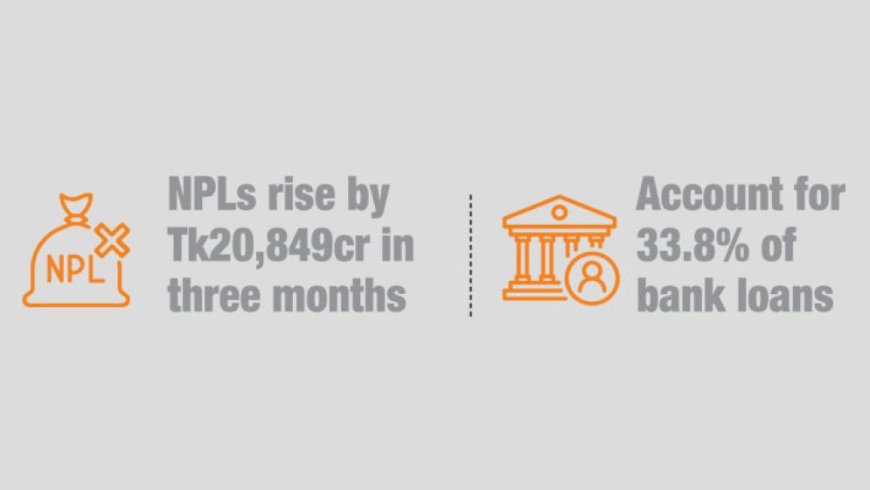
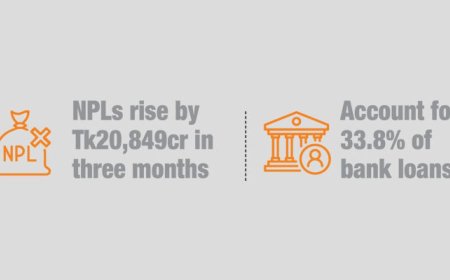
Non-performing loans (NPLs) in Bangladesh’s banking sector increased by Tk20,849 crore in just three months, reaching Tk6,27,404 crore at the end of September. The amount accounted for 33.80% of total outstanding loans, underscoring the growing vulnerability of the country’s financial sector.
According to the latest data released by Bangladesh Bank (BB) on Monday, classified loans rose from Tk6,06,555 crore at the end of June, when the NPL ratio stood at 32.78%. Meanwhile, total outstanding loans in the banking system increased marginally from Tk18,50,600 crore to around Tk18,56,200 crore during the same period, indicating that bad loans expanded at a much faster pace than overall lending.
The increase came despite several policy concessions and loan restructuring facilities introduced by the central bank to accelerate recovery and provide relief to genuine borrowers.
Bangladesh Bank data show that classified loans stood at Tk5,57,217 crore at the end of December 2025 before climbing to Tk5,88,704 crore during the first quarter of this year (January-March).
Banking sector insiders have largely blamed the deterioration in loan quality on widespread irregularities, financial scams, fraud and corruption during the Awami League government's 15-and-a-half-year tenure.
When the Awami League-led government assumed office in January 2009, classified loans amounted to Tk22,481 crore. The figure had skyrocketed to Tk2,11,391 crore by June 2024, shortly before the government was ousted.
Following the fall of the Awami League government, the interim administration began uncovering the actual state of the banking sector. The absence of several politically influential borrowers, alongside the identification of previously concealed bad loans, contributed to a sharp increase in classified loans.
The interim government subsequently introduced special loan rescheduling concessions, which temporarily brought down the volume of non-performing loans.
However, the latest central bank figures suggest that bad loans have continued to increase under the current government.
Bangladesh Bank Executive Director and spokesperson Arief Hossain Khan told the Daily Sun that although classified loans had not risen substantially during the latest quarter, the overall volume of bad loans was not declining at the expected pace.
He explained that policy support, including loan rescheduling facilities for genuine entrepreneurs, was taking time to secure approval and become operational.
"Some banks have approved the facilities, while others are at the implementation stage. We expect classified loans to come down after December, once genuine entrepreneurs are able to regularise their loans," he said.
Meanwhile, banks continued to face a significant provisioning shortfall, which stood at Tk2,18,339 crore at the end of September.
Zahid Hossain, former lead economist of the World Bank, told the Daily Sun that politically influenced lending practices and large-scale diversion of loan funds over the years had made a substantial portion of bad loans difficult to recover.
He emphasised that genuine business borrowers should receive necessary policy assistance, while loans secured through political influence or fraudulent practices should be treated separately.
Hossain also called for stringent action against those involved in loan scams and deliberate defaults, warning that failure to punish offenders could encourage similar misconduct in the future.
"Punishment must be imposed; otherwise, borrowers will not repay," he said, adding that deliberate defaulters should also face social boycotts.
Bank-wise Breakdown
Bangladesh Bank data reveal that state-owned banks had Tk1,49,712 crore in classified loans at the end of September, representing 46.59% of their total outstanding loans.
Private commercial banks accounted for the largest share of bad loans, with classified loans reaching Tk4,55,473 crore, equivalent to 32.02% of their total lending.
Meanwhile, foreign commercial banks reported Tk3,915 crore in classified loans, accounting for 5.92% of their total outstanding loans.
What's Your Reaction?