
























































7 November: The Day Bangladesh Discovered Its Path Forward
7 November: The Day Bangladesh Discovered Its Path Forward

With the dream of building a new nation, the people of Bangladesh embarked on the War of Independence in 1971. However, barely had the country achieved independence when it faced a series of political and economic crises under the one-party BAKSAL system. Thousands lost their lives during a devastating famine, while the state-sponsored Rakkhi Bahini was accused of unleashing violence and atrocities across the country.
In the newly independent nation, widespread misgovernance, famine and political uncertainty left people disillusioned, while economic activities had virtually ground to a halt. The confrontational politics of the Jatiya Samajtantrik Dal (JSD) further deepened the crisis.
At this critical juncture, when the country's political stability and even its future appeared uncertain, the events of 7 November 1975 emerged as a defining moment amid widespread despair, fear and uncertainty.
The significance of 7 November in Bangladesh's political history extends far beyond any particular political period. Its implications have been profound and long-lasting, shaping the country's subsequent political trajectory. The events of that day brought people from different parts of the country together and marked a decisive moment in determining the direction Bangladesh would take. It was, in this sense, the day Bangladesh found its way forward.
The political developments that began with Khaled Mosharraf's coup on 3 November 1975 culminated in the events of 7 November. Three central figures shaped this turbulent period: army officer and briefly appointed Chief of Army Staff Khaled Mosharraf, JSD leader Colonel Abu Taher, and the then Chief of Army Staff Ziaur Rahman.
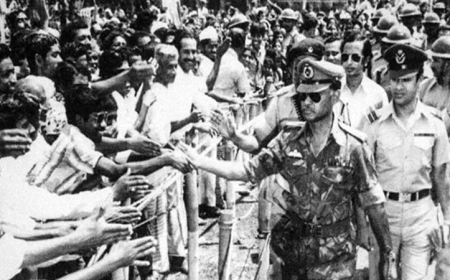
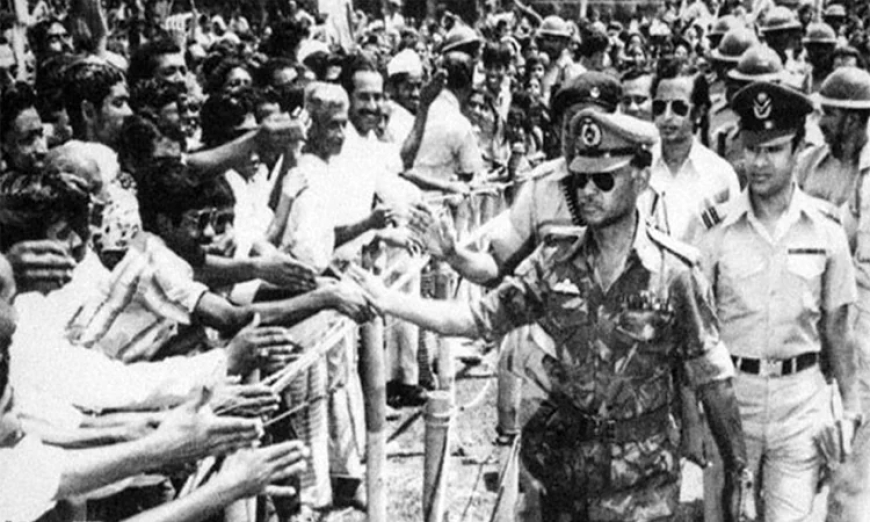
On 7 November, however, Ziaur Rahman emerged as the central figure with the backing of soldiers and sections of the public. Khaled Mosharraf and Colonel Taher subsequently lost their political influence amid allegations of conspiracy.
Between independence in 1971 and 1975, Bangladesh experienced deep political divisions under Awami League rule. Against this backdrop, Ziaur Rahman entered the political arena with a message of national unity and a vision of collective nation-building.
As the military officer who had announced the Declaration of Independence, Ziaur Rahman had already earned considerable public recognition and popularity. Khaled Mosharraf and Abu Taher, meanwhile, struggled to maintain their positions, partly because they failed to align their political strategies with the prevailing public mood and aspirations.
Many people viewed Ziaur Rahman as a credible national figure because of his role in the Liberation War. By contrast, the country had witnessed growing political confrontation involving the Awami League and the JSD.
While the Awami League had curtailed political freedoms through the BAKSAL system, the JSD pursued a confrontational political strategy that included violent activities. Historical accounts suggest that the JSD lacked the organisational strength to seize power independently and therefore sought to advance its ambitions through its reliance on Ziaur Rahman.
Ultimately, however, soldiers and sections of the public brought Ziaur Rahman to the forefront of the political landscape. As events unfolded, he consolidated control over the situation, while Colonel Taher failed to match his growing public acceptance. The developments of 7 November consequently marked a major setback for the JSD's political ambitions.
Following these events, Ziaur Rahman embarked on an effort to rebuild national unity and restore economic stability. He moved away from the highly centralised BAKSAL economic model towards a more market-oriented system, while retaining a degree of state oversight. His administration also introduced policies aimed at encouraging domestic and foreign investment.
During his tenure, private development organisations were given greater scope to resume and expand their activities. These organisations helped channel substantial development assistance into Bangladesh, creating employment opportunities and contributing to rural development.
The expansion of microcredit initiatives also became an important feature of the country's development landscape during this period. Alongside public investment and employment generation, efforts to attract foreign capital and strengthen relationships with international development partners contributed to improvements in the country's socio-economic conditions.
Economic recovery was accompanied by significant changes in the political arena. Ziaur Rahman pursued a policy of political inclusion, allowing the Awami League, which had been dissolved as an independent political entity under BAKSAL, to resume activities under its own name.
Other political parties, including Jamaat-e-Islami, which had opposed Bangladesh's independence, were also permitted to return to political activities. Ziaur Rahman sought to rebuild the post-war nation by bringing different political groups into the mainstream and encouraging people to put aside their differences in pursuit of national development.
In Bangladesh's political narrative, 7 November is therefore regarded by its supporters as a symbol of national unity, with Shaheed President Ziaur Rahman emerging as its central figure.
The political circumstances surrounding Ziaur Rahman's rise were not unique to Bangladesh. During that period, military coups and authoritarian regimes were prevalent across several parts of the world. Brazil was under military rule, Chile had come under Augusto Pinochet following the overthrow of Salvador Allende, and Argentina was entering the military dictatorship of Jorge Videla. In Africa and the Arab world, several countries were also governed by powerful military rulers and authoritarian leaders.
Against this international backdrop, Ziaur Rahman's political trajectory took a different course. Emerging from within the military establishment, he sought to stabilise Bangladesh, restore political order and eventually move the country towards a multiparty democratic framework. His leadership played a significant role in shaping the post-independence political landscape and the subsequent development of democratic institutions.
Ziaur Rahman was also a prominent freedom fighter who played a role in the Liberation War. His announcement of the Declaration of Independence through the radio broadcast in March 1971 helped inspire a nation confronting the Pakistani military crackdown. The courage associated with that period became an important part of his political identity and leadership.
On 7 November 1975, amid another period of national uncertainty, Ziaur Rahman once again emerged at the centre of Bangladesh's political developments.
From this perspective, the events of 7 November are viewed by his supporters as the beginning of a renewed effort to establish an independent, self-reliant and politically inclusive Bangladesh. Four years after the Liberation War, the day marked another moment of national mobilisation and became a defining chapter in the country's political history.
What's Your Reaction?